Microsoft Designing and Implementing Cloud-Native Applications Using Azure Cosmos DB DP-420 Dumps in PDF

Free Microsoft DP-420 Real Questions (page: 4)


Case Study
This is a case study. Case studies are not timed separately. You can use as much exam time as you would like to complete each case. However, there may be additional case studies and sections on this exam. You must manage your time to ensure that you are able to complete all questions included on this exam in the time provided.
To answer the questions included in a case study, you will need to reference information that is provided in the case study. Case studies might contain exhibits and other resources that provide more information about the scenario that is described in the case study. Each question is independent of the other questions in this case study.
At the end of this case study, a review screen will appear. This screen allows you to review your answers and to make changes before you move to the next section of the exam. After you begin a new section, you cannot return to this section.
To start the case study
To display the first question in this case study, click the Next button. Use the buttons in the left pane to explore the content of the case study before you answer the questions. Clicking these buttons displays information such as business requirements, existing environment, and problem statements. If the case study has an All Information tab, note that the information displayed is identical to the information displayed on the subsequent tabs.
When you are ready to answer a question, click the Question button to return to the question.
Overview
Litware, Inc. is a United States-based grocery retailer. Litware has a main office and a primary datacenter in Seattle. The company has 50 retail stores across the United States and an emerging online presence. Each store connects directly to the internet.
Existing environment. Cloud and Data Service Environments.
Litware has an Azure subscription that contains the resources shown in the following table.
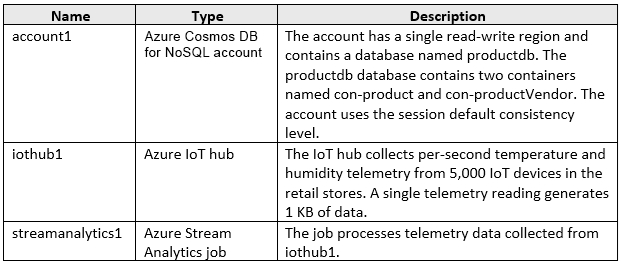
Each container in productdb is configured for manual throughput.
The con-product container stores the company's product catalog data. Each document in con-product includes a con-productVendor value. Most queries targeting the data in con-product are in the following format. SELECT * FROM con-product p WHERE p.con-productVendor = 'name'
Most queries targeting the data in the con-productVendor container are in the following format.
SELECT * FROM con-productVendor pv
ORDER BY pv.creditRating, pv.yearFounded
Existing environment. Current Problems.
Litware identifies the following issues:
-Updates to product categories in the con-productVendor container do not propagate automatically to documents in the con-product container.
-Application updates in con-product frequently cause HTTP status code 429 "Too many requests". You discover that the 429 status code relates to excessive request unit (RU) consumption during the updates.
Requirements. Planned Changes
Litware plans to implement a new Azure Cosmos DB for NoSQL account named account2 that will contain a database named iotdb. The iotdb database will contain two containers named con-iot1 and con-iot2.
Litware plans to make the following changes:
-Store the telemetry data in account2.
-Configure account1 to support multiple read-write regions.
-Implement referential integrity for the con-product container.
-Use Azure Functions to send notifications about product updates to different recipients.
-Develop an app named App1 that will run from all locations and query the data in account1.
-Develop an app named App2 that will run from the retail stores and query the data in account2. App2 must be limited to a single HTTPS endpoint when accessing account2.
Requirements. Business Requirements
Litware identifies the following business requirements:
-Whenever there are multiple solutions for a requirement, select the solution that provides the best performance, as long as there are no additional costs associated.
-Ensure that Azure Cosmos DB costs for IoT-related processing are predictable.
-Minimize the number of firewall changes in the retail stores.
Requirements. IoT Telemetry Requirements
Litware identifies the following IoT telemetry requirements:
-Write the telemetry data from streamanalytics1 to the con-iot1 container as the data arrives. Use streamanalytics1 to create hopping window aggregated telemetry readings once per hour and write the data to con-iot2.
-Automatically delete items in con-iot1 after one hour unless a per-item time to live is set.
-Optimize the partitioning of con-iot1 for queries that support historical data of a specific device.
-Aggregate the telemetry data by device by using streamanalytics1 and write the aggregate data to con-iot2.
-Ensure that the items in con-iot2 persist regardless of the per-item time to live setting.
Requirements. Product Catalog Requirements
Litware identifies the following requirements for the product catalog:
-Implement a custom conflict resolution policy for the product catalog data.
-Minimize the frequency of errors during updates of the con-product container.
-Once multi-region writes are configured, maximize the performance of App1 queries against the data in account1.
-Trigger the execution of two Azure functions following every update to any document in the con-product container.
-

Note: This question is part of a series of questions that present the same scenario. Each question in the series contains a unique solution that might meet the stated goals. Some question sets might have more than one correct solution, while others might not have a correct solution.
After you answer a question in this section, you will NOT be able to return to it. As a result, these questions will not appear in the review screen.
You have an Azure Cosmos DB for NoSQL account named account1 that uses autoscale throughput.
You need to run an Azure function when the normalized request units per second for a container in account1 exceeds a specific value.
Solution: You configure an application to use the change feed processor to read the change feed and you configure the application to trigger the function.
Does this meet the goal?

  1. Yes
  2. No

Answer(s): B

Explanation:

Instead configure an Azure Monitor alert to trigger the function.
You can set up alerts from the Azure Cosmos DB pane or the Azure Monitor service in the Azure portal.


Reference:

https://docs.microsoft.com/en-us/azure/cosmos-db/create-alerts


Case Study
This is a case study. Case studies are not timed separately. You can use as much exam time as you would like to complete each case. However, there may be additional case studies and sections on this exam. You must manage your time to ensure that you are able to complete all questions included on this exam in the time provided.
To answer the questions included in a case study, you will need to reference information that is provided in the case study. Case studies might contain exhibits and other resources that provide more information about the scenario that is described in the case study. Each question is independent of the other questions in this case study.
At the end of this case study, a review screen will appear. This screen allows you to review your answers and to make changes before you move to the next section of the exam. After you begin a new section, you cannot return to this section.
To start the case study
To display the first question in this case study, click the Next button. Use the buttons in the left pane to explore the content of the case study before you answer the questions. Clicking these buttons displays information such as business requirements, existing environment, and problem statements. If the case study has an All Information tab, note that the information displayed is identical to the information displayed on the subsequent tabs.
When you are ready to answer a question, click the Question button to return to the question.
Overview
Litware, Inc. is a United States-based grocery retailer. Litware has a main office and a primary datacenter in Seattle. The company has 50 retail stores across the United States and an emerging online presence. Each store connects directly to the internet.
Existing environment. Cloud and Data Service Environments.
Litware has an Azure subscription that contains the resources shown in the following table.

Each container in productdb is configured for manual throughput.
The con-product container stores the company's product catalog data. Each document in con-product includes a con-productVendor value. Most queries targeting the data in con-product are in the following format. SELECT * FROM con-product p WHERE p.con-productVendor = 'name'
Most queries targeting the data in the con-productVendor container are in the following format.
SELECT * FROM con-productVendor pv
ORDER BY pv.creditRating, pv.yearFounded
Existing environment. Current Problems.
Litware identifies the following issues:
-Updates to product categories in the con-productVendor container do not propagate automatically to documents in the con-product container.
-Application updates in con-product frequently cause HTTP status code 429 "Too many requests". You discover that the 429 status code relates to excessive request unit (RU) consumption during the updates.
Requirements. Planned Changes
Litware plans to implement a new Azure Cosmos DB for NoSQL account named account2 that will contain a database named iotdb. The iotdb database will contain two containers named con-iot1 and con-iot2.
Litware plans to make the following changes:
-Store the telemetry data in account2.
-Configure account1 to support multiple read-write regions.
-Implement referential integrity for the con-product container.
-Use Azure Functions to send notifications about product updates to different recipients.
-Develop an app named App1 that will run from all locations and query the data in account1.
-Develop an app named App2 that will run from the retail stores and query the data in account2. App2 must be limited to a single HTTPS endpoint when accessing account2.
Requirements. Business Requirements
Litware identifies the following business requirements:
-Whenever there are multiple solutions for a requirement, select the solution that provides the best performance, as long as there are no additional costs associated.
-Ensure that Azure Cosmos DB costs for IoT-related processing are predictable.
-Minimize the number of firewall changes in the retail stores.
Requirements. IoT Telemetry Requirements
Litware identifies the following IoT telemetry requirements:
-Write the telemetry data from streamanalytics1 to the con-iot1 container as the data arrives. Use streamanalytics1 to create hopping window aggregated telemetry readings once per hour and write the data to con-iot2.
-Automatically delete items in con-iot1 after one hour unless a per-item time to live is set.
-Optimize the partitioning of con-iot1 for queries that support historical data of a specific device.
-Aggregate the telemetry data by device by using streamanalytics1 and write the aggregate data to con-iot2.
-Ensure that the items in con-iot2 persist regardless of the per-item time to live setting.
Requirements. Product Catalog Requirements
Litware identifies the following requirements for the product catalog:
-Implement a custom conflict resolution policy for the product catalog data.
-Minimize the frequency of errors during updates of the con-product container.
-Once multi-region writes are configured, maximize the performance of App1 queries against the data in account1.
-Trigger the execution of two Azure functions following every update to any document in the con-product container.
-

You have an on-premises computer named Computer1 that runs Windows 11.
On Computer1, you install the Azure Cosmos DB Emulator by using the default settings.
You need to connect to the API for NoSQL clients hosted by the emulator.
What should you use?

  1. Computer1 and the credentials used when installing the emulator
  2. localhost:443 and the built-in Administrator user account credentials
  3. Computer1 and a randomly-generated key
  4. localhost:8081 and a well-known key

Answer(s): D

Explanation:

Develop locally using the Azure Cosmos DB emulator
Create a new instance of CosmosClient using the emulator's credentials.
In C#
using CosmosClient client = new(
accountEndpoint: "https://localhost:8081/",
authKeyOrResourceToken: "C2y6yDjf5/R+ob0N8A7Cgv30VRDJIWEHLM+4QDU5DE2nQ9nDuVTqobD4b8m GGyPMbIZnqyMsEcaGQy67XIw/Jw=="
);


Reference:

https://learn.microsoft.com/en-us/azure/cosmos-db/how-to-develop-emulator


Case Study
This is a case study. Case studies are not timed separately. You can use as much exam time as you would like to complete each case. However, there may be additional case studies and sections on this exam. You must manage your time to ensure that you are able to complete all questions included on this exam in the time provided.
To answer the questions included in a case study, you will need to reference information that is provided in the case study. Case studies might contain exhibits and other resources that provide more information about the scenario that is described in the case study. Each question is independent of the other questions in this case study.
At the end of this case study, a review screen will appear. This screen allows you to review your answers and to make changes before you move to the next section of the exam. After you begin a new section, you cannot return to this section.
To start the case study
To display the first question in this case study, click the Next button. Use the buttons in the left pane to explore the content of the case study before you answer the questions. Clicking these buttons displays information such as business requirements, existing environment, and problem statements. If the case study has an All Information tab, note that the information displayed is identical to the information displayed on the subsequent tabs.
When you are ready to answer a question, click the Question button to return to the question.
Overview
Litware, Inc. is a United States-based grocery retailer. Litware has a main office and a primary datacenter in Seattle. The company has 50 retail stores across the United States and an emerging online presence. Each store connects directly to the internet.
Existing environment. Cloud and Data Service Environments.
Litware has an Azure subscription that contains the resources shown in the following table.

Each container in productdb is configured for manual throughput.
The con-product container stores the company's product catalog data. Each document in con-product includes a con-productVendor value. Most queries targeting the data in con-product are in the following format. SELECT * FROM con-product p WHERE p.con-productVendor = 'name'
Most queries targeting the data in the con-productVendor container are in the following format.
SELECT * FROM con-productVendor pv
ORDER BY pv.creditRating, pv.yearFounded
Existing environment. Current Problems.
Litware identifies the following issues:
-Updates to product categories in the con-productVendor container do not propagate automatically to documents in the con-product container.
-Application updates in con-product frequently cause HTTP status code 429 "Too many requests". You discover that the 429 status code relates to excessive request unit (RU) consumption during the updates.
Requirements. Planned Changes
Litware plans to implement a new Azure Cosmos DB for NoSQL account named account2 that will contain a database named iotdb. The iotdb database will contain two containers named con-iot1 and con-iot2.
Litware plans to make the following changes:
-Store the telemetry data in account2.
-Configure account1 to support multiple read-write regions.
-Implement referential integrity for the con-product container.
-Use Azure Functions to send notifications about product updates to different recipients.
-Develop an app named App1 that will run from all locations and query the data in account1.
-Develop an app named App2 that will run from the retail stores and query the data in account2. App2 must be limited to a single HTTPS endpoint when accessing account2.
Requirements. Business Requirements
Litware identifies the following business requirements:
-Whenever there are multiple solutions for a requirement, select the solution that provides the best performance, as long as there are no additional costs associated.
-Ensure that Azure Cosmos DB costs for IoT-related processing are predictable.
-Minimize the number of firewall changes in the retail stores.
Requirements. IoT Telemetry Requirements
Litware identifies the following IoT telemetry requirements:
-Write the telemetry data from streamanalytics1 to the con-iot1 container as the data arrives. Use streamanalytics1 to create hopping window aggregated telemetry readings once per hour and write the data to con-iot2.
-Automatically delete items in con-iot1 after one hour unless a per-item time to live is set.
-Optimize the partitioning of con-iot1 for queries that support historical data of a specific device.
-Aggregate the telemetry data by device by using streamanalytics1 and write the aggregate data to con-iot2.
-Ensure that the items in con-iot2 persist regardless of the per-item time to live setting.
Requirements. Product Catalog Requirements
Litware identifies the following requirements for the product catalog:
-Implement a custom conflict resolution policy for the product catalog data.
-Minimize the frequency of errors during updates of the con-product container.
-Once multi-region writes are configured, maximize the performance of App1 queries against the data in account1.
-Trigger the execution of two Azure functions following every update to any document in the con-product container.
-

You have an Azure Cosmos DB for NoSQL database that hosts a container named Container1.
For Container1, the DefaultTimeToLive property is -1.
You insert an item into Container1. The ttl property of the inserted item is 1000.
When will the item be deleted automatically?

  1. one second after the item is last accessed
  2. 1,000 seconds after the item is last accessed
  3. 1,000 seconds after the item is last modified
  4. never

Answer(s): C

Explanation:

The item will be deleted after 1,000 seconds (approximately 16.7 minutes) from the time it was last modified.
In Azure Cosmos DB, the Time to Live (TTL) logic follows a specific hierarchy of precedence:
TTL Logic Breakdown
Container Level (DefaultTimeToLive = -1): This setting enables TTL for the container but instructs Cosmos DB to never expire items by default.
Item Level (ttl = 1000): When an individual item has a ttl property, it overrides the container-level setting.
The Result: Because the item-level value is a positive integer, the system honors that specific duration for that specific item.


Reference:

https://learn.microsoft.com/en-us/azure/cosmos-db/how-to-time-to-live


Case Study
This is a case study. Case studies are not timed separately. You can use as much exam time as you would like to complete each case. However, there may be additional case studies and sections on this exam. You must manage your time to ensure that you are able to complete all questions included on this exam in the time provided.
To answer the questions included in a case study, you will need to reference information that is provided in the case study. Case studies might contain exhibits and other resources that provide more information about the scenario that is described in the case study. Each question is independent of the other questions in this case study.
At the end of this case study, a review screen will appear. This screen allows you to review your answers and to make changes before you move to the next section of the exam. After you begin a new section, you cannot return to this section.
To start the case study
To display the first question in this case study, click the Next button. Use the buttons in the left pane to explore the content of the case study before you answer the questions. Clicking these buttons displays information such as business requirements, existing environment, and problem statements. If the case study has an All Information tab, note that the information displayed is identical to the information displayed on the subsequent tabs.
When you are ready to answer a question, click the Question button to return to the question.
Overview
Litware, Inc. is a United States-based grocery retailer. Litware has a main office and a primary datacenter in Seattle. The company has 50 retail stores across the United States and an emerging online presence. Each store connects directly to the internet.
Existing environment. Cloud and Data Service Environments.
Litware has an Azure subscription that contains the resources shown in the following table.

Each container in productdb is configured for manual throughput.
The con-product container stores the company's product catalog data. Each document in con-product includes a con-productVendor value. Most queries targeting the data in con-product are in the following format. SELECT * FROM con-product p WHERE p.con-productVendor = 'name'
Most queries targeting the data in the con-productVendor container are in the following format.
SELECT * FROM con-productVendor pv
ORDER BY pv.creditRating, pv.yearFounded
Existing environment. Current Problems.
Litware identifies the following issues:
-Updates to product categories in the con-productVendor container do not propagate automatically to documents in the con-product container.
-Application updates in con-product frequently cause HTTP status code 429 "Too many requests". You discover that the 429 status code relates to excessive request unit (RU) consumption during the updates.
Requirements. Planned Changes
Litware plans to implement a new Azure Cosmos DB for NoSQL account named account2 that will contain a database named iotdb. The iotdb database will contain two containers named con-iot1 and con-iot2.
Litware plans to make the following changes:
-Store the telemetry data in account2.
-Configure account1 to support multiple read-write regions.
-Implement referential integrity for the con-product container.
-Use Azure Functions to send notifications about product updates to different recipients.
-Develop an app named App1 that will run from all locations and query the data in account1.
-Develop an app named App2 that will run from the retail stores and query the data in account2. App2 must be limited to a single HTTPS endpoint when accessing account2.
Requirements. Business Requirements
Litware identifies the following business requirements:
-Whenever there are multiple solutions for a requirement, select the solution that provides the best performance, as long as there are no additional costs associated.
-Ensure that Azure Cosmos DB costs for IoT-related processing are predictable.
-Minimize the number of firewall changes in the retail stores.
Requirements. IoT Telemetry Requirements
Litware identifies the following IoT telemetry requirements:
-Write the telemetry data from streamanalytics1 to the con-iot1 container as the data arrives. Use streamanalytics1 to create hopping window aggregated telemetry readings once per hour and write the data to con-iot2.
-Automatically delete items in con-iot1 after one hour unless a per-item time to live is set.
-Optimize the partitioning of con-iot1 for queries that support historical data of a specific device.
-Aggregate the telemetry data by device by using streamanalytics1 and write the aggregate data to con-iot2.
-Ensure that the items in con-iot2 persist regardless of the per-item time to live setting.
Requirements. Product Catalog Requirements
Litware identifies the following requirements for the product catalog:
-Implement a custom conflict resolution policy for the product catalog data.
-Minimize the frequency of errors during updates of the con-product container.
-Once multi-region writes are configured, maximize the performance of App1 queries against the data in account1.
-Trigger the execution of two Azure functions following every update to any document in the con-product container.
-

HOTSPOT (Drag and Drop is not supported)
You plan to create an Azure Cosmos DB container named account that will contain items in the following format.

You need to define a query that will return the ids of all accounts that have ever recorded a negative value for balance.
How should you complete the query? To answer select the appropriate options in the answer area.
Note: Each correct selection is worth one point.
Hot Area:

  1. See Explanation section for answer.

Answer(s): A

Explanation:


Box 1: n IN c.balanceStatus
Subqueries in Azure Cosmos DB for NoSQL
Example: In this case, we're checking to see if the tags array contains an item named "outerwear."
SELECT p.name, p.tags
FROM
products p
WHERE
EXISTS (SELECT VALUE t FROM t IN p.tags WHERE t = "outerwear")
Box 2: n.balance
Using EXISTS can help to avoid this expensive cross-product. In this next example, the query filters on array elements within the EXISTS subquery. If an array element matches the filter, then you project it and EXISTS evaluates to true.
SELECT VALUE p.name
FROM
products p
WHERE
EXISTS (SELECT VALUE
a
FROM
a IN p.accessories
WHERE a.type = "chains" AND a.quantityOnHand >= 10)


Reference:

https://learn.microsoft.com/en-us/azure/cosmos-db/nosql/query/subquery


Case Study
This is a case study. Case studies are not timed separately. You can use as much exam time as you would like to complete each case. However, there may be additional case studies and sections on this exam. You must manage your time to ensure that you are able to complete all questions included on this exam in the time provided.
To answer the questions included in a case study, you will need to reference information that is provided in the case study. Case studies might contain exhibits and other resources that provide more information about the scenario that is described in the case study. Each question is independent of the other questions in this case study.
At the end of this case study, a review screen will appear. This screen allows you to review your answers and to make changes before you move to the next section of the exam. After you begin a new section, you cannot return to this section.
To start the case study
To display the first question in this case study, click the Next button. Use the buttons in the left pane to explore the content of the case study before you answer the questions. Clicking these buttons displays information such as business requirements, existing environment, and problem statements. If the case study has an All Information tab, note that the information displayed is identical to the information displayed on the subsequent tabs.
When you are ready to answer a question, click the Question button to return to the question.
Overview
Litware, Inc. is a United States-based grocery retailer. Litware has a main office and a primary datacenter in Seattle. The company has 50 retail stores across the United States and an emerging online presence. Each store connects directly to the internet.
Existing environment. Cloud and Data Service Environments.
Litware has an Azure subscription that contains the resources shown in the following table.

Each container in productdb is configured for manual throughput.
The con-product container stores the company's product catalog data. Each document in con-product includes a con-productVendor value. Most queries targeting the data in con-product are in the following format. SELECT * FROM con-product p WHERE p.con-productVendor = 'name'
Most queries targeting the data in the con-productVendor container are in the following format.
SELECT * FROM con-productVendor pv
ORDER BY pv.creditRating, pv.yearFounded
Existing environment. Current Problems.
Litware identifies the following issues:
-Updates to product categories in the con-productVendor container do not propagate automatically to documents in the con-product container.
-Application updates in con-product frequently cause HTTP status code 429 "Too many requests". You discover that the 429 status code relates to excessive request unit (RU) consumption during the updates.
Requirements. Planned Changes
Litware plans to implement a new Azure Cosmos DB for NoSQL account named account2 that will contain a database named iotdb. The iotdb database will contain two containers named con-iot1 and con-iot2.
Litware plans to make the following changes:
-Store the telemetry data in account2.
-Configure account1 to support multiple read-write regions.
-Implement referential integrity for the con-product container.
-Use Azure Functions to send notifications about product updates to different recipients.
-Develop an app named App1 that will run from all locations and query the data in account1.
-Develop an app named App2 that will run from the retail stores and query the data in account2. App2 must be limited to a single HTTPS endpoint when accessing account2.
Requirements. Business Requirements
Litware identifies the following business requirements:
-Whenever there are multiple solutions for a requirement, select the solution that provides the best performance, as long as there are no additional costs associated.
-Ensure that Azure Cosmos DB costs for IoT-related processing are predictable.
-Minimize the number of firewall changes in the retail stores.
Requirements. IoT Telemetry Requirements
Litware identifies the following IoT telemetry requirements:
-Write the telemetry data from streamanalytics1 to the con-iot1 container as the data arrives. Use streamanalytics1 to create hopping window aggregated telemetry readings once per hour and write the data to con-iot2.
-Automatically delete items in con-iot1 after one hour unless a per-item time to live is set.
-Optimize the partitioning of con-iot1 for queries that support historical data of a specific device.
-Aggregate the telemetry data by device by using streamanalytics1 and write the aggregate data to con-iot2.
-Ensure that the items in con-iot2 persist regardless of the per-item time to live setting.
Requirements. Product Catalog Requirements
Litware identifies the following requirements for the product catalog:
-Implement a custom conflict resolution policy for the product catalog data.
-Minimize the frequency of errors during updates of the con-product container.
-Once multi-region writes are configured, maximize the performance of App1 queries against the data in account1.
-Trigger the execution of two Azure functions following every update to any document in the con-product container.
-

You have an Azure Cosmos DB for NoSQL account named account1.
You plan to implement shared database containers in account1.
Upon which two properties is the throughput of a specific container dependent? Each correct answer presents part of the solution.
Note: Each correct answer is worth one point.

  1. the number of databases
  2. the maximum throughput of the database
  3. the number of physical partitions
  4. the choice of partition keys
  5. the number of containers

Answer(s): D,E

Explanation:

The two properties that affect the throughput of a specific container sharing database-level provisioned throughput are the number of containers in the database and the choice of partition keys across those containers.
Because all containers in a shared-throughput database share the same pool of provisioned Request Units (RU/s), Azure Cosmos DB cannot guarantee predictable performance for any single container. Instead, the throughput available to a specific container depends on these factors:
[D]
The Choice of Partition Keys
Throughput Distribution: At any given time, the throughput allocated to a shared container is distributed across its logical partitions.
Impact: If multiple containers share the same underlying physical storage partitions, an uneven distribution of the workload (or choosing a partition key that causes "hot partitions") will directly throttle or limit the remaining throughput available to other co-located containers.
[E]
The Number of Containers
Resource Dilution: All containers within the database compete for the same aggregate provisioned RU/s.
Impact: Adding more containers to the database natively reduces the slice of the throughput pool available to any individual container under heavy workloads.


Reference:

https://learn.microsoft.com/en-us/azure/cosmos-db/set-throughput


Case Study
This is a case study. Case studies are not timed separately. You can use as much exam time as you would like to complete each case. However, there may be additional case studies and sections on this exam. You must manage your time to ensure that you are able to complete all questions included on this exam in the time provided.
To answer the questions included in a case study, you will need to reference information that is provided in the case study. Case studies might contain exhibits and other resources that provide more information about the scenario that is described in the case study. Each question is independent of the other questions in this case study.
At the end of this case study, a review screen will appear. This screen allows you to review your answers and to make changes before you move to the next section of the exam. After you begin a new section, you cannot return to this section.
To start the case study
To display the first question in this case study, click the Next button. Use the buttons in the left pane to explore the content of the case study before you answer the questions. Clicking these buttons displays information such as business requirements, existing environment, and problem statements. If the case study has an All Information tab, note that the information displayed is identical to the information displayed on the subsequent tabs.
When you are ready to answer a question, click the Question button to return to the question.
Overview
Litware, Inc. is a United States-based grocery retailer. Litware has a main office and a primary datacenter in Seattle. The company has 50 retail stores across the United States and an emerging online presence. Each store connects directly to the internet.
Existing environment. Cloud and Data Service Environments.
Litware has an Azure subscription that contains the resources shown in the following table.

Each container in productdb is configured for manual throughput.
The con-product container stores the company's product catalog data. Each document in con-product includes a con-productVendor value. Most queries targeting the data in con-product are in the following format. SELECT * FROM con-product p WHERE p.con-productVendor = 'name'
Most queries targeting the data in the con-productVendor container are in the following format.
SELECT * FROM con-productVendor pv
ORDER BY pv.creditRating, pv.yearFounded
Existing environment. Current Problems.
Litware identifies the following issues:
-Updates to product categories in the con-productVendor container do not propagate automatically to documents in the con-product container.
-Application updates in con-product frequently cause HTTP status code 429 "Too many requests". You discover that the 429 status code relates to excessive request unit (RU) consumption during the updates.
Requirements. Planned Changes
Litware plans to implement a new Azure Cosmos DB for NoSQL account named account2 that will contain a database named iotdb. The iotdb database will contain two containers named con-iot1 and con-iot2.
Litware plans to make the following changes:
-Store the telemetry data in account2.
-Configure account1 to support multiple read-write regions.
-Implement referential integrity for the con-product container.
-Use Azure Functions to send notifications about product updates to different recipients.
-Develop an app named App1 that will run from all locations and query the data in account1.
-Develop an app named App2 that will run from the retail stores and query the data in account2. App2 must be limited to a single HTTPS endpoint when accessing account2.
Requirements. Business Requirements
Litware identifies the following business requirements:
-Whenever there are multiple solutions for a requirement, select the solution that provides the best performance, as long as there are no additional costs associated.
-Ensure that Azure Cosmos DB costs for IoT-related processing are predictable.
-Minimize the number of firewall changes in the retail stores.
Requirements. IoT Telemetry Requirements
Litware identifies the following IoT telemetry requirements:
-Write the telemetry data from streamanalytics1 to the con-iot1 container as the data arrives. Use streamanalytics1 to create hopping window aggregated telemetry readings once per hour and write the data to con-iot2.
-Automatically delete items in con-iot1 after one hour unless a per-item time to live is set.
-Optimize the partitioning of con-iot1 for queries that support historical data of a specific device.
-Aggregate the telemetry data by device by using streamanalytics1 and write the aggregate data to con-iot2.
-Ensure that the items in con-iot2 persist regardless of the per-item time to live setting.
Requirements. Product Catalog Requirements
Litware identifies the following requirements for the product catalog:
-Implement a custom conflict resolution policy for the product catalog data.
-Minimize the frequency of errors during updates of the con-product container.
-Once multi-region writes are configured, maximize the performance of App1 queries against the data in account1.
-Trigger the execution of two Azure functions following every update to any document in the con-product container.
-

HOTSPOT (Drag and Drop is not supported)
You have an Azure Cosmos DB for NoSQL account named account1.
The diagnostics logs of account1 are forwarded to a Log Analytics workspace.
You need to identify the request charge in RUs for the 100 largest queries.
How should you complete the query? To answer, select the appropriate options in the answer area.
Note: Each correct selection is worth one point.
Hot Area:

  1. See Explanation section for answer.

Answer(s): A

Explanation:


Box 1: CDBQueryRuntimeStatistics
Example query:
To find the request charge for the 100 largest queries, run this Kusto Query Language (KQL) query in your Log Analytics workspace:
CDBQueryRuntimeStatistics
| where TimeGenerated > ago(24h)
| project TimeGenerated, ActivityId, Querytext
| join kind=inner (
CDBDataPlaneRequests
| where TimeGenerated > ago(24h)
| where OperationName in ("Query", "ExecuteJavaScript")
| project ActivityId, RequestCharge, TableName
) on ActivityId
| order by RequestCharge desc
| take 100
Box 2: CDBDataPlaneRequests


Reference:

https://medium.com/emerline-tech-talk/mastering-azure-cosmos-db-the-ultimate-guide-for-developers-7e4d6d2 9caff


Case Study
This is a case study. Case studies are not timed separately. You can use as much exam time as you would like to complete each case. However, there may be additional case studies and sections on this exam. You must manage your time to ensure that you are able to complete all questions included on this exam in the time provided.
To answer the questions included in a case study, you will need to reference information that is provided in the case study. Case studies might contain exhibits and other resources that provide more information about the scenario that is described in the case study. Each question is independent of the other questions in this case study.
At the end of this case study, a review screen will appear. This screen allows you to review your answers and to make changes before you move to the next section of the exam. After you begin a new section, you cannot return to this section.
To start the case study
To display the first question in this case study, click the Next button. Use the buttons in the left pane to explore the content of the case study before you answer the questions. Clicking these buttons displays information such as business requirements, existing environment, and problem statements. If the case study has an All Information tab, note that the information displayed is identical to the information displayed on the subsequent tabs.
When you are ready to answer a question, click the Question button to return to the question.
Overview
Litware, Inc. is a United States-based grocery retailer. Litware has a main office and a primary datacenter in Seattle. The company has 50 retail stores across the United States and an emerging online presence. Each store connects directly to the internet.
Existing environment. Cloud and Data Service Environments.
Litware has an Azure subscription that contains the resources shown in the following table.

Each container in productdb is configured for manual throughput.
The con-product container stores the company's product catalog data. Each document in con-product includes a con-productVendor value. Most queries targeting the data in con-product are in the following format. SELECT * FROM con-product p WHERE p.con-productVendor = 'name'
Most queries targeting the data in the con-productVendor container are in the following format.
SELECT * FROM con-productVendor pv
ORDER BY pv.creditRating, pv.yearFounded
Existing environment. Current Problems.
Litware identifies the following issues:
-Updates to product categories in the con-productVendor container do not propagate automatically to documents in the con-product container.
-Application updates in con-product frequently cause HTTP status code 429 "Too many requests". You discover that the 429 status code relates to excessive request unit (RU) consumption during the updates.
Requirements. Planned Changes
Litware plans to implement a new Azure Cosmos DB for NoSQL account named account2 that will contain a database named iotdb. The iotdb database will contain two containers named con-iot1 and con-iot2.
Litware plans to make the following changes:
-Store the telemetry data in account2.
-Configure account1 to support multiple read-write regions.
-Implement referential integrity for the con-product container.
-Use Azure Functions to send notifications about product updates to different recipients.
-Develop an app named App1 that will run from all locations and query the data in account1.
-Develop an app named App2 that will run from the retail stores and query the data in account2. App2 must be limited to a single HTTPS endpoint when accessing account2.
Requirements. Business Requirements
Litware identifies the following business requirements:
-Whenever there are multiple solutions for a requirement, select the solution that provides the best performance, as long as there are no additional costs associated.
-Ensure that Azure Cosmos DB costs for IoT-related processing are predictable.
-Minimize the number of firewall changes in the retail stores.
Requirements. IoT Telemetry Requirements
Litware identifies the following IoT telemetry requirements:
-Write the telemetry data from streamanalytics1 to the con-iot1 container as the data arrives. Use streamanalytics1 to create hopping window aggregated telemetry readings once per hour and write the data to con-iot2.
-Automatically delete items in con-iot1 after one hour unless a per-item time to live is set.
-Optimize the partitioning of con-iot1 for queries that support historical data of a specific device.
-Aggregate the telemetry data by device by using streamanalytics1 and write the aggregate data to con-iot2.
-Ensure that the items in con-iot2 persist regardless of the per-item time to live setting.
Requirements. Product Catalog Requirements
Litware identifies the following requirements for the product catalog:
-Implement a custom conflict resolution policy for the product catalog data.
-Minimize the frequency of errors during updates of the con-product container.
-Once multi-region writes are configured, maximize the performance of App1 queries against the data in account1.
-Trigger the execution of two Azure functions following every update to any document in the con-product container.
-

You maintain a relational database for a book publisher. The database contains the following tables.

The most common query lists the books for a given authorId.
You need to develop a non-relational data model for Azure Cosmos DB for NoSQ that will replace the relational database. The solution must minimize latency and read operation costs.
What should you include in the solution?

  1. Create a container for Author and a container for Book. In each Author document, embed bookId for each book by the author. In each Book document embed authorId of each author.
  2. Create Author, Book, and Bookauthorlnk documents in the same container.
  3. Create a container that contains a document for each Author and a document for each Book. In each Book document, embed authorId.
  4. Create a container for Author and a container for Book. In each Author document and Book document embed the data from Bookauthorlnk.

Answer(s): C


Case Study
This is a case study. Case studies are not timed separately. You can use as much exam time as you would like to complete each case. However, there may be additional case studies and sections on this exam. You must manage your time to ensure that you are able to complete all questions included on this exam in the time provided.
To answer the questions included in a case study, you will need to reference information that is provided in the case study. Case studies might contain exhibits and other resources that provide more information about the scenario that is described in the case study. Each question is independent of the other questions in this case study.
At the end of this case study, a review screen will appear. This screen allows you to review your answers and to make changes before you move to the next section of the exam. After you begin a new section, you cannot return to this section.
To start the case study
To display the first question in this case study, click the Next button. Use the buttons in the left pane to explore the content of the case study before you answer the questions. Clicking these buttons displays information such as business requirements, existing environment, and problem statements. If the case study has an All Information tab, note that the information displayed is identical to the information displayed on the subsequent tabs.
When you are ready to answer a question, click the Question button to return to the question.
Overview
Litware, Inc. is a United States-based grocery retailer. Litware has a main office and a primary datacenter in Seattle. The company has 50 retail stores across the United States and an emerging online presence. Each store connects directly to the internet.
Existing environment. Cloud and Data Service Environments.
Litware has an Azure subscription that contains the resources shown in the following table.

Each container in productdb is configured for manual throughput.
The con-product container stores the company's product catalog data. Each document in con-product includes a con-productVendor value. Most queries targeting the data in con-product are in the following format. SELECT * FROM con-product p WHERE p.con-productVendor = 'name'
Most queries targeting the data in the con-productVendor container are in the following format.
SELECT * FROM con-productVendor pv
ORDER BY pv.creditRating, pv.yearFounded
Existing environment. Current Problems.
Litware identifies the following issues:
-Updates to product categories in the con-productVendor container do not propagate automatically to documents in the con-product container.
-Application updates in con-product frequently cause HTTP status code 429 "Too many requests". You discover that the 429 status code relates to excessive request unit (RU) consumption during the updates.
Requirements. Planned Changes
Litware plans to implement a new Azure Cosmos DB for NoSQL account named account2 that will contain a database named iotdb. The iotdb database will contain two containers named con-iot1 and con-iot2.
Litware plans to make the following changes:
-Store the telemetry data in account2.
-Configure account1 to support multiple read-write regions.
-Implement referential integrity for the con-product container.
-Use Azure Functions to send notifications about product updates to different recipients.
-Develop an app named App1 that will run from all locations and query the data in account1.
-Develop an app named App2 that will run from the retail stores and query the data in account2. App2 must be limited to a single HTTPS endpoint when accessing account2.
Requirements. Business Requirements
Litware identifies the following business requirements:
-Whenever there are multiple solutions for a requirement, select the solution that provides the best performance, as long as there are no additional costs associated.
-Ensure that Azure Cosmos DB costs for IoT-related processing are predictable.
-Minimize the number of firewall changes in the retail stores.
Requirements. IoT Telemetry Requirements
Litware identifies the following IoT telemetry requirements:
-Write the telemetry data from streamanalytics1 to the con-iot1 container as the data arrives. Use streamanalytics1 to create hopping window aggregated telemetry readings once per hour and write the data to con-iot2.
-Automatically delete items in con-iot1 after one hour unless a per-item time to live is set.
-Optimize the partitioning of con-iot1 for queries that support historical data of a specific device.
-Aggregate the telemetry data by device by using streamanalytics1 and write the aggregate data to con-iot2.
-Ensure that the items in con-iot2 persist regardless of the per-item time to live setting.
Requirements. Product Catalog Requirements
Litware identifies the following requirements for the product catalog:
-Implement a custom conflict resolution policy for the product catalog data.
-Minimize the frequency of errors during updates of the con-product container.
-Once multi-region writes are configured, maximize the performance of App1 queries against the data in account1.
-Trigger the execution of two Azure functions following every update to any document in the con-product container.
-

You have an app named App1 that uses an Azure Cosmos DB for NoSQL database.
App1 uses the spatial columns shown in the following table.

You need to design an indexing strategy for App1.
Which columns can be indexed by using spatial indexes?

  1. Col1 only
  2. Col1 and Col2 only
  3. Col1, Col2, and Col3 only
  4. Col1, Col2, and Col4 only

Answer(s): B

Explanation:

In Azure Cosmos DB for NoSQL, only the Point and LineString data types support spatial indexing. This allows for efficient querying of geospatial data, such as locations (points) and paths (lines). Other data types like Curve, MultiPolygon, and MultiCurve are not supported by spatial indexes in Cosmos DB.


Share your comments for Microsoft DP-420 exam with other users:

J
John Kennedy
9/20/2023 3:33:00 AM

good practice and well sites.

N
Nenad
7/12/2022 11:05:00 PM

passed my first exam last week and pass the second exam this morning. thank you sir for all the help and these brian dumps.

L
Lucky
10/31/2023 2:01:00 PM

does anyone who attended exam csa 8.8, can confirm these questions are really coming ? or these are just for practicing?

P
Prateek
9/18/2023 11:13:00 AM

kindly share the dumps

I
Irfan
11/25/2023 1:26:00 AM

very nice content

P
php
6/16/2023 12:49:00 AM

passed today

D
Durga
6/23/2023 1:22:00 AM

hi can you please upload questions

J
JJ
5/28/2023 4:32:00 AM

please upload quetions

N
Norris
1/3/2023 8:06:00 PM

i passed my exam thanks to this braindumps questions. these questions are valid in us and i highly recommend it!

A
abuti
7/21/2023 6:10:00 PM

are they truely latest

C
Curtis Nakawaki
7/5/2023 8:46:00 PM

questions appear contemporary.

V
Vv
12/2/2023 6:31:00 AM

good to prepare in this site

P
praveenkumar
11/20/2023 11:57:00 AM

very helpful to crack first attempt

A
asad Raza
5/15/2023 5:38:00 AM

please upload this exam

R
Reeta
7/17/2023 5:22:00 PM

please upload the c_activate22 dump questions with answer

W
Wong
12/20/2023 11:34:00 AM

q10 - the answer should be a. if its c, the criteria will meet if either the prospect is not part of the suppression lists or if the job title contains vice president

D
david
12/12/2023 12:38:00 PM

this was on the exam as of 1211/2023

T
Tink
7/24/2023 9:23:00 AM

great for prep

J
Jaro
12/18/2023 3:12:00 PM

i think in question 7 the first answer should be power bi portal (not power bi)

9
9eagles
4/7/2023 10:04:00 AM

on question 10 and so far 2 wrong answers as evident in the included reference link.

T
Tai
8/28/2023 5:28:00 AM

wonderful material

V
VoiceofMidnight
12/29/2023 4:48:00 PM

i passed!! ...but barely! got 728, but needed 720 to pass. the exam hit me with labs right out of the gate! then it went to multiple choice. protip: study the labs!

A
A K
8/3/2023 11:56:00 AM

correct answer for question 92 is c -aws shield

N
Nitin Mindhe
11/27/2023 6:12:00 AM

great !! it is really good

B
BailleyOne
11/22/2023 1:45:00 AM

explanations for the answers are to the point.

P
patel
10/25/2023 8:17:00 AM

how can rea next

M
MortonG
10/19/2023 6:32:00 PM

question: 128 d is the wrong answer...should be c

J
Jayant
11/2/2023 3:15:00 AM

thanks for az 700 dumps

B
Bipul Mishra
12/14/2023 7:12:00 AM

thank you for this tableau dumps . it will helpfull for tableau certification

H
hello
10/31/2023 12:07:00 PM

good content

M
Matheus
9/3/2023 2:14:00 PM

just testing if the comments are real

Y
yenvti2@gmail.com
8/12/2023 7:56:00 PM

very helpful for exam preparation

M
Miguel
10/5/2023 12:16:00 PM

question 11: https://help.salesforce.com/s/articleview?id=sf.admin_lead_to_patient_setup_overview.htm&type=5

N
Noushin
11/28/2023 4:52:00 PM

i think the answer to question 42 is b not c

AI Tutor 👋 I’m here to help!