Microsoft Designing and Implementing Cloud-Native Applications Using Azure Cosmos DB DP-420 Dumps in PDF

Free Microsoft DP-420 Real Questions (page: 1)


Case Study
This is a case study. Case studies are not timed separately. You can use as much exam time as you would like to complete each case. However, there may be additional case studies and sections on this exam. You must manage your time to ensure that you are able to complete all questions included on this exam in the time provided.
To answer the questions included in a case study, you will need to reference information that is provided in the case study. Case studies might contain exhibits and other resources that provide more information about the scenario that is described in the case study. Each question is independent of the other questions in this case study.
At the end of this case study, a review screen will appear. This screen allows you to review your answers and to make changes before you move to the next section of the exam. After you begin a new section, you cannot return to this section.
To start the case study
To display the first question in this case study, click the Next button. Use the buttons in the left pane to explore the content of the case study before you answer the questions. Clicking these buttons displays information such as business requirements, existing environment, and problem statements. If the case study has an All Information tab, note that the information displayed is identical to the information displayed on the subsequent tabs.
When you are ready to answer a question, click the Question button to return to the question.
Overview
Litware, Inc. is a United States-based grocery retailer. Litware has a main office and a primary datacenter in Seattle. The company has 50 retail stores across the United States and an emerging online presence. Each store connects directly to the internet.
Existing environment. Cloud and Data Service Environments.
Litware has an Azure subscription that contains the resources shown in the following table.
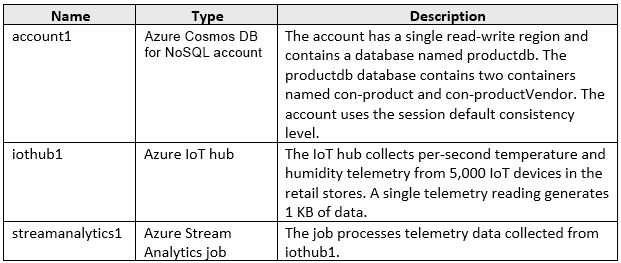
Each container in productdb is configured for manual throughput.
The con-product container stores the company's product catalog data. Each document in con-product includes a con-productVendor value. Most queries targeting the data in con-product are in the following format. SELECT * FROM con-product p WHERE p.con-productVendor = 'name'
Most queries targeting the data in the con-productVendor container are in the following format.
SELECT * FROM con-productVendor pv
ORDER BY pv.creditRating, pv.yearFounded
Existing environment. Current Problems.
Litware identifies the following issues:
-Updates to product categories in the con-productVendor container do not propagate automatically to documents in the con-product container.
-Application updates in con-product frequently cause HTTP status code 429 "Too many requests". You discover that the 429 status code relates to excessive request unit (RU) consumption during the updates.
Requirements. Planned Changes
Litware plans to implement a new Azure Cosmos DB for NoSQL account named account2 that will contain a database named iotdb. The iotdb database will contain two containers named con-iot1 and con-iot2.
Litware plans to make the following changes:
-Store the telemetry data in account2.
-Configure account1 to support multiple read-write regions.
-Implement referential integrity for the con-product container.
-Use Azure Functions to send notifications about product updates to different recipients.
-Develop an app named App1 that will run from all locations and query the data in account1.
-Develop an app named App2 that will run from the retail stores and query the data in account2. App2 must be limited to a single HTTPS endpoint when accessing account2.
Requirements. Business Requirements
Litware identifies the following business requirements:
-Whenever there are multiple solutions for a requirement, select the solution that provides the best performance, as long as there are no additional costs associated.
-Ensure that Azure Cosmos DB costs for IoT-related processing are predictable.
-Minimize the number of firewall changes in the retail stores.
Requirements. IoT Telemetry Requirements
Litware identifies the following IoT telemetry requirements:
-Write the telemetry data from streamanalytics1 to the con-iot1 container as the data arrives. Use streamanalytics1 to create hopping window aggregated telemetry readings once per hour and write the data to con-iot2.
-Automatically delete items in con-iot1 after one hour unless a per-item time to live is set.
-Optimize the partitioning of con-iot1 for queries that support historical data of a specific device.
-Aggregate the telemetry data by device by using streamanalytics1 and write the aggregate data to con-iot2.
-Ensure that the items in con-iot2 persist regardless of the per-item time to live setting.
Requirements. Product Catalog Requirements
Litware identifies the following requirements for the product catalog:
-Implement a custom conflict resolution policy for the product catalog data.
-Minimize the frequency of errors during updates of the con-product container.
-Once multi-region writes are configured, maximize the performance of App1 queries against the data in account1.
-Trigger the execution of two Azure functions following every update to any document in the con-product container.
-

You are troubleshooting the current issues caused by the application updates.
Which action can address the application updates issue without affecting the functionality of the application?

  1. Enable time to live for the con-product container.
  2. Set the default consistency level of account1 to strong.
  3. Set the default consistency level of account1 to bounded staleness.
  4. Add a custom indexing policy to the con-product container.

Answer(s): D


Case Study
This is a case study. Case studies are not timed separately. You can use as much exam time as you would like to complete each case. However, there may be additional case studies and sections on this exam. You must manage your time to ensure that you are able to complete all questions included on this exam in the time provided.
To answer the questions included in a case study, you will need to reference information that is provided in the case study. Case studies might contain exhibits and other resources that provide more information about the scenario that is described in the case study. Each question is independent of the other questions in this case study.
At the end of this case study, a review screen will appear. This screen allows you to review your answers and to make changes before you move to the next section of the exam. After you begin a new section, you cannot return to this section.
To start the case study
To display the first question in this case study, click the Next button. Use the buttons in the left pane to explore the content of the case study before you answer the questions. Clicking these buttons displays information such as business requirements, existing environment, and problem statements. If the case study has an All Information tab, note that the information displayed is identical to the information displayed on the subsequent tabs.
When you are ready to answer a question, click the Question button to return to the question.
Overview
Litware, Inc. is a United States-based grocery retailer. Litware has a main office and a primary datacenter in Seattle. The company has 50 retail stores across the United States and an emerging online presence. Each store connects directly to the internet.
Existing environment. Cloud and Data Service Environments.
Litware has an Azure subscription that contains the resources shown in the following table.

Each container in productdb is configured for manual throughput.
The con-product container stores the company's product catalog data. Each document in con-product includes a con-productVendor value. Most queries targeting the data in con-product are in the following format. SELECT * FROM con-product p WHERE p.con-productVendor = 'name'
Most queries targeting the data in the con-productVendor container are in the following format.
SELECT * FROM con-productVendor pv
ORDER BY pv.creditRating, pv.yearFounded
Existing environment. Current Problems.
Litware identifies the following issues:
-Updates to product categories in the con-productVendor container do not propagate automatically to documents in the con-product container.
-Application updates in con-product frequently cause HTTP status code 429 "Too many requests". You discover that the 429 status code relates to excessive request unit (RU) consumption during the updates.
Requirements. Planned Changes
Litware plans to implement a new Azure Cosmos DB for NoSQL account named account2 that will contain a database named iotdb. The iotdb database will contain two containers named con-iot1 and con-iot2.
Litware plans to make the following changes:
-Store the telemetry data in account2.
-Configure account1 to support multiple read-write regions.
-Implement referential integrity for the con-product container.
-Use Azure Functions to send notifications about product updates to different recipients.
-Develop an app named App1 that will run from all locations and query the data in account1.
-Develop an app named App2 that will run from the retail stores and query the data in account2. App2 must be limited to a single HTTPS endpoint when accessing account2.
Requirements. Business Requirements
Litware identifies the following business requirements:
-Whenever there are multiple solutions for a requirement, select the solution that provides the best performance, as long as there are no additional costs associated.
-Ensure that Azure Cosmos DB costs for IoT-related processing are predictable.
-Minimize the number of firewall changes in the retail stores.
Requirements. IoT Telemetry Requirements
Litware identifies the following IoT telemetry requirements:
-Write the telemetry data from streamanalytics1 to the con-iot1 container as the data arrives. Use streamanalytics1 to create hopping window aggregated telemetry readings once per hour and write the data to con-iot2.
-Automatically delete items in con-iot1 after one hour unless a per-item time to live is set.
-Optimize the partitioning of con-iot1 for queries that support historical data of a specific device.
-Aggregate the telemetry data by device by using streamanalytics1 and write the aggregate data to con-iot2.
-Ensure that the items in con-iot2 persist regardless of the per-item time to live setting.
Requirements. Product Catalog Requirements
Litware identifies the following requirements for the product catalog:
-Implement a custom conflict resolution policy for the product catalog data.
-Minimize the frequency of errors during updates of the con-product container.
-Once multi-region writes are configured, maximize the performance of App1 queries against the data in account1.
-Trigger the execution of two Azure functions following every update to any document in the con-product container.
-

You need to select the partition key for con-iot1. The solution must meet the IoT telemetry requirements.
What should you select?

  1. the timestamp
  2. the humidity
  3. the temperature
  4. the device ID

Answer(s): D

Explanation:

The partition key is what will determine how data is routed in the various partitions by Cosmos DB and needs to make sense in the context of your specific scenario. The IoT Device ID is generally the "natural" partition key for IoT applications.
Scenario: The iotdb database will contain two containers named con-iot1 and con-iot2.
Ensure that Azure Cosmos DB costs for IoT-related processing are predictable.


Reference:

https://docs.microsoft.com/en-us/azure/architecture/solution-ideas/articles/iot-using-cosmos-db


Case Study
This is a case study. Case studies are not timed separately. You can use as much exam time as you would like to complete each case. However, there may be additional case studies and sections on this exam. You must manage your time to ensure that you are able to complete all questions included on this exam in the time provided.
To answer the questions included in a case study, you will need to reference information that is provided in the case study. Case studies might contain exhibits and other resources that provide more information about the scenario that is described in the case study. Each question is independent of the other questions in this case study.
At the end of this case study, a review screen will appear. This screen allows you to review your answers and to make changes before you move to the next section of the exam. After you begin a new section, you cannot return to this section.
To start the case study
To display the first question in this case study, click the Next button. Use the buttons in the left pane to explore the content of the case study before you answer the questions. Clicking these buttons displays information such as business requirements, existing environment, and problem statements. If the case study has an All Information tab, note that the information displayed is identical to the information displayed on the subsequent tabs.
When you are ready to answer a question, click the Question button to return to the question.
Overview
Litware, Inc. is a United States-based grocery retailer. Litware has a main office and a primary datacenter in Seattle. The company has 50 retail stores across the United States and an emerging online presence. Each store connects directly to the internet.
Existing environment. Cloud and Data Service Environments.
Litware has an Azure subscription that contains the resources shown in the following table.

Each container in productdb is configured for manual throughput.
The con-product container stores the company's product catalog data. Each document in con-product includes a con-productVendor value. Most queries targeting the data in con-product are in the following format. SELECT * FROM con-product p WHERE p.con-productVendor = 'name'
Most queries targeting the data in the con-productVendor container are in the following format.
SELECT * FROM con-productVendor pv
ORDER BY pv.creditRating, pv.yearFounded
Existing environment. Current Problems.
Litware identifies the following issues:
-Updates to product categories in the con-productVendor container do not propagate automatically to documents in the con-product container.
-Application updates in con-product frequently cause HTTP status code 429 "Too many requests". You discover that the 429 status code relates to excessive request unit (RU) consumption during the updates.
Requirements. Planned Changes
Litware plans to implement a new Azure Cosmos DB for NoSQL account named account2 that will contain a database named iotdb. The iotdb database will contain two containers named con-iot1 and con-iot2.
Litware plans to make the following changes:
-Store the telemetry data in account2.
-Configure account1 to support multiple read-write regions.
-Implement referential integrity for the con-product container.
-Use Azure Functions to send notifications about product updates to different recipients.
-Develop an app named App1 that will run from all locations and query the data in account1.
-Develop an app named App2 that will run from the retail stores and query the data in account2. App2 must be limited to a single HTTPS endpoint when accessing account2.
Requirements. Business Requirements
Litware identifies the following business requirements:
-Whenever there are multiple solutions for a requirement, select the solution that provides the best performance, as long as there are no additional costs associated.
-Ensure that Azure Cosmos DB costs for IoT-related processing are predictable.
-Minimize the number of firewall changes in the retail stores.
Requirements. IoT Telemetry Requirements
Litware identifies the following IoT telemetry requirements:
-Write the telemetry data from streamanalytics1 to the con-iot1 container as the data arrives. Use streamanalytics1 to create hopping window aggregated telemetry readings once per hour and write the data to con-iot2.
-Automatically delete items in con-iot1 after one hour unless a per-item time to live is set.
-Optimize the partitioning of con-iot1 for queries that support historical data of a specific device.
-Aggregate the telemetry data by device by using streamanalytics1 and write the aggregate data to con-iot2.
-Ensure that the items in con-iot2 persist regardless of the per-item time to live setting.
Requirements. Product Catalog Requirements
Litware identifies the following requirements for the product catalog:
-Implement a custom conflict resolution policy for the product catalog data.
-Minimize the frequency of errors during updates of the con-product container.
-Once multi-region writes are configured, maximize the performance of App1 queries against the data in account1.
-Trigger the execution of two Azure functions following every update to any document in the con-product container.
-

HOTSPOT (Drag and Drop is not supported)
You plan to implement con-iot1 and con-iot2.
You need to configure the default Time to Live setting for each container. The solution must meet the IoT telemetry requirements.
What should you configure? To answer, select the appropriate options in the answer area.
Note: Each correct selection is worth one point.
Hot Area:

  1. See Explanation section for answer.

Answer(s): A

Explanation:


Box 1: On (3,600 seconds)
Note: Litware identifies the following IoT telemetry requirements:
Automatically delete items in con-iot1 after one hour unless a per-item time to live is set.
Box 2: On (no default)
Time to Live on a container (set using DefaultTimeToLive):
* If missing (or set to null), items are not expired automatically.
* If present and the value is set to "-1", it is equal to infinity, and items don’t expire by default.
* If present and the value is set to some non-zero number "n" – items will expire "n" seconds after their last modified time.
Note: Litware identifies the following IoT telemetry requirements:
Ensure that the items in con-iot2 persist regardless of the per-item time to live setting.


Reference:

https://docs.microsoft.com/en-us/azure/cosmos-db/sql/time-to-live


Case Study
This is a case study. Case studies are not timed separately. You can use as much exam time as you would like to complete each case. However, there may be additional case studies and sections on this exam. You must manage your time to ensure that you are able to complete all questions included on this exam in the time provided.
To answer the questions included in a case study, you will need to reference information that is provided in the case study. Case studies might contain exhibits and other resources that provide more information about the scenario that is described in the case study. Each question is independent of the other questions in this case study.
At the end of this case study, a review screen will appear. This screen allows you to review your answers and to make changes before you move to the next section of the exam. After you begin a new section, you cannot return to this section.
To start the case study
To display the first question in this case study, click the Next button. Use the buttons in the left pane to explore the content of the case study before you answer the questions. Clicking these buttons displays information such as business requirements, existing environment, and problem statements. If the case study has an All Information tab, note that the information displayed is identical to the information displayed on the subsequent tabs.
When you are ready to answer a question, click the Question button to return to the question.
Overview
Litware, Inc. is a United States-based grocery retailer. Litware has a main office and a primary datacenter in Seattle. The company has 50 retail stores across the United States and an emerging online presence. Each store connects directly to the internet.
Existing environment. Cloud and Data Service Environments.
Litware has an Azure subscription that contains the resources shown in the following table.

Each container in productdb is configured for manual throughput.
The con-product container stores the company's product catalog data. Each document in con-product includes a con-productVendor value. Most queries targeting the data in con-product are in the following format. SELECT * FROM con-product p WHERE p.con-productVendor = 'name'
Most queries targeting the data in the con-productVendor container are in the following format.
SELECT * FROM con-productVendor pv
ORDER BY pv.creditRating, pv.yearFounded
Existing environment. Current Problems.
Litware identifies the following issues:
-Updates to product categories in the con-productVendor container do not propagate automatically to documents in the con-product container.
-Application updates in con-product frequently cause HTTP status code 429 "Too many requests". You discover that the 429 status code relates to excessive request unit (RU) consumption during the updates.
Requirements. Planned Changes
Litware plans to implement a new Azure Cosmos DB for NoSQL account named account2 that will contain a database named iotdb. The iotdb database will contain two containers named con-iot1 and con-iot2.
Litware plans to make the following changes:
-Store the telemetry data in account2.
-Configure account1 to support multiple read-write regions.
-Implement referential integrity for the con-product container.
-Use Azure Functions to send notifications about product updates to different recipients.
-Develop an app named App1 that will run from all locations and query the data in account1.
-Develop an app named App2 that will run from the retail stores and query the data in account2. App2 must be limited to a single HTTPS endpoint when accessing account2.
Requirements. Business Requirements
Litware identifies the following business requirements:
-Whenever there are multiple solutions for a requirement, select the solution that provides the best performance, as long as there are no additional costs associated.
-Ensure that Azure Cosmos DB costs for IoT-related processing are predictable.
-Minimize the number of firewall changes in the retail stores.
Requirements. IoT Telemetry Requirements
Litware identifies the following IoT telemetry requirements:
-Write the telemetry data from streamanalytics1 to the con-iot1 container as the data arrives. Use streamanalytics1 to create hopping window aggregated telemetry readings once per hour and write the data to con-iot2.
-Automatically delete items in con-iot1 after one hour unless a per-item time to live is set.
-Optimize the partitioning of con-iot1 for queries that support historical data of a specific device.
-Aggregate the telemetry data by device by using streamanalytics1 and write the aggregate data to con-iot2.
-Ensure that the items in con-iot2 persist regardless of the per-item time to live setting.
Requirements. Product Catalog Requirements
Litware identifies the following requirements for the product catalog:
-Implement a custom conflict resolution policy for the product catalog data.
-Minimize the frequency of errors during updates of the con-product container.
-Once multi-region writes are configured, maximize the performance of App1 queries against the data in account1.
-Trigger the execution of two Azure functions following every update to any document in the con-product container.
-

HOTSPOT (Drag and Drop is not supported)
You need to select the capacity mode and scale configuration for account2 to support the planned changes and meet the business requirements.
What should you select? To answer, select the appropriate options in the answer area.
Note: Each correct selection is worth one point.
Hot Area:

  1. See Explanation section for answer.

Answer(s): A

Explanation:


Box 1: Provisioned throughput
Provisioned throughput is best suited for workloads with sustained traffic requiring predictable performance. Billing model: Billing is done on a per-hour basis for the RU/s provisioned, regardless of how many RUs were consumed.
Scenario: Ensure that Azure Cosmos DB costs for IoT-related processing are predictable.
Note: Azure Cosmos DB is available in two different capacity modes: provisioned throughput and serverless. You can perform the exact same database operations in both modes, but the way you get billed for these operations is radically different.
Box 2: Autoscale throughput on iotdb and throughput sharing across the containers
You can enable autoscale on a single container, or provision autoscale throughput on a database and share it among all the containers in the database.
Cost-effective: Autoscale helps optimize your RU/s usage and cost usage by scaling down when not in use. You only pay for the resources that your workloads need on a per-hour basis.
Incorrect: cannot autoscale on two containers.
Note: Autoscale provisioned throughput in Azure Cosmos DB allows you to scale the throughput (RU/s) of your database or container automatically and instantly.


Reference:

https://docs.microsoft.com/en-us/azure/cosmos-db/throughput-serverless https://docs.microsoft.com/en-us/azure/cosmos-db/sql/how-to-provision-autoscale-throughput


Case Study
This is a case study. Case studies are not timed separately. You can use as much exam time as you would like to complete each case. However, there may be additional case studies and sections on this exam. You must manage your time to ensure that you are able to complete all questions included on this exam in the time provided.
To answer the questions included in a case study, you will need to reference information that is provided in the case study. Case studies might contain exhibits and other resources that provide more information about the scenario that is described in the case study. Each question is independent of the other questions in this case study.
At the end of this case study, a review screen will appear. This screen allows you to review your answers and to make changes before you move to the next section of the exam. After you begin a new section, you cannot return to this section.
To start the case study
To display the first question in this case study, click the Next button. Use the buttons in the left pane to explore the content of the case study before you answer the questions. Clicking these buttons displays information such as business requirements, existing environment, and problem statements. If the case study has an All Information tab, note that the information displayed is identical to the information displayed on the subsequent tabs.
When you are ready to answer a question, click the Question button to return to the question.
Overview
Litware, Inc. is a United States-based grocery retailer. Litware has a main office and a primary datacenter in Seattle. The company has 50 retail stores across the United States and an emerging online presence. Each store connects directly to the internet.
Existing environment. Cloud and Data Service Environments.
Litware has an Azure subscription that contains the resources shown in the following table.

Each container in productdb is configured for manual throughput.
The con-product container stores the company's product catalog data. Each document in con-product includes a con-productVendor value. Most queries targeting the data in con-product are in the following format. SELECT * FROM con-product p WHERE p.con-productVendor = 'name'
Most queries targeting the data in the con-productVendor container are in the following format.
SELECT * FROM con-productVendor pv
ORDER BY pv.creditRating, pv.yearFounded
Existing environment. Current Problems.
Litware identifies the following issues:
-Updates to product categories in the con-productVendor container do not propagate automatically to documents in the con-product container.
-Application updates in con-product frequently cause HTTP status code 429 "Too many requests". You discover that the 429 status code relates to excessive request unit (RU) consumption during the updates.
Requirements. Planned Changes
Litware plans to implement a new Azure Cosmos DB for NoSQL account named account2 that will contain a database named iotdb. The iotdb database will contain two containers named con-iot1 and con-iot2.
Litware plans to make the following changes:
-Store the telemetry data in account2.
-Configure account1 to support multiple read-write regions.
-Implement referential integrity for the con-product container.
-Use Azure Functions to send notifications about product updates to different recipients.
-Develop an app named App1 that will run from all locations and query the data in account1.
-Develop an app named App2 that will run from the retail stores and query the data in account2. App2 must be limited to a single HTTPS endpoint when accessing account2.
Requirements. Business Requirements
Litware identifies the following business requirements:
-Whenever there are multiple solutions for a requirement, select the solution that provides the best performance, as long as there are no additional costs associated.
-Ensure that Azure Cosmos DB costs for IoT-related processing are predictable.
-Minimize the number of firewall changes in the retail stores.
Requirements. IoT Telemetry Requirements
Litware identifies the following IoT telemetry requirements:
-Write the telemetry data from streamanalytics1 to the con-iot1 container as the data arrives. Use streamanalytics1 to create hopping window aggregated telemetry readings once per hour and write the data to con-iot2.
-Automatically delete items in con-iot1 after one hour unless a per-item time to live is set.
-Optimize the partitioning of con-iot1 for queries that support historical data of a specific device.
-Aggregate the telemetry data by device by using streamanalytics1 and write the aggregate data to con-iot2.
-Ensure that the items in con-iot2 persist regardless of the per-item time to live setting.
Requirements. Product Catalog Requirements
Litware identifies the following requirements for the product catalog:
-Implement a custom conflict resolution policy for the product catalog data.
-Minimize the frequency of errors during updates of the con-product container.
-Once multi-region writes are configured, maximize the performance of App1 queries against the data in account1.
-Trigger the execution of two Azure functions following every update to any document in the con-product container.
-

HOTSPOT (Drag and Drop is not supported)
You have an Azure Cosmos DB for NoSQL account named account1 that has the disableKeyBasedMetadataWriteAccess property enabled.
You are developing an app named App1 that will be used by a user named DevUser1 to create containers in account1. DevUser1 has a non-privileged user account in the Azure AD tenant.
You need to ensure that DevUser1 can use App1 to create containers in account1.
What should you do? To answer, select the appropriate options in the answer area.
Note: Each correct selection is worth one point.
Hot Area:

  1. See Explanation section for answer.

Answer(s): A

Explanation:


Box 1: Resource tokens
Resource tokens provide access to the application resources within a database. Resource tokens:
Provide access to specific containers, partition keys, documents, attachments, stored procedures, triggers, and UDFs.
Box 2: Azure Resource Manager API
You can use Azure Resource Manager to help deploy and manage your Azure Cosmos DB accounts, databases, and containers.
Incorrect Answers:
The Microsoft Graph API is a RESTful web API that enables you to access Microsoft Cloud service resources.


Reference:

https://docs.microsoft.com/en-us/azure/cosmos-db/secure-access-to-data https://docs.microsoft.com/en-us/rest/api/resources/


Case Study
This is a case study. Case studies are not timed separately. You can use as much exam time as you would like to complete each case. However, there may be additional case studies and sections on this exam. You must manage your time to ensure that you are able to complete all questions included on this exam in the time provided.
To answer the questions included in a case study, you will need to reference information that is provided in the case study. Case studies might contain exhibits and other resources that provide more information about the scenario that is described in the case study. Each question is independent of the other questions in this case study.
At the end of this case study, a review screen will appear. This screen allows you to review your answers and to make changes before you move to the next section of the exam. After you begin a new section, you cannot return to this section.
To start the case study
To display the first question in this case study, click the Next button. Use the buttons in the left pane to explore the content of the case study before you answer the questions. Clicking these buttons displays information such as business requirements, existing environment, and problem statements. If the case study has an All Information tab, note that the information displayed is identical to the information displayed on the subsequent tabs.
When you are ready to answer a question, click the Question button to return to the question.
Overview
Litware, Inc. is a United States-based grocery retailer. Litware has a main office and a primary datacenter in Seattle. The company has 50 retail stores across the United States and an emerging online presence. Each store connects directly to the internet.
Existing environment. Cloud and Data Service Environments.
Litware has an Azure subscription that contains the resources shown in the following table.

Each container in productdb is configured for manual throughput.
The con-product container stores the company's product catalog data. Each document in con-product includes a con-productVendor value. Most queries targeting the data in con-product are in the following format. SELECT * FROM con-product p WHERE p.con-productVendor = 'name'
Most queries targeting the data in the con-productVendor container are in the following format.
SELECT * FROM con-productVendor pv
ORDER BY pv.creditRating, pv.yearFounded
Existing environment. Current Problems.
Litware identifies the following issues:
-Updates to product categories in the con-productVendor container do not propagate automatically to documents in the con-product container.
-Application updates in con-product frequently cause HTTP status code 429 "Too many requests". You discover that the 429 status code relates to excessive request unit (RU) consumption during the updates.
Requirements. Planned Changes
Litware plans to implement a new Azure Cosmos DB for NoSQL account named account2 that will contain a database named iotdb. The iotdb database will contain two containers named con-iot1 and con-iot2.
Litware plans to make the following changes:
-Store the telemetry data in account2.
-Configure account1 to support multiple read-write regions.
-Implement referential integrity for the con-product container.
-Use Azure Functions to send notifications about product updates to different recipients.
-Develop an app named App1 that will run from all locations and query the data in account1.
-Develop an app named App2 that will run from the retail stores and query the data in account2. App2 must be limited to a single HTTPS endpoint when accessing account2.
Requirements. Business Requirements
Litware identifies the following business requirements:
-Whenever there are multiple solutions for a requirement, select the solution that provides the best performance, as long as there are no additional costs associated.
-Ensure that Azure Cosmos DB costs for IoT-related processing are predictable.
-Minimize the number of firewall changes in the retail stores.
Requirements. IoT Telemetry Requirements
Litware identifies the following IoT telemetry requirements:
-Write the telemetry data from streamanalytics1 to the con-iot1 container as the data arrives. Use streamanalytics1 to create hopping window aggregated telemetry readings once per hour and write the data to con-iot2.
-Automatically delete items in con-iot1 after one hour unless a per-item time to live is set.
-Optimize the partitioning of con-iot1 for queries that support historical data of a specific device.
-Aggregate the telemetry data by device by using streamanalytics1 and write the aggregate data to con-iot2.
-Ensure that the items in con-iot2 persist regardless of the per-item time to live setting.
Requirements. Product Catalog Requirements
Litware identifies the following requirements for the product catalog:
-Implement a custom conflict resolution policy for the product catalog data.
-Minimize the frequency of errors during updates of the con-product container.
-Once multi-region writes are configured, maximize the performance of App1 queries against the data in account1.
-Trigger the execution of two Azure functions following every update to any document in the con-product container.
-

HOTSPOT (Drag and Drop is not supported)
You have an Azure Cosmos DB for NoSQL account that has a single write region in West Europe.
You run the following Azure CLI script.

For each of the following statements, select Yes if the statement is true. Otherwise, select No.
Note: Each correct selection is worth one point.
Hot Area:

  1. See Explanation section for answer.

Answer(s): A

Explanation:


Box 1: Yes
The Automatic failover option allows Azure Cosmos DB to failover to the region with the highest failover priority with no user action should a region become unavailable.
Box 2: No
West Europe is used for failover. Only North Europe is writable.
To Configure multi-region set UseMultipleWriteLocations to true.
Box 3: Yes
Provisioned throughput with single write region costs $0.008/hour per 100 RU/s and provisioned throughput with multiple writable regions costs $0.016/per hour per 100 RU/s.


Reference:

https://docs.microsoft.com/en-us/azure/cosmos-db/sql/how-to-multi-master https://docs.microsoft.com/en-us/azure/cosmos-db/optimize-cost-regions


Case Study
This is a case study. Case studies are not timed separately. You can use as much exam time as you would like to complete each case. However, there may be additional case studies and sections on this exam. You must manage your time to ensure that you are able to complete all questions included on this exam in the time provided.
To answer the questions included in a case study, you will need to reference information that is provided in the case study. Case studies might contain exhibits and other resources that provide more information about the scenario that is described in the case study. Each question is independent of the other questions in this case study.
At the end of this case study, a review screen will appear. This screen allows you to review your answers and to make changes before you move to the next section of the exam. After you begin a new section, you cannot return to this section.
To start the case study
To display the first question in this case study, click the Next button. Use the buttons in the left pane to explore the content of the case study before you answer the questions. Clicking these buttons displays information such as business requirements, existing environment, and problem statements. If the case study has an All Information tab, note that the information displayed is identical to the information displayed on the subsequent tabs.
When you are ready to answer a question, click the Question button to return to the question.
Overview
Litware, Inc. is a United States-based grocery retailer. Litware has a main office and a primary datacenter in Seattle. The company has 50 retail stores across the United States and an emerging online presence. Each store connects directly to the internet.
Existing environment. Cloud and Data Service Environments.
Litware has an Azure subscription that contains the resources shown in the following table.

Each container in productdb is configured for manual throughput.
The con-product container stores the company's product catalog data. Each document in con-product includes a con-productVendor value. Most queries targeting the data in con-product are in the following format. SELECT * FROM con-product p WHERE p.con-productVendor = 'name'
Most queries targeting the data in the con-productVendor container are in the following format.
SELECT * FROM con-productVendor pv
ORDER BY pv.creditRating, pv.yearFounded
Existing environment. Current Problems.
Litware identifies the following issues:
-Updates to product categories in the con-productVendor container do not propagate automatically to documents in the con-product container.
-Application updates in con-product frequently cause HTTP status code 429 "Too many requests". You discover that the 429 status code relates to excessive request unit (RU) consumption during the updates.
Requirements. Planned Changes
Litware plans to implement a new Azure Cosmos DB for NoSQL account named account2 that will contain a database named iotdb. The iotdb database will contain two containers named con-iot1 and con-iot2.
Litware plans to make the following changes:
-Store the telemetry data in account2.
-Configure account1 to support multiple read-write regions.
-Implement referential integrity for the con-product container.
-Use Azure Functions to send notifications about product updates to different recipients.
-Develop an app named App1 that will run from all locations and query the data in account1.
-Develop an app named App2 that will run from the retail stores and query the data in account2. App2 must be limited to a single HTTPS endpoint when accessing account2.
Requirements. Business Requirements
Litware identifies the following business requirements:
-Whenever there are multiple solutions for a requirement, select the solution that provides the best performance, as long as there are no additional costs associated.
-Ensure that Azure Cosmos DB costs for IoT-related processing are predictable.
-Minimize the number of firewall changes in the retail stores.
Requirements. IoT Telemetry Requirements
Litware identifies the following IoT telemetry requirements:
-Write the telemetry data from streamanalytics1 to the con-iot1 container as the data arrives. Use streamanalytics1 to create hopping window aggregated telemetry readings once per hour and write the data to con-iot2.
-Automatically delete items in con-iot1 after one hour unless a per-item time to live is set.
-Optimize the partitioning of con-iot1 for queries that support historical data of a specific device.
-Aggregate the telemetry data by device by using streamanalytics1 and write the aggregate data to con-iot2.
-Ensure that the items in con-iot2 persist regardless of the per-item time to live setting.
Requirements. Product Catalog Requirements
Litware identifies the following requirements for the product catalog:
-Implement a custom conflict resolution policy for the product catalog data.
-Minimize the frequency of errors during updates of the con-product container.
-Once multi-region writes are configured, maximize the performance of App1 queries against the data in account1.
-Trigger the execution of two Azure functions following every update to any document in the con-product container.
-

You are developing an application that will use an Azure Cosmos DB for NoSQL account as a data source.
You need to create a report that displays the top five most ordered fruits as shown in the following table.

A collection that contains aggregated data already exists. The following is a sample document:

Which two queries can you use to retrieve data for the report? Each correct answer presents a complete solution.
Note: Each correct selection is worth one point.


Answer(s): B,D

Explanation:

ARRAY_CONTAINS returns a Boolean indicating whether the array contains the specified value. You can check for a partial or full match of an object by using a boolean expression within the command.
Incorrect Answers:
A: Default sorting ordering is Ascending. Must use Descending order.
C: Order on Orders not on Type.


Reference:

https://docs.microsoft.com/en-us/azure/cosmos-db/sql/sql-query-array-contains


Case Study
This is a case study. Case studies are not timed separately. You can use as much exam time as you would like to complete each case. However, there may be additional case studies and sections on this exam. You must manage your time to ensure that you are able to complete all questions included on this exam in the time provided.
To answer the questions included in a case study, you will need to reference information that is provided in the case study. Case studies might contain exhibits and other resources that provide more information about the scenario that is described in the case study. Each question is independent of the other questions in this case study.
At the end of this case study, a review screen will appear. This screen allows you to review your answers and to make changes before you move to the next section of the exam. After you begin a new section, you cannot return to this section.
To start the case study
To display the first question in this case study, click the Next button. Use the buttons in the left pane to explore the content of the case study before you answer the questions. Clicking these buttons displays information such as business requirements, existing environment, and problem statements. If the case study has an All Information tab, note that the information displayed is identical to the information displayed on the subsequent tabs.
When you are ready to answer a question, click the Question button to return to the question.
Overview
Litware, Inc. is a United States-based grocery retailer. Litware has a main office and a primary datacenter in Seattle. The company has 50 retail stores across the United States and an emerging online presence. Each store connects directly to the internet.
Existing environment. Cloud and Data Service Environments.
Litware has an Azure subscription that contains the resources shown in the following table.

Each container in productdb is configured for manual throughput.
The con-product container stores the company's product catalog data. Each document in con-product includes a con-productVendor value. Most queries targeting the data in con-product are in the following format. SELECT * FROM con-product p WHERE p.con-productVendor = 'name'
Most queries targeting the data in the con-productVendor container are in the following format.
SELECT * FROM con-productVendor pv
ORDER BY pv.creditRating, pv.yearFounded
Existing environment. Current Problems.
Litware identifies the following issues:
-Updates to product categories in the con-productVendor container do not propagate automatically to documents in the con-product container.
-Application updates in con-product frequently cause HTTP status code 429 "Too many requests". You discover that the 429 status code relates to excessive request unit (RU) consumption during the updates.
Requirements. Planned Changes
Litware plans to implement a new Azure Cosmos DB for NoSQL account named account2 that will contain a database named iotdb. The iotdb database will contain two containers named con-iot1 and con-iot2.
Litware plans to make the following changes:
-Store the telemetry data in account2.
-Configure account1 to support multiple read-write regions.
-Implement referential integrity for the con-product container.
-Use Azure Functions to send notifications about product updates to different recipients.
-Develop an app named App1 that will run from all locations and query the data in account1.
-Develop an app named App2 that will run from the retail stores and query the data in account2. App2 must be limited to a single HTTPS endpoint when accessing account2.
Requirements. Business Requirements
Litware identifies the following business requirements:
-Whenever there are multiple solutions for a requirement, select the solution that provides the best performance, as long as there are no additional costs associated.
-Ensure that Azure Cosmos DB costs for IoT-related processing are predictable.
-Minimize the number of firewall changes in the retail stores.
Requirements. IoT Telemetry Requirements
Litware identifies the following IoT telemetry requirements:
-Write the telemetry data from streamanalytics1 to the con-iot1 container as the data arrives. Use streamanalytics1 to create hopping window aggregated telemetry readings once per hour and write the data to con-iot2.
-Automatically delete items in con-iot1 after one hour unless a per-item time to live is set.
-Optimize the partitioning of con-iot1 for queries that support historical data of a specific device.
-Aggregate the telemetry data by device by using streamanalytics1 and write the aggregate data to con-iot2.
-Ensure that the items in con-iot2 persist regardless of the per-item time to live setting.
Requirements. Product Catalog Requirements
Litware identifies the following requirements for the product catalog:
-Implement a custom conflict resolution policy for the product catalog data.
-Minimize the frequency of errors during updates of the con-product container.
-Once multi-region writes are configured, maximize the performance of App1 queries against the data in account1.
-Trigger the execution of two Azure functions following every update to any document in the con-product container.
-

HOTSPOT (Drag and Drop is not supported)
You have a database in an Azure Cosmos DB for NoSQL account.
You plan to create a container that will store employee data for 5,000 small companies. Each business will have up to 25 employees. Each employee item will have an emailAddress value.
You need to ensure that the emailAddress value for each employee within the same company is unique.
To what should you set the partition key and the unique key? To answer, select the appropriate options in the answer area.
Note: Each correct selection is worth one point.
Hot Area:

  1. See Explanation section for answer.

Answer(s): A

Explanation:


Box 1: CompanyID
After you create a container with a unique key policy, the creation of a new or an update of an existing item resulting in a duplicate within a logical partition is prevented, as specified by the unique key constraint. The partition key combined with the unique key guarantees the uniqueness of an item within the scope of the container.
For example, consider an Azure Cosmos container with Email address as the unique key constraint and CompanyID as the partition key.
When you configure the user's email address with a unique key, each item has a unique email address within a given CompanyID. Two items can't be created with duplicate email addresses and with the same partition key value.
Box 2: emailAddress


Reference:

https://docs.microsoft.com/en-us/azure/cosmos-db/unique-keys


Share your comments for Microsoft DP-420 exam with other users:

A
AD
7/22/2023 11:29:00 AM

please provide dumps

A
Ayyjayy
11/6/2023 7:29:00 AM

is the answer to question 15 correct ? i feel like the answer should be b

B
Blessious Phiri
8/12/2023 11:56:00 AM

its getting more technical

J
Jeanine J
7/11/2023 3:04:00 PM

i think these questions are what i need.

A
Aderonke
10/23/2023 2:13:00 PM

helpful assessment

T
Tom
1/5/2024 2:32:00 AM

i am confused about the answers to the questions. do you know if the answers are correct?

V
Vinit N.
8/28/2023 2:33:00 AM

hi, please make the dumps available for my upcoming examination.

S
Sanyog Deshpande
9/14/2023 7:05:00 AM

good practice

T
Tyron
9/8/2023 12:12:00 AM

so far it is really informative

B
beast
7/30/2023 2:22:00 PM

hi i want it please please upload it

M
Mirex
5/26/2023 3:45:00 AM

am preparing for exam ,just nice questions

E
exampei
8/7/2023 8:05:00 AM

please upload c_tadm_23 exam

A
Anonymous
9/12/2023 12:50:00 PM

can we get tdvan4 vantage data engineering pdf?

A
Aish
10/11/2023 5:51:00 AM

want to clear the exam.

S
Smaranika
6/22/2023 8:42:00 AM

could you please upload the dumps of sap c_sac_2302

B
Blessious Phiri
8/15/2023 1:56:00 PM

asm management configuration is about storage

L
Lewis
7/6/2023 8:49:00 PM

kool thumb up

M
Moreece
5/15/2023 8:44:00 AM

just passed the az-500 exam this last friday. most of the questions in this exam dumps are in the exam. i bought the full version and noticed some of the questions which were answered wrong in the free version are all corrected in the full version. this site is good but i wish the had it in an interactive version like a test engine simulator.

T
Terry
5/24/2023 4:41:00 PM

i can practice for exam

E
Emerys
7/29/2023 6:55:00 AM

please i need this exam.

G
Goni Mala
9/2/2023 12:27:00 PM

i need the dump

L
Lenny
9/29/2023 11:30:00 AM

i want it bad, even if cs6 maybe retired, i want to learn cs6

M
MilfSlayer
12/28/2023 8:32:00 PM

i hate comptia with all my heart with their "choose the best" answer format as an argument could be made on every question. they say "the "comptia way", lmao no this right here boys is the comptia way 100%. take it from someone whos failed this exam twice but can configure an entire complex network that these are the questions that are on the test 100% no questions asked. the pbqs are dead on! nice work

S
Swati Raj
11/14/2023 6:28:00 AM

very good materials

K
Ko Htet
10/17/2023 1:28:00 AM

thanks for your support.

P
Philippe
1/22/2023 10:24:00 AM

iam impressed with the quality of these dumps. they questions and answers were easy to understand and the xengine app was very helpful to use.

S
Sam
8/31/2023 10:32:00 AM

not bad but you question database from isaca

B
Brijesh kr
6/29/2023 4:07:00 AM

awesome contents

J
JM
12/19/2023 1:22:00 PM

answer to 134 is casb. while data loss prevention is the goal, in order to implement dlp in cloud applications you need to deploy a casb.

N
Neo
7/26/2023 9:36:00 AM

are these brain dumps sufficient enough to go write exam after practicing them? or does one need more material this wont be enough?

B
Bilal
8/22/2023 6:33:00 AM

i did attend the required cources and i need to be sure that i am ready to take the exam, i would ask you please to share the questions, to be sure that i am fit to proceed with taking the exam.

J
John
11/12/2023 8:48:00 PM

why only give explanations on some, and not all questions and their respective answers?

B
Biswa
11/20/2023 8:50:00 AM

refresh db knowledge

S
Shalini Sharma
10/17/2023 8:29:00 AM

interested for sap certification

AI Tutor 👋 I’m here to help!