Microsoft Administering Windows Server AZ-802 Dumps in PDF

Free Microsoft AZ-802 Real Questions (page: 24)


Case Study
Overview:
Company Information
A: Datum Corporation is a manufacturing company that has a main office in Seattle and two branch offices in Los Angeles and Montreal.
Fabrikam Partnership

A: Datum recently partnered with a company named Fabrikam, Inc.
Fabrikam is a manufacturing company that has a main office in Boston and a branch office in Orlando.
Both companies intend to collaborate on several joint projects.
Existing Environment

A: Datum AD DS Environment
The on-premises network of A. Datum contains an Active Directory Domain Services (AD DS) forest named adatum.com.
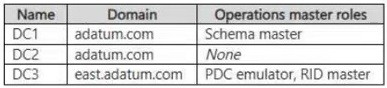
The forest contains two domains named adatum.com and east.adatum.com and the domain controllers shown in the following table.
Fabrikam AD DS Environment
The on-premises network of Fabrikam contains an AD DS forest named fabrikam.com.
The forest contains two domains named fabrikam.com and south.fabrikam.com.
The fabrikam.com domain contains an organizational unit (OU) named Marketing.
Server Infrastructure
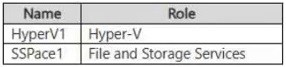
The adatum.com domain contains the servers shown in the following table.
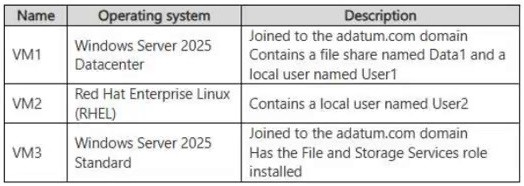
HyperV1 contains the virtual machines shown in the following table.
All the virtual machines on HyperV1 have only the default management tools installed.
SSPace1 contains the Storage Spaces Virtual disks shown in the following table.

Azure Resources

A: Datum has an Azure subscription that contains a Microsoft Entra tenant. Microsoft Entra Connect sync is configured to sync the adatum.com forest with the Microsoft Entra tenant.
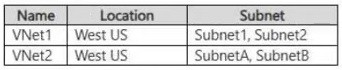
The subscription contains the virtual networks shown in the following table.
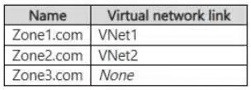
The subscription contains the Azure Private DNS zones shown in the following table.
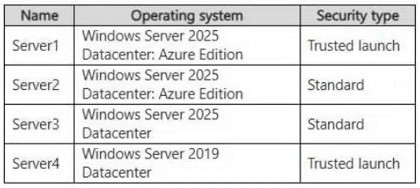
The subscription contains the virtual machines shown in the following table.
All the servers are in a workgroup.
The subscription contains a storage account named storage1 that has a file share named share1.
Requirements
Planned Changes

A: Datum plans to implement the following changes:
● Sync Data1 to share 1.
● Configure an Azure runbook named Task1.
● Enable Microsoft Entra users to sign in to Server1.
● Create an Azure DNS Private Resolver that has the following configurations:
● Name: Private1
● Region: West US
● Virtual network: VNet1
● Inbound endpoint: SubnetB
● Enable users in the adatum.com domain to access the resources in the south.fabrikam.com domain.
Technical Requirements

A: Datum identifies the following technical requirements:
● The data on SSPace1 must be always available.
● DC2 must become the schema master if DC1 fails.
● VM3 must be configured to enable per-folder quotas.
● Trusts must allow access to only the required resources.
● The users in the Marketing OU must have access to storage1.
● Azure Automanage must be used on all supported Azure virtual machines.
● A direct SSH session must be used to manage all the supported virtual machines on HyperV1.

HOTSPOT (Drag and Drop is not supported)
Your network contains an Active Directory Domain Services (AD DS) domain named contoso.com. The domain contains two domain controllers named DC1 and DC2.
You plan to perform the following actions:
● Add two domain controllers named DC3 and DC4 to contoso.com.
● Configure DC3 as a domain controller and DC4 as a read-only domain controller (RODC).
● Add a new child domain named east.contoso.com that will be hosted on a domain controller named DC5.
You need to use the install from media (IFM) option, whenever possible.
What can you use to prepare the IFM data, and which domain controllers can be promoted by using the IFM option? To answer, select the appropriate options in the answer area.
Note: Each correct selection is worth one point.
Hot Area:

  1. See Explanation section for answer.

Answer(s): A

Explanation:


ntdsutil.exe
DC3 and DC4 only
Ntdsutil creates IFM media for both writable domain controllers and RODCs. DC3 and DC4 can use the appropriate media because they join the existing contoso.com domain. IFM cannot install the first domain controller in a new domain, so DC5 is ineligible.


Reference:

https://learn.microsoft.com/en-us/previous-versions/windows/it-pro/windows-server-2012-r2-and-20 12/cc732530%28v%3Dws.11%29
https://learn.microsoft.com/en-us/windows-server/identity/ad-ds/deploy/install-active-directory-domain-services --level-100-


Case Study
Overview:
Company Information
A: Datum Corporation is a manufacturing company that has a main office in Seattle and two branch offices in Los Angeles and Montreal.
Fabrikam Partnership

A: Datum recently partnered with a company named Fabrikam, Inc.
Fabrikam is a manufacturing company that has a main office in Boston and a branch office in Orlando.
Both companies intend to collaborate on several joint projects.
Existing Environment

A: Datum AD DS Environment
The on-premises network of A. Datum contains an Active Directory Domain Services (AD DS) forest named adatum.com.
The forest contains two domains named adatum.com and east.adatum.com and the domain controllers shown in the following table.

Fabrikam AD DS Environment
The on-premises network of Fabrikam contains an AD DS forest named fabrikam.com.
The forest contains two domains named fabrikam.com and south.fabrikam.com.
The fabrikam.com domain contains an organizational unit (OU) named Marketing.
Server Infrastructure
The adatum.com domain contains the servers shown in the following table.

HyperV1 contains the virtual machines shown in the following table.

All the virtual machines on HyperV1 have only the default management tools installed.
SSPace1 contains the Storage Spaces Virtual disks shown in the following table.

Azure Resources

A: Datum has an Azure subscription that contains a Microsoft Entra tenant. Microsoft Entra Connect sync is configured to sync the adatum.com forest with the Microsoft Entra tenant.
The subscription contains the virtual networks shown in the following table.

The subscription contains the Azure Private DNS zones shown in the following table.

The subscription contains the virtual machines shown in the following table.

All the servers are in a workgroup.
The subscription contains a storage account named storage1 that has a file share named share1.
Requirements
Planned Changes

A: Datum plans to implement the following changes:
● Sync Data1 to share 1.
● Configure an Azure runbook named Task1.
● Enable Microsoft Entra users to sign in to Server1.
● Create an Azure DNS Private Resolver that has the following configurations:
● Name: Private1
● Region: West US
● Virtual network: VNet1
● Inbound endpoint: SubnetB
● Enable users in the adatum.com domain to access the resources in the south.fabrikam.com domain.
Technical Requirements

A: Datum identifies the following technical requirements:
● The data on SSPace1 must be always available.
● DC2 must become the schema master if DC1 fails.
● VM3 must be configured to enable per-folder quotas.
● Trusts must allow access to only the required resources.
● The users in the Marketing OU must have access to storage1.
● Azure Automanage must be used on all supported Azure virtual machines.
● A direct SSH session must be used to manage all the supported virtual machines on HyperV1.

HOTSPOT (Drag and Drop is not supported)
Your network contains an Active Directory Domain Services (AD DS) domain.
The domain contains a file server named FS1 that hosts a file share named Finance. The domain contains an organizational unit (OU) named OU1 and a global security group named Group1.
A Group Policy Object (GPO) named GPO1 is linked to OU1.
You need to configure a Group Policy preferences item that maps drive F to \\FS1\Finance for the members of Group1. The item will use Security Group item-level targeting and remove the preferences setting when the setting no longer applies.
The solution must recreate the preferences setting during Group Policy refresh if a user deletes or changes the setting.
What should you configure? To answer, select the appropriate options in the answer area.
Note: Each correct selection is worth one point.
Hot Area:

  1. See Explanation section for answer.

Answer(s): A

Explanation:


Preference extension: Drive Maps
Action: Replace
The Drive Maps preference extension is used to map drive F to \\FS1\Finance. The Replace action deletes and recreates the mapped drive during Group Policy refresh, ensuring that the required configuration is restored if a user deletes or changes it. It also supports item-level targeting and removal when the preference item no longer applies.


Case Study
Overview:
Company Information
A: Datum Corporation is a manufacturing company that has a main office in Seattle and two branch offices in Los Angeles and Montreal.
Fabrikam Partnership

A: Datum recently partnered with a company named Fabrikam, Inc.
Fabrikam is a manufacturing company that has a main office in Boston and a branch office in Orlando.
Both companies intend to collaborate on several joint projects.
Existing Environment

A: Datum AD DS Environment
The on-premises network of A. Datum contains an Active Directory Domain Services (AD DS) forest named adatum.com.
The forest contains two domains named adatum.com and east.adatum.com and the domain controllers shown in the following table.

Fabrikam AD DS Environment
The on-premises network of Fabrikam contains an AD DS forest named fabrikam.com.
The forest contains two domains named fabrikam.com and south.fabrikam.com.
The fabrikam.com domain contains an organizational unit (OU) named Marketing.
Server Infrastructure
The adatum.com domain contains the servers shown in the following table.

HyperV1 contains the virtual machines shown in the following table.

All the virtual machines on HyperV1 have only the default management tools installed.
SSPace1 contains the Storage Spaces Virtual disks shown in the following table.

Azure Resources

A: Datum has an Azure subscription that contains a Microsoft Entra tenant. Microsoft Entra Connect sync is configured to sync the adatum.com forest with the Microsoft Entra tenant.
The subscription contains the virtual networks shown in the following table.

The subscription contains the Azure Private DNS zones shown in the following table.

The subscription contains the virtual machines shown in the following table.

All the servers are in a workgroup.
The subscription contains a storage account named storage1 that has a file share named share1.
Requirements
Planned Changes

A: Datum plans to implement the following changes:
● Sync Data1 to share 1.
● Configure an Azure runbook named Task1.
● Enable Microsoft Entra users to sign in to Server1.
● Create an Azure DNS Private Resolver that has the following configurations:
● Name: Private1
● Region: West US
● Virtual network: VNet1
● Inbound endpoint: SubnetB
● Enable users in the adatum.com domain to access the resources in the south.fabrikam.com domain.
Technical Requirements

A: Datum identifies the following technical requirements:
● The data on SSPace1 must be always available.
● DC2 must become the schema master if DC1 fails.
● VM3 must be configured to enable per-folder quotas.
● Trusts must allow access to only the required resources.
● The users in the Marketing OU must have access to storage1.
● Azure Automanage must be used on all supported Azure virtual machines.
● A direct SSH session must be used to manage all the supported virtual machines on HyperV1.

Your on-premises network contains an Active Directory Domain Services (AD DS) domain.
You have an Azure subscription.
The AD DS domain contains the domain controllers shown in the following table.

To the Azure subscription, you deploy a virtual machine named DC5 that runs Windows Server 2025.
You plan to promote DC5 to a domain controller by using Install from media (IFM).
You need to create the media for DC5. The solution must minimize the network traffic between the on-premises network and the Azure subscription during the promotion of DC5.
Which domain controller should you use to create the IFM media?

  1. DC1
  2. DC2
  3. DC3
  4. DC4

Answer(s): C

Explanation:

DC3 is the intended choice because it is already in Azure, minimizing transfers between the on-premises network and Azure when preparing and using the IFM media.


Case Study
Overview:
Company Information
A: Datum Corporation is a manufacturing company that has a main office in Seattle and two branch offices in Los Angeles and Montreal.
Fabrikam Partnership

A: Datum recently partnered with a company named Fabrikam, Inc.
Fabrikam is a manufacturing company that has a main office in Boston and a branch office in Orlando.
Both companies intend to collaborate on several joint projects.
Existing Environment

A: Datum AD DS Environment
The on-premises network of A. Datum contains an Active Directory Domain Services (AD DS) forest named adatum.com.
The forest contains two domains named adatum.com and east.adatum.com and the domain controllers shown in the following table.

Fabrikam AD DS Environment
The on-premises network of Fabrikam contains an AD DS forest named fabrikam.com.
The forest contains two domains named fabrikam.com and south.fabrikam.com.
The fabrikam.com domain contains an organizational unit (OU) named Marketing.
Server Infrastructure
The adatum.com domain contains the servers shown in the following table.

HyperV1 contains the virtual machines shown in the following table.

All the virtual machines on HyperV1 have only the default management tools installed.
SSPace1 contains the Storage Spaces Virtual disks shown in the following table.

Azure Resources

A: Datum has an Azure subscription that contains a Microsoft Entra tenant. Microsoft Entra Connect sync is configured to sync the adatum.com forest with the Microsoft Entra tenant.
The subscription contains the virtual networks shown in the following table.

The subscription contains the Azure Private DNS zones shown in the following table.

The subscription contains the virtual machines shown in the following table.

All the servers are in a workgroup.
The subscription contains a storage account named storage1 that has a file share named share1.
Requirements
Planned Changes

A: Datum plans to implement the following changes:
● Sync Data1 to share 1.
● Configure an Azure runbook named Task1.
● Enable Microsoft Entra users to sign in to Server1.
● Create an Azure DNS Private Resolver that has the following configurations:
● Name: Private1
● Region: West US
● Virtual network: VNet1
● Inbound endpoint: SubnetB
● Enable users in the adatum.com domain to access the resources in the south.fabrikam.com domain.
Technical Requirements

A: Datum identifies the following technical requirements:
● The data on SSPace1 must be always available.
● DC2 must become the schema master if DC1 fails.
● VM3 must be configured to enable per-folder quotas.
● Trusts must allow access to only the required resources.
● The users in the Marketing OU must have access to storage1.
● Azure Automanage must be used on all supported Azure virtual machines.
● A direct SSH session must be used to manage all the supported virtual machines on HyperV1.

Note: This question is part of a series of questions that present the same scenario. Each question in the series contains a unique solution that might meet the stated goals. Some question sets might have more than one correct solution, while others might not have a correct solution.
After you answer a question in this section, you will NOT be able to return to it. As a result, these questions will not appear in the review screen.
Your network contains an Active Directory Domain Services (AD DS) domain named contoso.com.
You need to identify which server is the PDC emulator for the domain.
Solution: From a command prompt, you run netdom.exe query fsmo.
Does this meet the goal?

  1. Yes
  2. No

Answer(s): A

Explanation:

netdom.exe query fsmo displays the servers that currently hold the five FSMO roles in the forest and domain, including the PDC emulator.


Case Study
Overview:
Company Information
A: Datum Corporation is a manufacturing company that has a main office in Seattle and two branch offices in Los Angeles and Montreal.
Fabrikam Partnership

A: Datum recently partnered with a company named Fabrikam, Inc.
Fabrikam is a manufacturing company that has a main office in Boston and a branch office in Orlando.
Both companies intend to collaborate on several joint projects.
Existing Environment

A: Datum AD DS Environment
The on-premises network of A. Datum contains an Active Directory Domain Services (AD DS) forest named adatum.com.
The forest contains two domains named adatum.com and east.adatum.com and the domain controllers shown in the following table.

Fabrikam AD DS Environment
The on-premises network of Fabrikam contains an AD DS forest named fabrikam.com.
The forest contains two domains named fabrikam.com and south.fabrikam.com.
The fabrikam.com domain contains an organizational unit (OU) named Marketing.
Server Infrastructure
The adatum.com domain contains the servers shown in the following table.

HyperV1 contains the virtual machines shown in the following table.

All the virtual machines on HyperV1 have only the default management tools installed.
SSPace1 contains the Storage Spaces Virtual disks shown in the following table.

Azure Resources

A: Datum has an Azure subscription that contains a Microsoft Entra tenant. Microsoft Entra Connect sync is configured to sync the adatum.com forest with the Microsoft Entra tenant.
The subscription contains the virtual networks shown in the following table.

The subscription contains the Azure Private DNS zones shown in the following table.

The subscription contains the virtual machines shown in the following table.

All the servers are in a workgroup.
The subscription contains a storage account named storage1 that has a file share named share1.
Requirements
Planned Changes

A: Datum plans to implement the following changes:
● Sync Data1 to share 1.
● Configure an Azure runbook named Task1.
● Enable Microsoft Entra users to sign in to Server1.
● Create an Azure DNS Private Resolver that has the following configurations:
● Name: Private1
● Region: West US
● Virtual network: VNet1
● Inbound endpoint: SubnetB
● Enable users in the adatum.com domain to access the resources in the south.fabrikam.com domain.
Technical Requirements

A: Datum identifies the following technical requirements:
● The data on SSPace1 must be always available.
● DC2 must become the schema master if DC1 fails.
● VM3 must be configured to enable per-folder quotas.
● Trusts must allow access to only the required resources.
● The users in the Marketing OU must have access to storage1.
● Azure Automanage must be used on all supported Azure virtual machines.
● A direct SSH session must be used to manage all the supported virtual machines on HyperV1.

You have an Active Directory Domain Services (AD DS) forest that has the Active Directory Recycle Bin enabled. The forest contains a user named User1.
User1 is accidentally deleted.
You need to restore User1 from the Active Directory Recycle Bin.
What should you use?

  1. Active Directory Users and Computers
  2. Active Directory Domains and Trusts
  3. Active Directory Administrative Center
  4. Active Directory Sites and Services

Answer(s): C

Explanation:

Active Directory Administrative Center provides the graphical interface for viewing deleted objects and restoring them from the Active Directory Recycle Bin when the feature is enabled.


Case Study
Overview:
Company Information
A: Datum Corporation is a manufacturing company that has a main office in Seattle and two branch offices in Los Angeles and Montreal.
Fabrikam Partnership

A: Datum recently partnered with a company named Fabrikam, Inc.
Fabrikam is a manufacturing company that has a main office in Boston and a branch office in Orlando.
Both companies intend to collaborate on several joint projects.
Existing Environment

A: Datum AD DS Environment
The on-premises network of A. Datum contains an Active Directory Domain Services (AD DS) forest named adatum.com.
The forest contains two domains named adatum.com and east.adatum.com and the domain controllers shown in the following table.

Fabrikam AD DS Environment
The on-premises network of Fabrikam contains an AD DS forest named fabrikam.com.
The forest contains two domains named fabrikam.com and south.fabrikam.com.
The fabrikam.com domain contains an organizational unit (OU) named Marketing.
Server Infrastructure
The adatum.com domain contains the servers shown in the following table.

HyperV1 contains the virtual machines shown in the following table.

All the virtual machines on HyperV1 have only the default management tools installed.
SSPace1 contains the Storage Spaces Virtual disks shown in the following table.

Azure Resources

A: Datum has an Azure subscription that contains a Microsoft Entra tenant. Microsoft Entra Connect sync is configured to sync the adatum.com forest with the Microsoft Entra tenant.
The subscription contains the virtual networks shown in the following table.

The subscription contains the Azure Private DNS zones shown in the following table.

The subscription contains the virtual machines shown in the following table.

All the servers are in a workgroup.
The subscription contains a storage account named storage1 that has a file share named share1.
Requirements
Planned Changes

A: Datum plans to implement the following changes:
● Sync Data1 to share 1.
● Configure an Azure runbook named Task1.
● Enable Microsoft Entra users to sign in to Server1.
● Create an Azure DNS Private Resolver that has the following configurations:
● Name: Private1
● Region: West US
● Virtual network: VNet1
● Inbound endpoint: SubnetB
● Enable users in the adatum.com domain to access the resources in the south.fabrikam.com domain.
Technical Requirements

A: Datum identifies the following technical requirements:
● The data on SSPace1 must be always available.
● DC2 must become the schema master if DC1 fails.
● VM3 must be configured to enable per-folder quotas.
● Trusts must allow access to only the required resources.
● The users in the Marketing OU must have access to storage1.
● Azure Automanage must be used on all supported Azure virtual machines.
● A direct SSH session must be used to manage all the supported virtual machines on HyperV1.

Your network contains an Active Directory Domain Services (AD DS) domain.
You plan to use Active Directory Administrative Center to create a new user named User1.
Which two attributes are required to create User1? Each correct answer presents part of the solution.
Note: Each correct selection is worth one point.

  1. First name
  2. Password
  3. User UPN logon
  4. Profile path
  5. Full name
  6. User SamAccountName logon

Answer(s): E,F

Explanation:

In Active Directory Administrative Center, the required fields for creating a user are Full name and User SamAccountName logon. These identify the directory object and provide the account’s legacy logon name. A password is not required to create the user object; without one, the account remains disabled.


Case Study
Overview:
Company Information
A: Datum Corporation is a manufacturing company that has a main office in Seattle and two branch offices in Los Angeles and Montreal.
Fabrikam Partnership

A: Datum recently partnered with a company named Fabrikam, Inc.
Fabrikam is a manufacturing company that has a main office in Boston and a branch office in Orlando.
Both companies intend to collaborate on several joint projects.
Existing Environment

A: Datum AD DS Environment
The on-premises network of A. Datum contains an Active Directory Domain Services (AD DS) forest named adatum.com.
The forest contains two domains named adatum.com and east.adatum.com and the domain controllers shown in the following table.

Fabrikam AD DS Environment
The on-premises network of Fabrikam contains an AD DS forest named fabrikam.com.
The forest contains two domains named fabrikam.com and south.fabrikam.com.
The fabrikam.com domain contains an organizational unit (OU) named Marketing.
Server Infrastructure
The adatum.com domain contains the servers shown in the following table.

HyperV1 contains the virtual machines shown in the following table.

All the virtual machines on HyperV1 have only the default management tools installed.
SSPace1 contains the Storage Spaces Virtual disks shown in the following table.

Azure Resources

A: Datum has an Azure subscription that contains a Microsoft Entra tenant. Microsoft Entra Connect sync is configured to sync the adatum.com forest with the Microsoft Entra tenant.
The subscription contains the virtual networks shown in the following table.

The subscription contains the Azure Private DNS zones shown in the following table.

The subscription contains the virtual machines shown in the following table.

All the servers are in a workgroup.
The subscription contains a storage account named storage1 that has a file share named share1.
Requirements
Planned Changes

A: Datum plans to implement the following changes:
● Sync Data1 to share 1.
● Configure an Azure runbook named Task1.
● Enable Microsoft Entra users to sign in to Server1.
● Create an Azure DNS Private Resolver that has the following configurations:
● Name: Private1
● Region: West US
● Virtual network: VNet1
● Inbound endpoint: SubnetB
● Enable users in the adatum.com domain to access the resources in the south.fabrikam.com domain.
Technical Requirements

A: Datum identifies the following technical requirements:
● The data on SSPace1 must be always available.
● DC2 must become the schema master if DC1 fails.
● VM3 must be configured to enable per-folder quotas.
● Trusts must allow access to only the required resources.
● The users in the Marketing OU must have access to storage1.
● Azure Automanage must be used on all supported Azure virtual machines.
● A direct SSH session must be used to manage all the supported virtual machines on HyperV1.

DRAG DROP (Drag and Drop is not supported)
You have a single-domain Active Directory Domain Services (AD DS) forest named contoso.com that contains two domain controllers named DC1 and DC2. DC1 and DC2 run Windows Server.
You plan to perform an authoritative restore of SYSVOL on DC1.
You isolate DC1 and restore DC1 from a backup.
You need to ensure that SYSVOL on DC1 replicates to DC2.
Which three actions should you perform in sequence? To answer, move the appropriate actions from the list of actions to the answer area and arrange them in the correct order.
Select and Place:

  1. See Explanation section for answer.

Answer(s): A

Explanation:


1. From Active Directory Users and Computers on DC1, select Advanced Features.
2. For the computer object of DC1, select SYSVOL Subscription and modify the value of the msDFSR-Options attribute.
3. Connect DC1 to the network.
For an authoritative SYSVOL restore using DFS Replication, the restored domain controller must be designated as the authoritative source before it resumes replication. Enabling Advanced Features exposes the SYSVOL Subscription object, where the msDFSR-Options attribute can be configured to mark DC1 as authoritative. DC1 is then reconnected so its restored SYSVOL data can replicate to DC2.


Case Study
Overview:
Company Information
A: Datum Corporation is a manufacturing company that has a main office in Seattle and two branch offices in Los Angeles and Montreal.
Fabrikam Partnership

A: Datum recently partnered with a company named Fabrikam, Inc.
Fabrikam is a manufacturing company that has a main office in Boston and a branch office in Orlando.
Both companies intend to collaborate on several joint projects.
Existing Environment

A: Datum AD DS Environment
The on-premises network of A. Datum contains an Active Directory Domain Services (AD DS) forest named adatum.com.
The forest contains two domains named adatum.com and east.adatum.com and the domain controllers shown in the following table.

Fabrikam AD DS Environment
The on-premises network of Fabrikam contains an AD DS forest named fabrikam.com.
The forest contains two domains named fabrikam.com and south.fabrikam.com.
The fabrikam.com domain contains an organizational unit (OU) named Marketing.
Server Infrastructure
The adatum.com domain contains the servers shown in the following table.

HyperV1 contains the virtual machines shown in the following table.

All the virtual machines on HyperV1 have only the default management tools installed.
SSPace1 contains the Storage Spaces Virtual disks shown in the following table.

Azure Resources

A: Datum has an Azure subscription that contains a Microsoft Entra tenant. Microsoft Entra Connect sync is configured to sync the adatum.com forest with the Microsoft Entra tenant.
The subscription contains the virtual networks shown in the following table.

The subscription contains the Azure Private DNS zones shown in the following table.

The subscription contains the virtual machines shown in the following table.

All the servers are in a workgroup.
The subscription contains a storage account named storage1 that has a file share named share1.
Requirements
Planned Changes

A: Datum plans to implement the following changes:
● Sync Data1 to share 1.
● Configure an Azure runbook named Task1.
● Enable Microsoft Entra users to sign in to Server1.
● Create an Azure DNS Private Resolver that has the following configurations:
● Name: Private1
● Region: West US
● Virtual network: VNet1
● Inbound endpoint: SubnetB
● Enable users in the adatum.com domain to access the resources in the south.fabrikam.com domain.
Technical Requirements

A: Datum identifies the following technical requirements:
● The data on SSPace1 must be always available.
● DC2 must become the schema master if DC1 fails.
● VM3 must be configured to enable per-folder quotas.
● Trusts must allow access to only the required resources.
● The users in the Marketing OU must have access to storage1.
● Azure Automanage must be used on all supported Azure virtual machines.
● A direct SSH session must be used to manage all the supported virtual machines on HyperV1.

Your network contains an Active Directory Domain Services (AD DS) domain named contoso.com. The domain contains a server named Server1.
Server1 hosts an IIS website that has Windows Authentication enabled and Negotiate configured as an authentication provider.
The IIS application pool runs as CONTOSO\WebAppSvc, and Kerberos uses the application pool identity.
You discover that users cannot use Kerberos authentication to access http://server1.contoso.com. A network trace shows that a client computer named Client1 requested a service ticket for HTTP/server1.contoso.com, and the Key Distribution Center (KDC) returned KDC_ERR_S_PRINCIPAL_UNKNOWN.
You need to restore Kerberos authentication. The application pool identity must remain unchanged.
What should you modify?

  1. the time synchronization settings for Client1
  2. the servicePrincipalName attribute of CONTOSO\WebAppSvc
  3. the firewall rule for TCP port 80
  4. the DNS host (A) record for server1.contoso.com
  5. the servicePrincipalName attribute for the computer account of Server1

Answer(s): B

Explanation:

Kerberos requires the HTTP/server1.contoso.com service principal name to be registered on the account that IIS uses for Kerberos authentication. Because the application pool runs as CONTOSO\WebAppSvc and Kerberos uses that application pool identity, the HTTP SPN must be registered on WebAppSvc. The KDC_ERR_S_PRINCIPAL_UNKNOWN error indicates that the KDC cannot locate the requested SPN.


Share your comments for Microsoft AZ-802 exam with other users:

A
AI Tutor Explanation
10/29/2026 1:06:38 PM

Question 21:
You’re right to question the answer key. An ordinary Microsoft Entra security group cannot generally be used to assign Exchange mailbox permissions.
The important distinction is:

  • Standard Entra security group: Used for access control, licensing, application permissions, and similar purposes. It is not automatically an Exchange recipient.
  • Mail-enabled security group: Has an Exchange mail object and can be used in supported Exchange permission scenarios.
  • Microsoft 365 group: This is different from a mail-enabled security group and is not the general answer for mailbox delegation.

Therefore, if Question 21 literally says “a Microsoft Entra security group”, the safest answer is No, unless the group is specifically mail-enabled.
The answer key’s “Yes” is too broad. It becomes correct only when “security group” means a mail-enabled security group recognized by Exchange. Membership-based permissions may also require using Exchange-supported group types and permission models; not every mailbox permission can automatically be delegated through any group.

A
AI Tutor Explanation
10/22/2026 3:15:32 AM

I think that - when RBAC is enabled - only Global Admins and Security Admins can access the Defender portal. So assuming, a Security Operator,, a Security Reader and an Application Admin cannot access Defender portal. Is it correct?
No. That assumption is not correct.

  • Global Administrator and Security Administrator have broad Defender access.
  • Security Operator can access Defender and perform permitted operational tasks, such as managing alerts and investigations.
  • Security Reader can access Defender with read-only permissions.
  • Application Administrator does not automatically receive Microsoft Defender permissions.

When Defender for Endpoint RBAC is enabled, access is controlled by the assigned Defender RBAC role and device-group scope. Therefore, a Security Operator or Security Reader may access the Defender portal, but their actions and visible devices are limited by their assignments.
The key distinction is:
  • Portal access: whether the role permits access to Defender.
  • Permissions and scope: what the user can do and which devices they can view.

An Application Administrator must be separately assigned an appropriate Defender role; that Entra role alone does not grant Defender access.

A
AI Tutor Explanation
10/16/2026 6:57:41 AM

Question 5:
You’re right to distinguish assignability from who receives the license.
The correct answer should be Group1, Group2, and Group3 only—not all five.

  • Group1: Security group; eligible.
  • Group2: Security group; eligible.
  • Group3: Security group; eligible, even though it currently contains only Device1. The license assignment can be made to the group, but no device receives a user license.
  • Group4 and Group5: Microsoft 365 groups; they are not supported for group-based license assignment in this scenario.

Therefore, the stated answer B is incorrect. The correct option would be “Group1, Group2, and Group3 only” if that option is available.
The key rule is: group-based licensing is assigned to supported security groups, not Microsoft 365 groups. Membership composition affects license consumption, but it does not change whether the group itself can be selected.

A
AI Tutor Explanation
10/16/2026 4:59:05 AM

then what about the first objective? it says finalize .... and migration plan
You’re right to question it. If the first objective explicitly says “finalize the Implementation and Migration Plan,” it belongs to Phase F, not Phase E.
The correct distinction is:

  • Phase E – Opportunities & Solutions: Identifies major implementation projects, Transition Architectures, and the overall migration strategy.
  • Phase F – Migration Planning: Finalizes the Implementation and Migration Plan, including prioritization, costs, risks, and sequencing.

Therefore, assuming the other objectives are as shown:
  • 1 ? F: Finalize the migration plan
  • 2 ? F: Confirm readiness and ability to undergo change
  • 3 ? E: Determine the need for an incremental approach and identify Transition Architectures
  • 4 ? G: Perform governance during implementation

That gives Answer D: 1F–2F–3E–4G.
The displayed answer key’s B appears incorrect if objective 1 really contains “finalize.” My previous response incorrectly repeated the key’s explanation.

A
AI Tutor Explanation
10/16/2026 3:47:24 AM

Question 52:
Question 52’s stated answer looks partly incorrect.

  • Commit trigger: This is appropriate for automatically starting an image build when source code is committed. However, because the scenario also says images must rebuild when a Docker Hub base image changes, a base-image-update trigger is also relevant.
  • Build service: The requirement explicitly says image build automation must run inside Azure Container Registry and eliminate external build services. Therefore, the correct service should be ACR Tasks, not a GitHub workflow.

ACR Tasks can:
  • Build container images in Azure, without a developer machine.
  • Trigger builds from source-code commits.
  • Rebuild images when a base image is updated.
  • Push the resulting image to ACR.

A GitHub Actions workflow could validate pull requests before merging, but it is an external build service and conflicts with the explicit “build inside ACR” requirement.
So, if the hotspot choices include them, the likely correct configuration is:
  • Trigger: Commit (and possibly Base image update for the rebuild requirement)
  • Build mechanism: ACR Task

The answer key’s “GitHub workflow” does not fully satisfy the stated technical requirements.

A
AI Tutor Explanation
10/14/2026 5:21:09 PM

Question 17:
Question 17 tests how an Azure Container App securely accesses Azure Key Vault without storing credentials.
The answer key’s sequence appears questionable. The logical sequence should be:

  1. Assign a system-assigned managed identity to the Azure Container App
This creates an identity in Microsoft Entra ID that the app can use automatically.
  1. Grant the managed identity the Key Vault Secrets User role
Assign this role at the Key Vault scope. It grants data-plane permission to read secret values. The identity must exist before its role can be assigned.
  1. Retrieve the secret by using the Azure SDK
In Python, the application can use DefaultAzureCredential with SecretClient. The SDK obtains an access token through the Container App’s managed identity.
The answer key lists the role assignment before enabling the identity. That is generally not the correct operational order because you need the managed identity’s principal ID before assigning RBAC permissions. If the unseen drag-and-drop options encode a combined or implicit identity-creation step, verify the exact wording, but conceptually the order is:
Identity ? permissions ? SDK retrieval.

A
AI Tutor Explanation
10/9/2026 5:34:51 AM

Question 12:
Question 12 is a hotspot question, but the statements and answer choices are shown only as [Image], so I can’t see what it is testing or verify the answer key.
The reference to Microsoft’s privacy page suggests it may involve concepts such as:

  • Privacy by design
  • Transparency about data collection and use
  • User control over personal data
  • Data protection and security
  • Compliance with applicable privacy laws

Please paste the statements and available Yes/No choices, or upload a readable image, and I’ll explain each selection and check whether the stated answer is correct.

A
AI Tutor Explanation
10/3/2026 6:43:41 AM

Configure AWS Security Hub This is optional and only needed for importing Security Hub findings. It is not required for onboarding or agent deployment.
You’re right. The answer key’s B is incorrect for this wording.
Correct answer: D — Create an Access control (IAM) role for Defender for Cloud.
For onboarding an AWS account through the native Defender for Cloud connector, Defender for Cloud needs an AWS IAM role with the required trust relationship and permissions. This role allows Azure to access the AWS account securely without using long-term AWS user credentials.

  • AWS Security Hub: Optional. It is required only if you want to import Security Hub findings into Defender for Cloud.
  • AWS SSM agent: Used for certain Defender for Servers capabilities, but it is not the first onboarding prerequisite.
  • AWS user: Not the recommended authentication method and violates least-privilege/security best practices compared with role-based access.

In practice, the role may be created automatically through the Defender for Cloud onboarding workflow or its supplied CloudFormation template. However, among the listed choices, D best answers what must be established first for the connector.

A
AI Tutor Explanation
10/3/2026 4:52:01 AM

see the dropdown choices in the question first dropdown choice should be later as there is no union in the first choice.
Yes—you’re correct. The dropdown order in the answer explanation appears reversed.
Given the query structure:

kusto 
DeviceLogonEvents 
| extend Table = "DeviceLogonEvents" 
| take 100 
| [Dropdown 1] ( 
    [Dropdown 2] 
    | extend Table = "IdentityLogonEvents" 
    | take 100 
)

the selections must be:
  1. union — because it follows the first table and precedes the parentheses.
  2. IdentityLogonEvents — because it is the table inside the parentheses.

The completed query is:
kusto 
DeviceLogonEvents 
| extend Table = "DeviceLogonEvents" 
| take 100 
| union ( 
    IdentityLogonEvents 
    | extend Table = "IdentityLogonEvents" 
    | take 100 
)

So if the answer key says Box 1 = IdentityLogonEvents and Box 2 = union, it is likely labeling the hotspot boxes incorrectly. Also, this query takes 100 events from each table; it does not strictly return the overall 100 most recent events unless the query orders and limits after the union.

A
AI Tutor Explanation
10/3/2026 4:22:15 AM

but the documentation from the given reference clearly shows security admin can Add/assign initiatives (including regulatory compliance standards)
You’re correct—the answer key and my previous explanation oversimplified this.
In the Microsoft Defender for Cloud permissions documentation, Security Admin can:

  • Add or assign security initiatives, including regulatory compliance standards
  • Manage Defender for Cloud security policies

Therefore, for the wording used in this question, the least-privilege mapping should be:
  • Assign initiatives — Security Admin
  • Apply security recommendations — Contributor

Owner is broader than necessary. It may be required for unrestricted subscription-level Azure Policy operations in some contexts, but the Defender for Cloud operation described by the reference is specifically supported by Security Admin.
So the community answer showing Owner for assigning initiatives appears incorrect, assuming the available role is Security Admin and the task is performed through Defender for Cloud.

M
Muhammad Shahid
9/29/2026 3:49:56 PM

need support for ITIL bridge exam

A
AI Tutor Explanation
9/28/2026 6:29:40 AM

Question 2:
Correct answer: Read-access geo-redundant storage (RA-GRS).
Why:

  • Geo-redundant storage (GRS) replicates data to a secondary Azure region, but applications normally cannot read from that secondary region.
  • RA-GRS provides the same geo-replication plus read-only access to the secondary region. This directly satisfies all three requirements:
- Multiple copies/nodes - Replication across geographic locations - Reads from both primary and secondary locations
  • Zone-redundant storage (ZRS) replicates within availability zones in one region, not across geographic regions.
  • Locally redundant storage (LRS) keeps copies within a single datacenter or region and does not provide geographic redundancy.

Therefore, the answer key’s B is correct.

A
AI Tutor Explanation
9/24/2026 11:16:10 AM

Question 5:
Correct answer: A — True
Snowflake supports bulk unloading with COPY INTO <location> using a SELECT statement as the source. This allows you to export either:

  • All or selected columns from a table
  • Filtered rows using WHERE
  • Transformed or joined data

Example:
sql 
COPY INTO @my_stage/export/ 
FROM ( 
  SELECT customer_id, order_date 
  FROM orders 
  WHERE order_date >= '2025-01-01' 
);

Snowflake writes the query results to files in the specified internal or external stage. The key distinction is that COPY INTO is used for bulk movement of data, while a regular SELECT only returns query results and does not unload them to staged files.

A
AI Tutor Explanation
9/21/2026 11:14:59 AM

Question 1:
The correct answers are C and D:

  • C. Generate a summary of key insights from your data
Copilot can analyze an Excel table and identify trends, outliers, patterns, and notable findings. You can ask it for a summary in natural language.
  • D. Build a pivot table based on your data
Copilot can help analyze structured data and create a PivotTable to summarize values by categories, dates, or other fields.
Why the others are less suitable:
  • A. Customize conditional formatting rules — Excel already supports this directly, and Copilot is not primarily tested as a tool for creating highly specific custom rules.
  • B. Insert a custom chart with specific formatting — Copilot can suggest or create visualizations, but detailed, exact chart formatting is generally still a manual Excel task.

The answer key’s C,D is consistent with Copilot’s main Excel capabilities: data analysis and automated summarization plus data visualization and PivotTables.

A
AI Tutor Explanation
9/17/2026 11:15:56 AM

Question 60:
Correct answer: C — Information barriers
Microsoft Purview Information Barriers let an organization restrict communication and collaboration between defined groups, such as two departments. They can prevent users in one department from communicating with or sharing information with users in another department—for example, to meet compliance or ethical-wall requirements.
Why the others are incorrect:

  • Sensitivity label policies classify and protect content, such as documents and emails; they do not primarily block communication between departments.
  • Customer Lockbox controls Microsoft access to customer content during support operations.
  • Privileged Access Management (PAM) provides time-limited access to privileged tasks, not department-to-department communication restrictions.

A
AI Tutor Explanation
9/17/2026 10:54:40 AM

Question 24:
Question 24 correct answer: B — To allow communication between the VPC and the internet.
An Internet Gateway (IGW) is a horizontally scaled, redundant VPC component that enables communication between resources in a VPC and the public internet.
For internet access to work, the following are typically needed:

  • An Internet Gateway attached to the VPC
  • A route in a subnet’s route table pointing internet-bound traffic to the IGW
  • A public IPv4 address or equivalent public connectivity for the resource
  • Appropriate security group and network ACL rules

Why the other options are incorrect:
  • A: Site-to-site VPN connections use a virtual private gateway or transit gateway, not an IGW.
  • C: An IGW does not impose bandwidth constraints.
  • D: Load balancing internet traffic is handled by services such as Elastic Load Balancing, not the IGW.

A
AI Tutor Explanation
9/16/2026 3:43:57 PM

Question 43:
Question 43’s answer key appears to be incorrect. The correct answer should be: Yes.

  • Azure App Service is a PaaS service.
  • Azure Storage accounts provide managed storage such as Blob, File, Queue, and Table storage. They are generally considered PaaS, because Microsoft manages the underlying hardware, operating system, and storage infrastructure.
  • You manage the data and configuration, not the physical infrastructure or storage servers.

The explanation incorrectly classifies Azure Storage accounts as IaaS. IaaS examples include Azure virtual machines, where you manage the operating system and installed software.
Therefore, this solution uses PaaS services and meets the stated goal.

A
AI Tutor Explanation
9/16/2026 8:50:14 AM

Question 11:
Correct answer: B — Store contact details in DynamoDB and the photo object keys in Amazon S3.
Why:

  • DynamoDB is well suited for employee records, such as name, department, phone number, and email.
  • High-resolution photos are large binary objects, so they should be stored in Amazon S3.
  • The DynamoDB item stores the corresponding S3 object key, such as employees/12345/photo.jpg.
  • The application uses AWS APIs to:
1. Query or retrieve the employee’s details from DynamoDB. 2. Use the stored S3 key to retrieve the photo from S3.
Why the others are unsuitable:
  • A: Base64 encoding increases data size and is inefficient for storing photos in DynamoDB.
  • C: Cognito user pools manage authentication and user identities, not a general employee directory with high-resolution photos.
  • D: RDS plus EFS is more operationally complex and is unnecessary for this access pattern.

This demonstrates a common AWS design principle: store metadata in DynamoDB and large objects in S3, linking them with an object key.

A
AI Tutor Explanation
9/13/2026 1:52:44 PM

Question 1:
Correct answer: B — With the mobile user license, set up Explicit Proxy.
The customer wants to replace a third-party web proxy for endpoint internet traffic. Prisma Access Explicit Proxy is designed for this use case: client applications send web traffic to the proxy, and Prisma Access applies security controls such as URL filtering, threat prevention, and logging.
Why the other options are incorrect:

  • A: GlobalProtect uses a VPN/tunnel-based approach rather than directly replacing an explicit proxy deployment.
  • C: A service connection connects Prisma Access to private enterprise networks or data centers; it is not for securing mobile users’ internet traffic.
  • D: A corporate access node is associated with private application access, not proxying mobile-user internet traffic.

The answer key’s B is consistent with the intended exam concept: use the mobile-user deployment and Explicit Proxy when migrating endpoint web access from an existing proxy.

A
AI Tutor Explanation
9/8/2026 11:26:31 AM

Question 6:
Correct answer: A — Move rule 1 to the bottom of the list.
I can’t see the role-mapping exhibit itself, but the key concept is ClearPass role-mapping rule order. Rules are evaluated from top to bottom, and a broad rule placed first can match a certificate before a more specific rule gets a chance to assign the intended role.
Typically:

  • Specific certificate conditions should be evaluated first.
  • Broad or catch-all conditions should be placed later.
  • The default role should handle clients that match none of the intended rules.

Therefore, moving rule 1 to the bottom prevents it from overriding the more specific mappings, such as the mapping for mobile-onboarded devices.
The other options do not address rule precedence:
  • Changing the default role does not correct an earlier match.
  • Issuer-CN versus Subject-CN depends on the certificate design and cannot be changed without the exhibit.
  • Selecting all matches could assign multiple roles and may create conflicting results.

The answer key’s A is consistent with normal ClearPass role-mapping precedence.

A
AI Tutor Explanation
9/8/2026 11:22:07 AM

Question 4:
Correct answer: D — Specify an OCSP responder and set the hostname to localhost.
The question describes creating a ClearPass local CA to issue certificates to mobile clients. Those certificates must also be usable for client authentication, which requires a revocation-checking mechanism.

  • OCSP allows ClearPass to check whether an issued client certificate has been revoked.
  • For certificates issued by a local ClearPass CA, the OCSP responder is hosted on the ClearPass server itself, so the responder hostname should be localhost.
  • This lets ClearPass include the appropriate OCSP information in issued certificates and validate certificate status during authentication.

Why the other choices are incorrect:
  • External validator for EST: relates to validating EST enrollment requests, not the required certificate-status responder.
  • SHA-512: changes the digest algorithm but does not provide revocation checking.
  • Microsoft Entra ID registration authority: is unrelated to the described on-premises ClearPass CA design.

The answer key’s D is consistent with the ClearPass CA and certificate-authentication requirements.

A
AI Tutor Explanation
9/8/2026 10:13:39 AM

so why did u mark it as certified incorrectly
You’re right to challenge that. I made an error by accepting the question bank’s explanation instead of checking whether dashboards support endorsement.
I should have identified that:

  • Certified is an endorsement applied to supported Power BI items, such as semantic models and reports.
  • A Power BI dashboard cannot be endorsed, so executive approval does not make it “Certified.”
  • Entity4 should therefore be No badge / Not applicable, if that option exists.

The answer key’s mapping of Entity4 to Certified is incorrect. I apologize for reinforcing it initially.

A
AI Tutor Explanation
9/4/2026 6:42:23 AM

The second question is "Paying electricity for your datacenter is an example of OpEx". According to your explanation this statement would be correct then, right?
Yes, you’re right. My previous explanation was incorrect.
Paying for electricity used by your datacenter is OpEx because it is an ongoing operating cost, not an upfront investment in a long-term asset.
The technically correct selections should be:

  1. No — Pay-as-you-go cloud services are OpEx, not CapEx.
  2. Yes — Datacenter electricity is an ongoing operational expense.
  3. Yes — Deploying or building your own datacenter requires upfront investment and is CapEx.

So the correct sequence is No, Yes, Yes.
The answer key’s explanation incorrectly labels datacenter electricity as CapEx. It may be loosely grouping datacenter costs together, but under the standard Microsoft CapEx versus OpEx distinction, electricity is OpEx.

A
AI Tutor Explanation
9/3/2026 5:25:59 AM

Question 1:
Correct answer: B — Clustering keys
Snowflake automatically organizes table data into micro-partitions and uses natural clustering based on how data is loaded. However, for large tables where query performance depends on particular columns, you can define a clustering key.
A clustering key:

  • Specifies one or more columns or expressions Snowflake should use when organizing table data.
  • Helps Snowflake’s automatic reclustering keep related rows grouped together.
  • Can improve pruning for queries that frequently filter or join on those columns.

Why the others are incorrect:
  • Micro-partitions: Snowflake’s storage units; users do not directly define them as an override mechanism.
  • Key partitions: Not a Snowflake feature.
  • Clustered partitions: Not the name of the customer-defined mechanism.

The answer key’s B is correct.

A
AI Tutor Explanation
9/1/2026 11:22:20 AM

Question 2:
For Question 2, the intended answer is C and D:

  • C. Generate a summary of the key points in your document — clearly supported by Copilot in Word.
  • D. Insert a custom watermark that has specific text and formatting — likely intended to represent Copilot-assisted formatting and visual customization.

A is a standard Word capability: Word can generate a table of contents from heading styles without Copilot. B is also ordinary page-layout formatting.
Important caveat: D is less clearly documented as a dedicated Copilot feature than C. The answer key’s C, D is likely the exam author’s intended selection, but the question is imperfect because watermark creation is traditionally handled through Word’s built-in commands.

A
AI Tutor Explanation
9/1/2026 11:20:15 AM

Question 2:
Question 2 tests what Copilot in Word can do, rather than ordinary Word features.

  • C. Generate a summary of the key points in your document — Correct.
Copilot can analyze a document and provide a concise summary of its main ideas, decisions, or action items.
  • D. Insert a custom watermark — The answer key is questionable.
Word supports watermarks, but inserting a specifically formatted custom watermark is normally a standard Word formatting task—not a documented core Copilot capability. The explanation’s claim that Copilot can “add formatting/visuals” does not clearly establish that it can create custom watermarks.
  • A. Insert a table of contents and B. Customize page margins are also long-standing Word features, generally performed through Word’s commands rather than Copilot.

So, C is clearly valid, but I would not confidently accept D as a reliable Copilot capability. This question may be poorly written or based on a broader interpretation of Copilot’s formatting abilities. The official Microsoft objectives should take priority over this community answer key.

A
AI Tutor Explanation
9/1/2026 4:45:47 AM

Question 25:
Correct answer: A — Read Table3.
Why:

  • Table3 is a managed lakehouse table, so it is exposed through the lakehouse SQL analytics endpoint and can be queried with read-only T-SQL.
  • The SQL endpoint is read-only. Therefore, you cannot update Table3 or any other table through it.
  • A table created as an external Spark table (Table2) isn’t available for querying through the SQL endpoint in this scenario.
  • Although Table1 is a Delta table based on a shortcut, the SQL endpoint does not provide an update operation for shortcut data. In any case, “Update the data in Table1” is invalid because the endpoint is read-only.

Exam rule: Treat the lakehouse SQL endpoint as a read-only relational interface, primarily used to query supported managed Delta tables. Use Spark, pipelines, or other write-capable tools to modify lakehouse data.

A
AI Tutor Explanation
8/28/2026 11:39:56 AM

Question 17:
Correct answer: D — To accommodate a more complex workload.
Increasing a Virtual Warehouse from X-Small to Medium is vertical scaling. The larger warehouse provides more compute resources, which can improve performance for:

  • Complex queries
  • Large scans or joins
  • Resource-intensive transformations
  • Queries involving substantial processing

Why the others are less appropriate:
  • More users / more queries: This usually calls for multi-cluster warehouses, which add clusters to handle concurrency.
  • Fluctuations in workload: This is typically addressed with auto-suspend/auto-resume or multi-cluster scaling, rather than simply choosing a larger warehouse.

Thus, warehouse size primarily affects the compute power available to individual workloads.

A
AI Tutor Explanation
8/28/2026 3:59:41 AM

Question 1:
Correct answer: Buffer overflow (C).
The program copies a user-controlled string into buffer1, which can store only 10 bytes. If the input exceeds that capacity, the extra data may overwrite adjacent memory, such as other variables, control data, or the return address.
That condition is a buffer overflow vulnerability. It can cause:

  • Program crashes or denial of service
  • Corruption of data
  • Potential execution of attacker-controlled code

Why the other options do not fit:
  • SQL injection: Requires unsanitized input being used in a database query.
  • Denial-of-Service: Describes an impact, not the specific vulnerability shown.
  • Cross-site scripting: Involves injecting scripts into web pages viewed by other users.

The key exam clue is copying unrestricted user input into a fixed-size character buffer.

A
AI Tutor Explanation
8/27/2026 12:05:49 AM

Question 5:
The correct answer is A: Prepare the training data.
Even when the data is consistent and uniform, it must be made ready for machine learning. This usually includes:

  • Verifying the data format and schema
  • Selecting relevant features and the target column
  • Handling missing or invalid values, if present
  • Splitting the data into training and evaluation sets
  • Registering or making the data available as an Azure Machine Learning data asset

The typical sequence is:
  1. Prepare the training data
  2. Train the model
  3. Evaluate the model
  4. Tune hyperparameters, if needed
  5. Deploy the model

You cannot reliably train or evaluate a model until the data has been prepared and organized. “Consistent and uniform” reduces cleaning work, but it does not remove the need for preparation.

A
AI Tutor Explanation
8/27/2026 12:00:36 AM

Question 1:
The answer key shows C, but I believe the best answer is A: Provides a scalable platform for developing and deploying generative AI solutions.
Why A is correct:

  • Microsoft Foundry is an enterprise platform aimed mainly at developers, data scientists, and IT teams.
  • It supports the full lifecycle: selecting models, connecting enterprise data, evaluating solutions, deploying applications, and monitoring them.
  • It is designed to scale a generative AI solution from experimentation to production.

Why the other options are weaker:
  • B: You still need to select and configure an appropriate model; Foundry provides model choices rather than eliminating that requirement.
  • C: Business users can use some visual tools, but they are not the primary target audience for building complete solutions.
  • D: Foundry may include low-code or visual experiences, but it is not primarily a low-code platform.

So, A best matches Microsoft Foundry’s central benefit.

A
AI Tutor Explanation
8/26/2026 6:04:00 AM

Question 1:
Correct answers: C and D

  • C. Generate a summary of key insights from your data
Copilot in Excel can analyze a table or dataset, identify trends and outliers, and summarize important findings using natural-language prompts. For example: “Summarize the main trends in this sales data.”
  • D. Build a pivot table based on your data
Copilot can help analyze structured data and create a PivotTable to organize information by categories, totals, or other fields.
Why the other options are less suitable:
  • A. Customize conditional formatting rules — Excel already provides conditional-formatting tools, but highly specific rule customization is generally a standard Excel task rather than a core Copilot capability tested here.
  • B. Insert a custom chart with specific formatting — Copilot can assist with charts and visualizations, but precise, custom formatting is normally completed manually in Excel.

The answer key’s C and D is consistent with Copilot’s main Excel strengths: data analysis and visualization/structured summarization.

A
AI Tutor Explanation
8/24/2026 9:10:14 AM

Question 2:
Answer: B — Add-AzVhd
Add-AzVhd uploads a local, generalized .vhd file to an Azure Storage account as a fixed VHD. This was the traditional process for making an on-premises Hyper-V image available in Azure.
Why the other options are not correct:

  • Add-AzVM creates or configures a virtual machine; it does not upload a VHD.
  • Add-AzImage creates an Azure VM image resource from an existing managed disk or snapshot. It does not upload the local VHD itself.
  • Add-AzImageDataDisk is used for adding data disks to an image, not for uploading the operating-system VHD.

In a complete older workflow, you would typically:
  1. Generalize the VM with Sysprep.
  2. Upload the VHD using Add-AzVhd.
  3. Create an Azure image from that uploaded VHD.

So the answer key’s B is correct for the upload step. Modern Azure deployments commonly use managed images, Azure Compute Gallery, or direct managed-disk upload workflows instead.

A
AI Tutor Explanation
8/24/2026 9:08:47 AM

Question 1:
Correct answer: A — Configure a SetupComplete.cmd file in %windir%\setup\scripts.
SetupComplete.cmd runs automatically near the end of Windows Setup, after the operating system has been installed. It is suitable for running initial configuration scripts on newly deployed VMs.
The batch file can invoke your PowerShell scripts, for example:

cmd 
powershell.exe -ExecutionPolicy Bypass -File C:\Scripts\ConfigureVM.ps1

Why the other options are less suitable:
  • Logon GPO: Runs when a user logs on, so it is not guaranteed to perform initial VM configuration before use.
  • Startup GPO: Runs during startup and may run repeatedly. It also depends on the VM being able to contact the domain.
  • Place scripts in a VHD: Merely storing scripts in a disk does not execute them automatically.

The answer key’s choice A is reasonable, but its explanation is misleading: it discusses the Azure Custom Script Extension, which applies to Azure VMs, while this question describes on-premises Hyper-V VMs.

AI Tutor 👋 I’m here to help!