Microsoft Administering Windows Server AZ-802 Dumps in PDF

Free Microsoft AZ-802 Real Questions (page: 20)


Case Study
Overview:
Company Information
A: Datum Corporation is a manufacturing company that has a main office in Seattle and two branch offices in Los Angeles and Montreal.
Fabrikam Partnership

A: Datum recently partnered with a company named Fabrikam, Inc.
Fabrikam is a manufacturing company that has a main office in Boston and a branch office in Orlando.
Both companies intend to collaborate on several joint projects.
Existing Environment

A: Datum AD DS Environment
The on-premises network of A. Datum contains an Active Directory Domain Services (AD DS) forest named adatum.com.
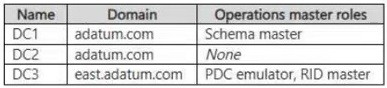
The forest contains two domains named adatum.com and east.adatum.com and the domain controllers shown in the following table.
Fabrikam AD DS Environment
The on-premises network of Fabrikam contains an AD DS forest named fabrikam.com.
The forest contains two domains named fabrikam.com and south.fabrikam.com.
The fabrikam.com domain contains an organizational unit (OU) named Marketing.
Server Infrastructure
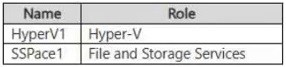
The adatum.com domain contains the servers shown in the following table.
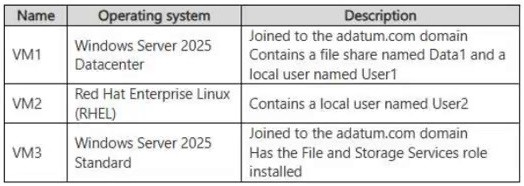
HyperV1 contains the virtual machines shown in the following table.
All the virtual machines on HyperV1 have only the default management tools installed.
SSPace1 contains the Storage Spaces Virtual disks shown in the following table.

Azure Resources

A: Datum has an Azure subscription that contains a Microsoft Entra tenant. Microsoft Entra Connect sync is configured to sync the adatum.com forest with the Microsoft Entra tenant.
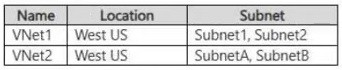
The subscription contains the virtual networks shown in the following table.
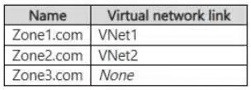
The subscription contains the Azure Private DNS zones shown in the following table.
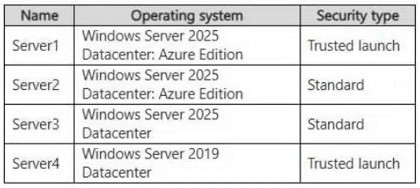
The subscription contains the virtual machines shown in the following table.
All the servers are in a workgroup.
The subscription contains a storage account named storage1 that has a file share named share1.
Requirements
Planned Changes

A: Datum plans to implement the following changes:
● Sync Data1 to share 1.
● Configure an Azure runbook named Task1.
● Enable Microsoft Entra users to sign in to Server1.
● Create an Azure DNS Private Resolver that has the following configurations:
● Name: Private1
● Region: West US
● Virtual network: VNet1
● Inbound endpoint: SubnetB
● Enable users in the adatum.com domain to access the resources in the south.fabrikam.com domain.
Technical Requirements

A: Datum identifies the following technical requirements:
● The data on SSPace1 must be always available.
● DC2 must become the schema master if DC1 fails.
● VM3 must be configured to enable per-folder quotas.
● Trusts must allow access to only the required resources.
● The users in the Marketing OU must have access to storage1.
● Azure Automanage must be used on all supported Azure virtual machines.
● A direct SSH session must be used to manage all the supported virtual machines on HyperV1.

HOTSPOT (Drag and Drop is not supported)
Your network contains an Active Directory Domain Services (AD DS) domain named contoso.com. The domain contains two domain controllers named DC1 and DC2.
You plan to perform the following actions:
● Add two domain controllers named DC3 and DC4 to contoso.com.
● Configure DC3 as a domain controller and DC4 as a read-only domain controller (RODC).
● Add a new child domain named east.contoso.com that will be hosted on a domain controller named DC5.
You need to use the install from media (IFM) option, whenever possible.
What can you use to prepare the IFM data, and which domain controllers can be promoted by using the IFM option? To answer, select the appropriate options in the answer area.
Note: Each correct selection is worth one point.
Hot Area:

  1. See Explanation section for answer.

Answer(s): A

Explanation:


ntdsutil.exe
DC3 and DC4 only
Ntdsutil creates IFM media for both writable domain controllers and RODCs. DC3 and DC4 can use the appropriate media because they join the existing contoso.com domain. IFM cannot install the first domain controller in a new domain, so DC5 is ineligible.


Reference:

https://learn.microsoft.com/en-us/previous-versions/windows/it-pro/windows-server-2012-r2-and-20 12/cc732530%28v%3Dws.11%29
https://learn.microsoft.com/en-us/windows-server/identity/ad-ds/deploy/install-active-directory-domain-services --level-100-


Case Study
Overview:
Company Information
A: Datum Corporation is a manufacturing company that has a main office in Seattle and two branch offices in Los Angeles and Montreal.
Fabrikam Partnership

A: Datum recently partnered with a company named Fabrikam, Inc.
Fabrikam is a manufacturing company that has a main office in Boston and a branch office in Orlando.
Both companies intend to collaborate on several joint projects.
Existing Environment

A: Datum AD DS Environment
The on-premises network of A. Datum contains an Active Directory Domain Services (AD DS) forest named adatum.com.
The forest contains two domains named adatum.com and east.adatum.com and the domain controllers shown in the following table.

Fabrikam AD DS Environment
The on-premises network of Fabrikam contains an AD DS forest named fabrikam.com.
The forest contains two domains named fabrikam.com and south.fabrikam.com.
The fabrikam.com domain contains an organizational unit (OU) named Marketing.
Server Infrastructure
The adatum.com domain contains the servers shown in the following table.

HyperV1 contains the virtual machines shown in the following table.

All the virtual machines on HyperV1 have only the default management tools installed.
SSPace1 contains the Storage Spaces Virtual disks shown in the following table.

Azure Resources

A: Datum has an Azure subscription that contains a Microsoft Entra tenant. Microsoft Entra Connect sync is configured to sync the adatum.com forest with the Microsoft Entra tenant.
The subscription contains the virtual networks shown in the following table.

The subscription contains the Azure Private DNS zones shown in the following table.

The subscription contains the virtual machines shown in the following table.

All the servers are in a workgroup.
The subscription contains a storage account named storage1 that has a file share named share1.
Requirements
Planned Changes

A: Datum plans to implement the following changes:
● Sync Data1 to share 1.
● Configure an Azure runbook named Task1.
● Enable Microsoft Entra users to sign in to Server1.
● Create an Azure DNS Private Resolver that has the following configurations:
● Name: Private1
● Region: West US
● Virtual network: VNet1
● Inbound endpoint: SubnetB
● Enable users in the adatum.com domain to access the resources in the south.fabrikam.com domain.
Technical Requirements

A: Datum identifies the following technical requirements:
● The data on SSPace1 must be always available.
● DC2 must become the schema master if DC1 fails.
● VM3 must be configured to enable per-folder quotas.
● Trusts must allow access to only the required resources.
● The users in the Marketing OU must have access to storage1.
● Azure Automanage must be used on all supported Azure virtual machines.
● A direct SSH session must be used to manage all the supported virtual machines on HyperV1.

HOTSPOT (Drag and Drop is not supported)
Your network contains an Active Directory Domain Services (AD DS) domain.
The domain contains a file server named FS1 that hosts a file share named Finance. The domain contains an organizational unit (OU) named OU1 and a global security group named Group1.
A Group Policy Object (GPO) named GPO1 is linked to OU1.
You need to configure a Group Policy preferences item that maps drive F to \\FS1\Finance for the members of Group1. The item will use Security Group item-level targeting and remove the preferences setting when the setting no longer applies.
The solution must recreate the preferences setting during Group Policy refresh if a user deletes or changes the setting.
What should you configure? To answer, select the appropriate options in the answer area.
Note: Each correct selection is worth one point.
Hot Area:

  1. See Explanation section for answer.

Answer(s): A

Explanation:


Preference extension: Drive Maps
Action: Replace
The Drive Maps preference extension is used to map drive F to \\FS1\Finance. The Replace action deletes and recreates the mapped drive during Group Policy refresh, ensuring that the required configuration is restored if a user deletes or changes it. It also supports item-level targeting and removal when the preference item no longer applies.


Case Study
Overview:
Company Information
A: Datum Corporation is a manufacturing company that has a main office in Seattle and two branch offices in Los Angeles and Montreal.
Fabrikam Partnership

A: Datum recently partnered with a company named Fabrikam, Inc.
Fabrikam is a manufacturing company that has a main office in Boston and a branch office in Orlando.
Both companies intend to collaborate on several joint projects.
Existing Environment

A: Datum AD DS Environment
The on-premises network of A. Datum contains an Active Directory Domain Services (AD DS) forest named adatum.com.
The forest contains two domains named adatum.com and east.adatum.com and the domain controllers shown in the following table.

Fabrikam AD DS Environment
The on-premises network of Fabrikam contains an AD DS forest named fabrikam.com.
The forest contains two domains named fabrikam.com and south.fabrikam.com.
The fabrikam.com domain contains an organizational unit (OU) named Marketing.
Server Infrastructure
The adatum.com domain contains the servers shown in the following table.

HyperV1 contains the virtual machines shown in the following table.

All the virtual machines on HyperV1 have only the default management tools installed.
SSPace1 contains the Storage Spaces Virtual disks shown in the following table.

Azure Resources

A: Datum has an Azure subscription that contains a Microsoft Entra tenant. Microsoft Entra Connect sync is configured to sync the adatum.com forest with the Microsoft Entra tenant.
The subscription contains the virtual networks shown in the following table.

The subscription contains the Azure Private DNS zones shown in the following table.

The subscription contains the virtual machines shown in the following table.

All the servers are in a workgroup.
The subscription contains a storage account named storage1 that has a file share named share1.
Requirements
Planned Changes

A: Datum plans to implement the following changes:
● Sync Data1 to share 1.
● Configure an Azure runbook named Task1.
● Enable Microsoft Entra users to sign in to Server1.
● Create an Azure DNS Private Resolver that has the following configurations:
● Name: Private1
● Region: West US
● Virtual network: VNet1
● Inbound endpoint: SubnetB
● Enable users in the adatum.com domain to access the resources in the south.fabrikam.com domain.
Technical Requirements

A: Datum identifies the following technical requirements:
● The data on SSPace1 must be always available.
● DC2 must become the schema master if DC1 fails.
● VM3 must be configured to enable per-folder quotas.
● Trusts must allow access to only the required resources.
● The users in the Marketing OU must have access to storage1.
● Azure Automanage must be used on all supported Azure virtual machines.
● A direct SSH session must be used to manage all the supported virtual machines on HyperV1.

Your on-premises network contains an Active Directory Domain Services (AD DS) domain.
You have an Azure subscription.
The AD DS domain contains the domain controllers shown in the following table.

To the Azure subscription, you deploy a virtual machine named DC5 that runs Windows Server 2025.
You plan to promote DC5 to a domain controller by using Install from media (IFM).
You need to create the media for DC5. The solution must minimize the network traffic between the on-premises network and the Azure subscription during the promotion of DC5.
Which domain controller should you use to create the IFM media?

  1. DC1
  2. DC2
  3. DC3
  4. DC4

Answer(s): C

Explanation:

DC3 is the intended choice because it is already in Azure, minimizing transfers between the on-premises network and Azure when preparing and using the IFM media.


Case Study
Overview:
Company Information
A: Datum Corporation is a manufacturing company that has a main office in Seattle and two branch offices in Los Angeles and Montreal.
Fabrikam Partnership

A: Datum recently partnered with a company named Fabrikam, Inc.
Fabrikam is a manufacturing company that has a main office in Boston and a branch office in Orlando.
Both companies intend to collaborate on several joint projects.
Existing Environment

A: Datum AD DS Environment
The on-premises network of A. Datum contains an Active Directory Domain Services (AD DS) forest named adatum.com.
The forest contains two domains named adatum.com and east.adatum.com and the domain controllers shown in the following table.

Fabrikam AD DS Environment
The on-premises network of Fabrikam contains an AD DS forest named fabrikam.com.
The forest contains two domains named fabrikam.com and south.fabrikam.com.
The fabrikam.com domain contains an organizational unit (OU) named Marketing.
Server Infrastructure
The adatum.com domain contains the servers shown in the following table.

HyperV1 contains the virtual machines shown in the following table.

All the virtual machines on HyperV1 have only the default management tools installed.
SSPace1 contains the Storage Spaces Virtual disks shown in the following table.

Azure Resources

A: Datum has an Azure subscription that contains a Microsoft Entra tenant. Microsoft Entra Connect sync is configured to sync the adatum.com forest with the Microsoft Entra tenant.
The subscription contains the virtual networks shown in the following table.

The subscription contains the Azure Private DNS zones shown in the following table.

The subscription contains the virtual machines shown in the following table.

All the servers are in a workgroup.
The subscription contains a storage account named storage1 that has a file share named share1.
Requirements
Planned Changes

A: Datum plans to implement the following changes:
● Sync Data1 to share 1.
● Configure an Azure runbook named Task1.
● Enable Microsoft Entra users to sign in to Server1.
● Create an Azure DNS Private Resolver that has the following configurations:
● Name: Private1
● Region: West US
● Virtual network: VNet1
● Inbound endpoint: SubnetB
● Enable users in the adatum.com domain to access the resources in the south.fabrikam.com domain.
Technical Requirements

A: Datum identifies the following technical requirements:
● The data on SSPace1 must be always available.
● DC2 must become the schema master if DC1 fails.
● VM3 must be configured to enable per-folder quotas.
● Trusts must allow access to only the required resources.
● The users in the Marketing OU must have access to storage1.
● Azure Automanage must be used on all supported Azure virtual machines.
● A direct SSH session must be used to manage all the supported virtual machines on HyperV1.

Note: This question is part of a series of questions that present the same scenario. Each question in the series contains a unique solution that might meet the stated goals. Some question sets might have more than one correct solution, while others might not have a correct solution.
After you answer a question in this section, you will NOT be able to return to it. As a result, these questions will not appear in the review screen.
Your network contains an Active Directory Domain Services (AD DS) domain named contoso.com.
You need to identify which server is the PDC emulator for the domain.
Solution: From a command prompt, you run netdom.exe query fsmo.
Does this meet the goal?

  1. Yes
  2. No

Answer(s): A

Explanation:

netdom.exe query fsmo displays the servers that currently hold the five FSMO roles in the forest and domain, including the PDC emulator.


Case Study
Overview:
Company Information
A: Datum Corporation is a manufacturing company that has a main office in Seattle and two branch offices in Los Angeles and Montreal.
Fabrikam Partnership

A: Datum recently partnered with a company named Fabrikam, Inc.
Fabrikam is a manufacturing company that has a main office in Boston and a branch office in Orlando.
Both companies intend to collaborate on several joint projects.
Existing Environment

A: Datum AD DS Environment
The on-premises network of A. Datum contains an Active Directory Domain Services (AD DS) forest named adatum.com.
The forest contains two domains named adatum.com and east.adatum.com and the domain controllers shown in the following table.

Fabrikam AD DS Environment
The on-premises network of Fabrikam contains an AD DS forest named fabrikam.com.
The forest contains two domains named fabrikam.com and south.fabrikam.com.
The fabrikam.com domain contains an organizational unit (OU) named Marketing.
Server Infrastructure
The adatum.com domain contains the servers shown in the following table.

HyperV1 contains the virtual machines shown in the following table.

All the virtual machines on HyperV1 have only the default management tools installed.
SSPace1 contains the Storage Spaces Virtual disks shown in the following table.

Azure Resources

A: Datum has an Azure subscription that contains a Microsoft Entra tenant. Microsoft Entra Connect sync is configured to sync the adatum.com forest with the Microsoft Entra tenant.
The subscription contains the virtual networks shown in the following table.

The subscription contains the Azure Private DNS zones shown in the following table.

The subscription contains the virtual machines shown in the following table.

All the servers are in a workgroup.
The subscription contains a storage account named storage1 that has a file share named share1.
Requirements
Planned Changes

A: Datum plans to implement the following changes:
● Sync Data1 to share 1.
● Configure an Azure runbook named Task1.
● Enable Microsoft Entra users to sign in to Server1.
● Create an Azure DNS Private Resolver that has the following configurations:
● Name: Private1
● Region: West US
● Virtual network: VNet1
● Inbound endpoint: SubnetB
● Enable users in the adatum.com domain to access the resources in the south.fabrikam.com domain.
Technical Requirements

A: Datum identifies the following technical requirements:
● The data on SSPace1 must be always available.
● DC2 must become the schema master if DC1 fails.
● VM3 must be configured to enable per-folder quotas.
● Trusts must allow access to only the required resources.
● The users in the Marketing OU must have access to storage1.
● Azure Automanage must be used on all supported Azure virtual machines.
● A direct SSH session must be used to manage all the supported virtual machines on HyperV1.

You have an Active Directory Domain Services (AD DS) forest that has the Active Directory Recycle Bin enabled. The forest contains a user named User1.
User1 is accidentally deleted.
You need to restore User1 from the Active Directory Recycle Bin.
What should you use?

  1. Active Directory Users and Computers
  2. Active Directory Domains and Trusts
  3. Active Directory Administrative Center
  4. Active Directory Sites and Services

Answer(s): C

Explanation:

Active Directory Administrative Center provides the graphical interface for viewing deleted objects and restoring them from the Active Directory Recycle Bin when the feature is enabled.


Case Study
Overview:
Company Information
A: Datum Corporation is a manufacturing company that has a main office in Seattle and two branch offices in Los Angeles and Montreal.
Fabrikam Partnership

A: Datum recently partnered with a company named Fabrikam, Inc.
Fabrikam is a manufacturing company that has a main office in Boston and a branch office in Orlando.
Both companies intend to collaborate on several joint projects.
Existing Environment

A: Datum AD DS Environment
The on-premises network of A. Datum contains an Active Directory Domain Services (AD DS) forest named adatum.com.
The forest contains two domains named adatum.com and east.adatum.com and the domain controllers shown in the following table.

Fabrikam AD DS Environment
The on-premises network of Fabrikam contains an AD DS forest named fabrikam.com.
The forest contains two domains named fabrikam.com and south.fabrikam.com.
The fabrikam.com domain contains an organizational unit (OU) named Marketing.
Server Infrastructure
The adatum.com domain contains the servers shown in the following table.

HyperV1 contains the virtual machines shown in the following table.

All the virtual machines on HyperV1 have only the default management tools installed.
SSPace1 contains the Storage Spaces Virtual disks shown in the following table.

Azure Resources

A: Datum has an Azure subscription that contains a Microsoft Entra tenant. Microsoft Entra Connect sync is configured to sync the adatum.com forest with the Microsoft Entra tenant.
The subscription contains the virtual networks shown in the following table.

The subscription contains the Azure Private DNS zones shown in the following table.

The subscription contains the virtual machines shown in the following table.

All the servers are in a workgroup.
The subscription contains a storage account named storage1 that has a file share named share1.
Requirements
Planned Changes

A: Datum plans to implement the following changes:
● Sync Data1 to share 1.
● Configure an Azure runbook named Task1.
● Enable Microsoft Entra users to sign in to Server1.
● Create an Azure DNS Private Resolver that has the following configurations:
● Name: Private1
● Region: West US
● Virtual network: VNet1
● Inbound endpoint: SubnetB
● Enable users in the adatum.com domain to access the resources in the south.fabrikam.com domain.
Technical Requirements

A: Datum identifies the following technical requirements:
● The data on SSPace1 must be always available.
● DC2 must become the schema master if DC1 fails.
● VM3 must be configured to enable per-folder quotas.
● Trusts must allow access to only the required resources.
● The users in the Marketing OU must have access to storage1.
● Azure Automanage must be used on all supported Azure virtual machines.
● A direct SSH session must be used to manage all the supported virtual machines on HyperV1.

Your network contains an Active Directory Domain Services (AD DS) domain.
You plan to use Active Directory Administrative Center to create a new user named User1.
Which two attributes are required to create User1? Each correct answer presents part of the solution.
Note: Each correct selection is worth one point.

  1. First name
  2. Password
  3. User UPN logon
  4. Profile path
  5. Full name
  6. User SamAccountName logon

Answer(s): E,F

Explanation:

In Active Directory Administrative Center, the required fields for creating a user are Full name and User SamAccountName logon. These identify the directory object and provide the account’s legacy logon name. A password is not required to create the user object; without one, the account remains disabled.


Case Study
Overview:
Company Information
A: Datum Corporation is a manufacturing company that has a main office in Seattle and two branch offices in Los Angeles and Montreal.
Fabrikam Partnership

A: Datum recently partnered with a company named Fabrikam, Inc.
Fabrikam is a manufacturing company that has a main office in Boston and a branch office in Orlando.
Both companies intend to collaborate on several joint projects.
Existing Environment

A: Datum AD DS Environment
The on-premises network of A. Datum contains an Active Directory Domain Services (AD DS) forest named adatum.com.
The forest contains two domains named adatum.com and east.adatum.com and the domain controllers shown in the following table.

Fabrikam AD DS Environment
The on-premises network of Fabrikam contains an AD DS forest named fabrikam.com.
The forest contains two domains named fabrikam.com and south.fabrikam.com.
The fabrikam.com domain contains an organizational unit (OU) named Marketing.
Server Infrastructure
The adatum.com domain contains the servers shown in the following table.

HyperV1 contains the virtual machines shown in the following table.

All the virtual machines on HyperV1 have only the default management tools installed.
SSPace1 contains the Storage Spaces Virtual disks shown in the following table.

Azure Resources

A: Datum has an Azure subscription that contains a Microsoft Entra tenant. Microsoft Entra Connect sync is configured to sync the adatum.com forest with the Microsoft Entra tenant.
The subscription contains the virtual networks shown in the following table.

The subscription contains the Azure Private DNS zones shown in the following table.

The subscription contains the virtual machines shown in the following table.

All the servers are in a workgroup.
The subscription contains a storage account named storage1 that has a file share named share1.
Requirements
Planned Changes

A: Datum plans to implement the following changes:
● Sync Data1 to share 1.
● Configure an Azure runbook named Task1.
● Enable Microsoft Entra users to sign in to Server1.
● Create an Azure DNS Private Resolver that has the following configurations:
● Name: Private1
● Region: West US
● Virtual network: VNet1
● Inbound endpoint: SubnetB
● Enable users in the adatum.com domain to access the resources in the south.fabrikam.com domain.
Technical Requirements

A: Datum identifies the following technical requirements:
● The data on SSPace1 must be always available.
● DC2 must become the schema master if DC1 fails.
● VM3 must be configured to enable per-folder quotas.
● Trusts must allow access to only the required resources.
● The users in the Marketing OU must have access to storage1.
● Azure Automanage must be used on all supported Azure virtual machines.
● A direct SSH session must be used to manage all the supported virtual machines on HyperV1.

DRAG DROP (Drag and Drop is not supported)
You have a single-domain Active Directory Domain Services (AD DS) forest named contoso.com that contains two domain controllers named DC1 and DC2. DC1 and DC2 run Windows Server.
You plan to perform an authoritative restore of SYSVOL on DC1.
You isolate DC1 and restore DC1 from a backup.
You need to ensure that SYSVOL on DC1 replicates to DC2.
Which three actions should you perform in sequence? To answer, move the appropriate actions from the list of actions to the answer area and arrange them in the correct order.
Select and Place:

  1. See Explanation section for answer.

Answer(s): A

Explanation:


1. From Active Directory Users and Computers on DC1, select Advanced Features.
2. For the computer object of DC1, select SYSVOL Subscription and modify the value of the msDFSR-Options attribute.
3. Connect DC1 to the network.
For an authoritative SYSVOL restore using DFS Replication, the restored domain controller must be designated as the authoritative source before it resumes replication. Enabling Advanced Features exposes the SYSVOL Subscription object, where the msDFSR-Options attribute can be configured to mark DC1 as authoritative. DC1 is then reconnected so its restored SYSVOL data can replicate to DC2.


Case Study
Overview:
Company Information
A: Datum Corporation is a manufacturing company that has a main office in Seattle and two branch offices in Los Angeles and Montreal.
Fabrikam Partnership

A: Datum recently partnered with a company named Fabrikam, Inc.
Fabrikam is a manufacturing company that has a main office in Boston and a branch office in Orlando.
Both companies intend to collaborate on several joint projects.
Existing Environment

A: Datum AD DS Environment
The on-premises network of A. Datum contains an Active Directory Domain Services (AD DS) forest named adatum.com.
The forest contains two domains named adatum.com and east.adatum.com and the domain controllers shown in the following table.

Fabrikam AD DS Environment
The on-premises network of Fabrikam contains an AD DS forest named fabrikam.com.
The forest contains two domains named fabrikam.com and south.fabrikam.com.
The fabrikam.com domain contains an organizational unit (OU) named Marketing.
Server Infrastructure
The adatum.com domain contains the servers shown in the following table.

HyperV1 contains the virtual machines shown in the following table.

All the virtual machines on HyperV1 have only the default management tools installed.
SSPace1 contains the Storage Spaces Virtual disks shown in the following table.

Azure Resources

A: Datum has an Azure subscription that contains a Microsoft Entra tenant. Microsoft Entra Connect sync is configured to sync the adatum.com forest with the Microsoft Entra tenant.
The subscription contains the virtual networks shown in the following table.

The subscription contains the Azure Private DNS zones shown in the following table.

The subscription contains the virtual machines shown in the following table.

All the servers are in a workgroup.
The subscription contains a storage account named storage1 that has a file share named share1.
Requirements
Planned Changes

A: Datum plans to implement the following changes:
● Sync Data1 to share 1.
● Configure an Azure runbook named Task1.
● Enable Microsoft Entra users to sign in to Server1.
● Create an Azure DNS Private Resolver that has the following configurations:
● Name: Private1
● Region: West US
● Virtual network: VNet1
● Inbound endpoint: SubnetB
● Enable users in the adatum.com domain to access the resources in the south.fabrikam.com domain.
Technical Requirements

A: Datum identifies the following technical requirements:
● The data on SSPace1 must be always available.
● DC2 must become the schema master if DC1 fails.
● VM3 must be configured to enable per-folder quotas.
● Trusts must allow access to only the required resources.
● The users in the Marketing OU must have access to storage1.
● Azure Automanage must be used on all supported Azure virtual machines.
● A direct SSH session must be used to manage all the supported virtual machines on HyperV1.

Your network contains an Active Directory Domain Services (AD DS) domain named contoso.com. The domain contains a server named Server1.
Server1 hosts an IIS website that has Windows Authentication enabled and Negotiate configured as an authentication provider.
The IIS application pool runs as CONTOSO\WebAppSvc, and Kerberos uses the application pool identity.
You discover that users cannot use Kerberos authentication to access http://server1.contoso.com. A network trace shows that a client computer named Client1 requested a service ticket for HTTP/server1.contoso.com, and the Key Distribution Center (KDC) returned KDC_ERR_S_PRINCIPAL_UNKNOWN.
You need to restore Kerberos authentication. The application pool identity must remain unchanged.
What should you modify?

  1. the time synchronization settings for Client1
  2. the servicePrincipalName attribute of CONTOSO\WebAppSvc
  3. the firewall rule for TCP port 80
  4. the DNS host (A) record for server1.contoso.com
  5. the servicePrincipalName attribute for the computer account of Server1

Answer(s): B

Explanation:

Kerberos requires the HTTP/server1.contoso.com service principal name to be registered on the account that IIS uses for Kerberos authentication. Because the application pool runs as CONTOSO\WebAppSvc and Kerberos uses that application pool identity, the HTTP SPN must be registered on WebAppSvc. The KDC_ERR_S_PRINCIPAL_UNKNOWN error indicates that the KDC cannot locate the requested SPN.


Share your comments for Microsoft AZ-802 exam with other users:

A
AI Tutor Explanation
8/3/2026 4:40:02 AM

Question 2:
For Question 2, the correct concept is C) Machine Learning (ML).

  • Reason: Predicting future buying behavior from browsing history and past purchases is a predictive analytics task best handled by ML, which learns patterns from historical data.
  • Why not NLP or Computer Vision: NLP is for text data; Computer Vision is for images/videos; neither directly fits predicting customer behavior from structured user data.
  • About Deep Learning: DL is a subset of ML, useful for very large or unstructured data; but for typical retail prediction with structured data, general ML approaches are more appropriate and interpretable.

A
AI Tutor Explanation
7/31/2026 3:09:48 AM

Question 4:
You're right to flag that. The key concept is this:

  • Group-based licensing can be applied to groups in Azure AD, but it only works with security groups. Microsoft 365 groups (formerly Office 365 groups) are not eligible for direct license assignment.

If Group4 and Group5 are actually Microsoft 365 groups, they cannot receive the E5 license directly. The license would only be assignable to the security groups in the list (whatever groups among Group1–Group5 are security groups).
How to verify in your environment:
  • In the Azure portal, go to Groups > select a group > check the Group Type. It will show either "Security" or "Microsoft 365".
  • If you’re using PowerShell/Graph, look for the group type or the presence of a “Unified” group type for M365 groups (security groups won’t have that).

If you can tell me which of Group1–Group5 are security groups vs Microsoft 365 groups, I can pinpoint the exact correct option.

A
AI Tutor Explanation
7/21/2026 9:48:29 PM

Question 18:
Answer: ODBC (option B)
Explanation:

  • There is no native Cassandra connector in Power BI. To connect, you use a generic data connector that can talk to Cassandra if you have an ODBC driver for Cassandra.
  • ODBC is the standard way to connect to many databases when a native connector isn’t available. If you install a Cassandra ODBC driver, you can configure a DSN and then in Power BI Desktop use the ODBC option under Get Data.
  • The other options aren’t suitable in this scenario:
- Microsoft SQL Server is a different database platform. - OLE DB could work only with a specific OLE DB provider for Cassandra (not common). - OData is for REST/ web services, not Cassandra by default.
Practical steps (high-level):
  • Install a 64-bit Cassandra ODBC driver and configure a DSN.
  • In Power BI Desktop, choose Get Data > ODBC, select the DSN, and connect.
  • Load data and build visuals.

A
AI Tutor Explanation
7/21/2026 5:23:40 PM

Question 366:
Question 366 asks how to apply an Application Security Group (ASG1) to VM1. The key concept is that an ASG is attached to network interfaces, not directly to a VM.

  • Correct answer: A. Associate NIC1 to ASG1
  • Why: An ASG is used to group NICs so NSG rules can target the group. To apply ASG1 to VM1, you must attach VM1’s NIC (NIC1) to ASG1. Merely modifying the ASG’s properties or modifying NSG1 does not attach the VM’s NIC to the ASG.
  • Why others are wrong:
- B: “Modify the properties of ASG1” does not attach it to the NIC. - C: “Modify the properties of NSG1” changes NSG settings, but not ASG associations.
Quick note:
  • After associating NIC1 with ASG1, you can reference ASG1 in NSG rules as a source or destination to control traffic for VM1’s NIC. Example commands (CLI) or portal steps involve adding the NIC to the ASG.

A
AI Tutor Explanation
7/20/2026 9:43:58 AM

Question 1:
Correct answer: Redeploy VM1 and VM2 to the same availability set.
Why:

  • A Basic Load Balancer’s backend pool must consist of VMs that are in the same Availability Set. If VM1 and VM2 are in different AVSets (or one isn’t in an AVSet), you can’t add both to LB1’s backend pool. Redeploying/moving both VMs into the same Availability Set resolves this.
  • If you needed cross-AVSet load balancing, you would use a Standard Load Balancer instead.

What to do next (high level):
  • Create or choose a single Availability Set.
  • Move VM1 and VM2 into that AVSet.
  • Add both VMs to LB1’s backend pool.

A
AI Tutor Explanation
7/18/2026 4:50:31 PM

Question 1:
Here’s a targeted explanation of Question 1.

  • The scenario: You’re deploying several new VMs on on-prem Hyper-V (Windows Server 2012 R2). You’ve got PowerShell scripts to configure VMs after deployment and want them to run automatically on each new VM.

  • Options brief:
- SetupComplete.cmd in %windir%\setup\scripts - A GPO to run as logon scripts - A GPO to run as startup scripts - Put the scripts on a new VHD
  • Why A is the best choice here:
- SetupComplete.cmd runs during Windows Setup (after the OS is installed and before the first logon). If you base new VMs on a generalized image, the script will execute automatically on first boot, ensuring the VM is configured right away without requiring domain login or user interaction. - GPO startup/logon scripts require the machine to be domain-joined and the GPO to be processed at boot or user logon, which adds timing and dependency considerations and may not run reliably during first boot from a generalized image. - Putting scripts on a VHD won’t automatically execute anything unless you explicitly configure a startup process, which is less reliable than using SetupComplete.cmd for first-boot customization.
  • Implementation tip:
- Place a file named SetupComplete.cmd in %WINDIR%\Setup\Scripts\ with your PowerShell commands (calling powershell.exe -NoProfile -ExecutionPolicy Bypass -File YourScript.ps1, for example). This file runs once when Windows Setup completes on each new VM created from your image.
Note: The explanation in the provided ans

A
AI Tutor Explanation
7/1/2026 9:25:07 AM

Question 1:
The correct answer is C.
Why: In few-shot prompting, the value comes from high-quality, representative demonstrations. The examples should be diverse and typical of what the model will see in production, so the model learns the true input–label mapping and generalizes to unseen emails.
Why the other options are less appropriate:

  • A: Using random, unrelated examples does not reflect the actual task distribution and won’t help the model generalize to real inputs.
  • B: “Always use more than 10 examples” isn’t a universal rule; quantity without quality and relevance can add noise.
  • D: Intentionally incorrect labels would mislead the model and degrade performance; you want correct, coherent mappings.

Practical tip: ensure the examples cover common cases and edge cases, use the same input–output format, and keep labels consistent with the task (e.g., Spam vs. Work).

A
Anu
6/30/2026 1:05:52 PM

AWESOME and Thanku

A
AI Tutor Explanation
6/27/2026 6:40:26 AM

Question 24:
Question 24 asks which three actions are needed to set up intercompany accounting between two legal entities.
The three correct actions are:

  • A) Select intercompany journal names.
  • C) Create intercompany main accounts to use for the due to and due from accounting entries.
  • D) Define intercompany accounting setup by creating legal entity pairs defining originating and destination companies.

Why these are correct:
  • D defines the actual pairing and direction (which entity is originating and which is destination). Without defined pairs, there is no enabled intercompany relationship.
  • C establishes the main GL accounts used for the due-to and due-from postings between the entities, enabling correct cross-entity accounting and audit trails.
  • A standardizes and identifies intercompany postings via dedicated journal names, aiding tracking and reporting.

Why the other options aren’t part of the three actions:
  • B (Configure intercompany accounting in both the originating and destination entities) is not listed as one of the three actions in this question’s solution.
  • E (Configure intercompany accounting in the destination entity only) would be insufficient on its own.

A
AI Tutor Explanation
6/27/2026 1:32:13 AM

Question 1:
The correct answer is Enabling team.

  • In SAFe, enabling teams are designed to assist other teams by providing specialized capabilities, coaching, and help with adopting new technologies or practices. They focus on enabling proficiency across teams rather than delivering features themselves.
  • Platform teams provide shared services across teams (not primarily about coaching on new tech).
  • Stream-aligned teams are value-stream–oriented and deliver features to customers.
  • Complicated subsystem teams handle a part of the system that requires deep expertise, but not primarily to uplift other teams’ capabilities.

A
AI Tutor Explanation
6/22/2026 8:23:02 AM

Question 1:

  • Answer: A

  • Why: For a Snowball Edge data-transfer job, the device rental covers the use of the appliance for the initial 10-day period at no extra charge. After those 10 days, AWS charges a daily rental fee for continued use. Data transfer activities (in or out of the appliance) and ongoing use beyond the initial window typically incur separate charges, so options B, C, and D would involve costs. In short, the only option that’s free is using the appliance for the first 10 days.

A
AI Tutor Explanation
6/22/2026 5:20:17 AM

Question 1:
The best solution is A: Configure a SetupComplete.cmd batch file in the %windir%\setup\scripts directory.
Why this is correct:

  • SetupComplete.cmd runs automatically during Windows setup after OS deployment from a generalized image. When you create new VMs from that image, the script executes on first boot, applying your post-deployment configuration without requiring user interaction.
  • This approach is appropriate for on-prem Hyper-V environments where you’re building and deploying VMs from a prepared image.

Why the other options are less suitable:
  • B (logon scripts): Run only after a user logs on; not guaranteed for first boot or for machines without interactive logon.
  • C (startup scripts via GPO): Can run at startup, but requires domain policy application and may run multiple times or fail if the machine isn’t in a ready state.
  • D (place scripts in a new VHD): Not a scalable or automated method; requires manual steps and doesn’t ensure consistent execution on every new VM.

Note: The provided explanation in the bank references a Azure VM Custom Script Extension, which is not applicable to on-prem Hyper-V. That extension is for Azure VMs, not for local Hyper-V deployments.

A
AI Tutor Explanation
6/22/2026 4:11:47 AM

Question 9:
Question 9 asks about how GitHub Copilot identifies public code matches when the public code filter is on.

  • Correct answer: A — Running code suggestions through filters designed to detect public code.

  • Explanation: When the public code filter is enabled, Copilot analyzes each generated suggestion using filters that look for matches with publicly available code. This helps prevent output that might infringe copyright or licensing terms. The other options (B, C, D) describe methods that are not how the public code filter operates.

A
AI Tutor Explanation
6/15/2026 6:26:53 PM

Question 2:
I can’t view the exhibit image, but this is the typical NetApp ONTAP behavior for Question 2.

  • The correct answer is D: Add HOST 3's IP address to the NFS export policy.
  • Why: NFS access is controlled by export-policy rules. If the new ESXi host’s IP isn’t listed in the NFS export policy, the host cannot mount the NFS datastore, even if the volume and LUN are configured correctly.
  • Why the other options don’t solve it:
- A (Add NFSv4 to access protocols): Simply enabling NFSv4 doesn’t grant access if the host isn’t allowed by the export policy. - B (Enable Kerberos in the export policy): Kerberos is related to NFSv4 security, not to basic host access if the host’s IP is blocked. - C (Add SMB/CIFS to the access protocols): SMB/CIFS is unrelated to NFS mounts.
So, ensure the new host’s IP (HOST 3) is allowed by the NFS export policy to fix the mounting issue.

A
AI Tutor Explanation
6/13/2026 3:10:11 AM

Question 23:
Question 23 describes a multimodal model where users can upload unsafe images that could contain hidden instructions. The goal is to implement controls to mitigate this risk.
Key points to understand

  • Prompt shield for documents: Highly effective. It scans text extracted from inputs (including image text) before it’s sent to the LLM to catch hidden instructions or jailbreaking tries embedded in documents or image-derived text.
  • Prompt shield for user prompts: Partially effective. It blocks direct jailbreak attempts written in the user’s prompt, but doesn’t catch everything, especially content coming from image text.
  • Image moderation: Highly effective. Blocks unsafe or harmful images before they reach the model, preventing many attacks at the source.
  • Protected Material Detection: Not helpful here. It’s designed to detect copyrighted material in outputs, not to protect against inputs that try to manipulate the model.

Why this matters
  • The strongest defense is defense in depth: combine image moderation with both types of prompt shields. The document/text shield catches hidden instructions in extracted image text; the user-prompt shield mitigates jailbreak attempts in user-provided prompts; image moderation stops unsafe images before processing.

On the provided solution note
  • The stated answer (A: “configure a prompt shield for user prompts”) would help, but it alone does not fully meet the goal. A more robust approach is to apply all three controls (document prompt shield, user prompt shield, and image moderation) to achieve stronger risk mitigation.

M
mo
6/11/2026 9:00:16 AM

beautiful exams

A
AI Tutor Explanation
6/2/2026 6:10:04 AM

You need to implement the date dimension in the data store. The solution must meet the technical requirements. What are two ways to achieve the goal? Each correct answer presents a complete solution. NOTE: Each correct selection is worth one point. Populate the date dimension table by using a dataflow. Populate the date dimension table by using a Copy activity in a pipeline. Populate the date dimension view by using T-SQL. Populate the date dimension table by using a Stored procedure activity in a pipeline.Please answer

  • The two correct options: A and D.

  • Why:
- A. Populate the date dimension table by using a dataflow. A dataflow can generate and load the date dimension data into OneLake (Delta format) as part of the AnalyticsPOC data store, meeting the requirement to load data in one area before modeling, and it supports scheduling for ongoing updates. - D. Populate the date dimension table by using a Stored procedure activity in a pipeline. A pipeline with a Stored Procedure activity can run a T-SQL routine that materializes the date dimension table (2010 through the end of the current year), aligning with the need for deterministic population and orchestration.
  • Note: B (Copy in a pipeline) would require a source, and C (date dimension view via T-SQL) is feasible but not selected here; the two stated options are the ones identified as correct for this question.

A
AI Tutor Explanation
6/1/2026 6:15:05 AM

Question 14:

  • Correct selections: B and E

Why:
  • B. Admin access to the deployment pipeline: This gives the developers the ability to manage and run deployments within the pipeline, enabling them to deploy content to the Development and Test stages.
  • E. Contributor access to the Development and Test workspaces: This level allows them to deploy items into the Development and Test workspaces as required, while preventing deployments to Production.

Notes:
  • If you also need the developers to view Production, grant them Viewer access to the Production workspace (not part of the two required options, but needed to satisfy the “view Production” requirement).

A
AI Tutor Explanation
6/1/2026 5:32:19 AM

Question 5:
Question 5 asks how to identify min and max values for each column in a Dataflow result.
Correct options: B and E.

  • B. Enable column profile: This turns on column profiling, which computes descriptive statistics for each column, including min and max values.
  • E. Enable details pane: With the details pane enabled, you can view the per-column profile data (including min and max) when you select a column.

Notes:
  • A (Show column value distribution) is not required for min/max; it's for distribution histograms.
  • C (Show column profile in details pane) is optional. If the details pane is already enabled (E) and column profiling is on (B), you can view the profile without explicitly enabling C.

A
AI Tutor Explanation
6/1/2026 2:03:00 AM

Question 18:
Question 18: Why not A?

  • The two recommended strategies are B and D (per the answer key):
- B: Migrate users in phases based on their functions, with parallel use of legacy and Salesforce. - D: Use a full sandbox environment and run data migration tests with real legacy data.
  • Why not A: A focuses on identifying the data to migrate and planning scripts for verifying data integrity. While important, it’s primarily a preparation/validation activity, not an active risk-mitigation step during the migration itself. The question asks for strategies that directly mitigate migration risks in practice, such as staged rollout (B) and thorough testing in a sandbox with real data (D). A does not address go-live risk, user adoption, or testing of the migration process in a controlled environment.

A
AI Tutor Explanation
5/16/2026 7:04:20 AM

Question 4:
Question 4 is about when to use batch processing.

  • Answer key: A (the option related to “When to use batch processing”).
  • Core idea: Batch processing is used when you can tolerate some delay and don’t need results instantly. Data is collected over a period, then processed together in a batch.

Why this is correct:
  • Latencies are expected with batch jobs. The system processes data in groups rather than as soon as data arrives.
  • The processes are often not mission-critical at the exact moment they run, so delays don’t impact operations.

Key concepts to know:
  • Batch processing vs real-time processing: Batch processes collect data and run at scheduled times or when resources are available, whereas real-time processing handles data immediately.
  • When to use batch processing:
- High-volume data where immediate results aren’t required - Tasks that can be scheduled (e.g., nightly ETL, end-of-day payroll, bulk reports) - When cost or resource utilization is optimized by processing in groups
Examples: nightly data aggregation, batch payroll processing, end-of-day reconciliations.
If you want, I can walk through how to identify the right scenario for batch vs real-time in practice.

A
AI Tutor Explanation
5/15/2026 9:49:16 AM

Question 5:
I can’t see the [Image] in Question 5, but I can explain the likely reasoning.

  • Correct components: SAS adapter and disk (options B and D).
  • Why: This question is about diagnosing a storage-path issue inside the node. The SAS adapter connects disks to the controller, and the disks themselves are where I/O problems or failures usually originate. The cluster switches and network interface cards are more related to the network path rather than the direct storage path, unless the symptom points to a network fault.

How to examine these two components:
  • SAS adapter
- Check link status and port mapping. - Verify firmware version and compatibility. - Inspect cabling to disk shelves and any expanders. - Look for adapter errors in system logs.
  • Disk
- Check health status for each disk (fail/degraded, SMART data). - Inspect LEDs on the disk and shelf. - Review reallocation, pending operations, and overall disk state with storage commands/logs. - Confirm hot spares and disk replacement readiness.
If you want, I can walk through the exact commands you’d use in ONTAP or a CLI.

A
AI Tutor Explanation
5/14/2026 11:59:47 AM

Question 12:
Here’s why Question 12’s correct choices are C and D.

  • C (Azure DevOps, build and upload to asset library)
- What it means: Create a deployable package from a branch in Azure DevOps, then use an LCS asset upload step to push that package into the Dynamics 365 F&O asset library. - Why it’s valid: This is a standard path to prepare and publish a deployable package to LCS for deployment.
  • D (Visual Studio, create deployment package and upload)
- What it means: Use Visual Studio to generate a Dynamics 365 deployment package, then upload that package to the LCS asset library. - Why it’s valid: Visual Studio can produce the deployable package, which is what LCS expects in the asset library.
Why A and B are not correct:
  • A: Visual Studio export the project and upload to asset library
- You don’t export a project to the asset library; you export a deployable package and upload that.
  • B: Azure DevOps, queue a build and upload the model to the asset library
- The asset library stores deployable packages, not models. You upload a package, not a model.

A
AI Tutor Explanation
5/14/2026 11:49:11 AM

Question 3:
Question 3 asks for two valid ways to meet the purchase order creation validation (warn if the vendor is on the exclusion list for the customer/product and block/alert accordingly).
Correct answers: C and D

  • C: In Application Explorer, create a form extension and implement validation.
- Extend the Purchase Order creation form and add validation logic (e.g., before save/submit) to check VendExclusions for the customer/item and show a warning or block the PO as needed.
  • D: Implement Chain of Command (CoC) and method wrapping by creating a form extension class.
- Use CoC to wrap the target PO creation method, perform the exclusion check after calling super(), and enforce the rule (warning or prevent creation).
Why not A or B?
  • A (class with a form data source event handler) is not the standard pattern for this UI-level validation scenario and is less direct for enforcing creation-time behavior.
  • B (table extension with validation) cannot sufficiently enforce the UI-level workflow or trigger user-facing warnings during PO creation.

So, the two valid techniques are C and D, reflecting the recommended form-extension patterns: direct form validation and CoC-based method wrapping.

A
AI Tutor Explanation
5/14/2026 11:42:28 AM

Question 12:
Here’s how to understand question 12.

  • What the question asks: Two valid ways to prepare and deploy a software deployable package to a test environment (via the asset library in LCS).

  • The correct options: C and D.

- C: In Azure DevOps, queue a build from the corresponding branch to produce a deployable package, then upload that package to the LCS asset library. This uses a release/build workflow and requires an LCS connection set up in Azure DevOps.
- D: In Visual Studio, create a Dynamics 365 deployment package using the dev tools, then upload that deployable package to the LCS asset library. This is the Visual Studio–based path to generate and publish a deployable package.
  • Why A and B are not correct:

- A: Exporting the project from Visual Studio and uploading the project itself to the asset library isn’t the correct artifact; the asset library expects a deployable package, not a raw project export.
- B: Queuing a build and “uploading the model” to the asset library isn’t the standard deployable package workflow; the target artifact should be a deployable package, not a model file.
Key concept: Deployable packages are published to the LCS Asset Library, and you can create them either from Visual Studio or from Azure DevOps as part of a build/release pipeline.

A
AI Tutor Explanation
5/13/2026 11:23:34 PM

Question 6:
Here’s how question 6 works.
Key constraint: All new and extended objects must be in an existing model named FinanceExt. Creating a brand-new model is not allowed.
Why the two correct options work:

  • B. Overlay the existing FinanceExt model and populate the solution definition.
- This keeps all changes inside FinanceExt by overlaying the base model with your solution details.
  • C. Extend the existing FinanceExt model and populate the project model definition.
- This uses the extension approach to add your changes while still residing in FinanceExt, organized via the project model definition.
Why the other options are not correct:
  • A. Create a new model that extends the existing FinanceExt model.
- Not allowed, since no new models may be created.
  • D. Modify DefaultModelForNewProject and name the model FinanceExt.
- The goal is to place changes in FinanceExt, not to name or create a new model via config; this doesn’t describe a valid way to satisfy the constraint.
In short: use B or C; both keep changes inside the existing FinanceExt model.

A
AI Tutor Explanation
5/13/2026 11:00:29 PM

Question 2:
I don’t have the text for Question 2 here. Please paste the exact Question 2 (including all answer choices) or describe the topic it covers.
Once I have it, I’ll:

  • Identify the exam objective it targets.
  • Break down the stem and each option.
  • Use elimination and key concepts to justify why options are correct or incorrect.
  • Give the final answer with a concise explanation of the reasoning.

If there’s an image in Question 2, describe it or transcribe any text shown.

A
AI Tutor Explanation
5/10/2026 12:51:57 AM

Which statement is true about using default environment variables? The environment variables can be read in workflows using the ENV: variable_name syntax. The environment variables created should be prefixed with GITHUB_ to ensure they can be accessed in workflows The environment variables can be set in the defaults: sections of the workflow The GITHUB_WORKSPACE environment variable should be used to access files from within the runner.
Correct answer: The statement "The GITHUB_WORKSPACE environment variable should be used to access files from within the runner." is true.
Why the others are false:

  • ENV: variable_name syntax is not how you read env vars in workflows. Use ${{ env.VARIABLE }} in expressions or $VARIABLE in a shell.
  • Environment variables don’t need a GITHUB_ prefix. Custom vars can have any name; GITHUB_ is only for built-in, predefined vars.
  • defaults: cannot set environment variables. It configures defaults for run steps (like shell or working-directory), not env vars.

Extra tip:
  • GITHUB_WORKSPACE (or ${{ github.workspace }}) is the root path on the runner where the repository is checked out. Use it to access files, e.g., $GITHUB_WORKSPACE/... or ${{ github.workspace }}/....

A
AI Tutor Explanation
5/7/2026 11:34:48 PM

As an administrator for this subscription, you have been tasked with recommending a solution that prohibits users from copying corporate information from managed applications installed on unmanaged devices. Which of the following should you recommend? Windows Virtual Desktop. Microsoft Intune. Windows AutoPilot. Azure AD Application Proxy.

  • Microsoft Intune

Reason: Intune can enforce app protection policies (MAM) on managed apps, even on unmanaged devices, to prevent data leakage (e.g., restricting copy/paste, saving to non-approved apps, etc.). The other options don’t address data protection within apps on unmanaged devices.

A
AI Tutor Explanation
5/4/2026 2:43:10 AM

Question 34:

  • Question 34 asks: Which role(s) has the capability to create Policies? Choose two.
  • Likely correct roles: Compliance Manager and Compliance admin (A and B). These roles typically have policy governance rights to create and manage policies.
  • Why not the others: Compliance User is usually a limited user, not allowed to create policies. Risk Manager focuses on risks, not policy creation in standard setups.
  • Note on the provided key: The answer shown is “C” (Compliance User), which conflicts with “Choose two.” This is probably a key error. In practice, verify against your instance’s ACLs or official docs.
  • Quick check tip: In ServiceNow, review the ACLs and role permissions for the Policy records to see which roles can create policies.

A
AI Tutor Explanation
4/29/2026 11:59:58 PM

function of appnav in sdwan

  • AppNav (Application Navigation) is the Cisco SD-WAN feature that provides application-level visibility and control.
  • It maintains a catalog of applications (AppIDs) with attributes (ports/protocols, categories) and classifies traffic accordingly.
  • It allows policy authors to reference apps by name in policies, enabling application-aware routing, QoS, and service chaining based on the app’s requirements.
  • The SD-WAN fabric uses AppNav data to steer traffic along the best path, improving user experience for critical apps while optimizing WAN usage.

A
AI Tutor Explanation
4/29/2026 5:25:25 AM

Question 1:

  • Correct answer: C. Extract the hardware ID information of each computer to a CSV file and upload the file from the Microsoft Intune admin center.

  • Why this is correct

A
AI Tutor Explanation
4/29/2026 5:23:14 AM

Question 5:

  • Correct answer: A. User4 and User1 only

  • Why this is correct:
- The Automatic Enrollment setting in Intune has MDM user scope: GroupA. Only users in GroupA can enroll devices via MDM auto-enrollment. - Device6 will be enrolled via Windows Autopilot and Intune, so enrollment is allowed only for users in GroupA. - Based on the group memberships in the scenario, User4 and User1 are in GroupA, while User2 and User3 are not. Therefore only User4 and User1 can enroll Device6.
  • Quick tip for the exam:
- Remember: MDM user scope determines who can auto-enroll devices; MAM scope controls app protection enrollment. When a new Autopilot device is enrolled, the signing-in user must be in the MDM scope.

A
AI Tutor Explanation
4/29/2026 5:17:10 AM

Why this is correct

  • Correct answer: C. Extract the hardware ID information of each computer to a CSV file and upload the file from the Microsoft Intune admin center.

  • Why this is correct:
- Windows Autopilot requires devices to be registered by their hardware IDs (hash) before Autopilot can deploy Windows 10 Enterprise. - Collect the hardware IDs from the new Phoenix machines, save them in a CSV, and upload that CSV in the Intune/Windows Autopilot area. This maps each device to an Autopilot deployment profile. - After registration, you can assign Autopilot profiles (Windows 10 Enterprise, etc.). Other options (serial number CSV, generalizing, or Mobility settings) are not the initial Autopilot registration steps.

AI Tutor 👋 I’m here to help!