APMG International Agile Project Management (AgilePM) Practitioner AgilePM-Practitioner Dumps in PDF

Free APMG International AgilePM-Practitioner Real Questions (page: 20)


Overview
Scenario:

Hoy Hall Hotel Refurbishment Project

Note:
Hoy Hall, a historic, timber-framed building dating from the 17th century, was originally the residence of the Lords of the Manor of Hoytown. The building is registered as a Heritage Building of Special Interest and is subject to restrictions in terms of development. Used as a hotel for over a century, it has recently fallen into disrepair, and for two years it has been completely unused, accelerating its deterioration. The local community has formed the Action Group "Hoy for Hoy Hall" to save the building, and wants to be closely involved in its future success.

After much discussion Hoy Hall has been purchased by Architecture Angels (AA), a small company whose directors are experienced hoteliers. Five years ago they decided to move into the property renovation business and have recently restored two other similarly-endangered buildings for use as hotels.

Architecture Angels are keen to both support local businesses and to have local people run their hotels, giving them a significant amount of autonomy to do this. To maintain core consistency, the hotels use Architecture Angels' Head Office services, such as IT operations, accounting, payroll, stocktaking, compliance, human resources and property management. The Head Office is based 80 miles from Hoy Hall.

Recently Architecture Angels commenced an Agile project to renovate Hoy Hall, which has a large downstairs hall and reception area, and 20 potential bedrooms upstairs. The roof requires extensive repairs and the electrical and plumbing installations require complete replacement. The 40 acres of land around the site are overgrown and need to be restored, and the driveway needs re-laying.

In the hotel industry, the trend for direct customer bookings via the internet has had a major impact on the growth of those hotels with this facility. Online booking now accounts for around 80% of room bookings, with only 20% being made via walk-in and telephone enquiries. Before Hoy Hall can open for business, a reservation system must be fully operational.

Architecture Angels use contractors to manage such work and have good relationships with two local companies: Timber Tigers (TT) who will handle the internal works, and Earth Excavations (EE) who will handle the gardens.

A Project Manager, who has since left the company, started the Feasibility phase. This phase has been continued by the Senior Management Team, which consists of the Sales, Marketing, and Finance Directors and the Chief Executive. This was scheduled to take a month and has almost been completed. A Feasibility Assessment has been produced. An Outline Business Case has been completed which assessed the project as being viable.

The Architecture Angels Senior Management Team will be responsible for Steering the project.

The table below shows the appointments planned for the project team and is subject to change.


Additional Information:
The project is approaching the end of Feasibility. The original Project Manager was involved in drafting a Delivery Plan for the project but not in the outline refurbishment options.

The Senior Management Team generated several options for the refurbishment. All the options included a landscaping solution for the gardens and re-laying of the driveway, as the solution will not be acceptable without these. However, the best solution for the refurbishment is still under debate. The new Project Manager has suggested that a Feasibility Prototype could consist of paper-based drawings for each option. The "Hoy for Hoy Hall" Action Group thinks that a physically-built representation is mandatory for a prototype and wants a small-scale model of the recommendation for the building. The time available to produce this, however, is limited.

Contracts for resources have not yet been signed and will be postponed until the chosen outline solution has been agreed.
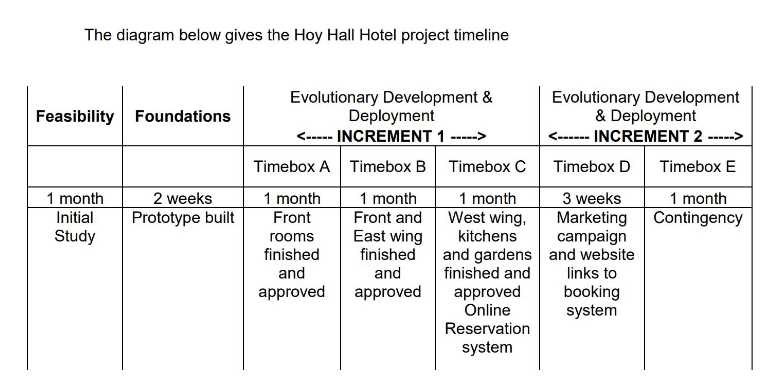


How should the lack of provision of a fire escape from the upstairs of the building in Timebox B initially be dealt with?

  1. The Solution Development Team should revise the Timebox Plans for Timeboxes B and C.
  2. The Solution Development Team should commence understanding and delivering the new requirement.
  3. The Architect, in the role of Technical Co-ordinator, should escalate the issue to Architecture Angels' Senior Management Team.
  4. The Project Manager should escalate the issue to the Marketing Director, who is in the role of Business Visionary.

Answer(s): C

Explanation:

The initial action to deal with the lack of provision of a fire escape from the upstairs of the building in Timebox B should be:
C: The Architect, in the role of Technical Co-ordinator, should escalate the issue to Architecture Angels' Senior Management Team.
This is because the lack of a fire escape is a significant safety concern that could have legal and regulatory implications. It's important that the Senior Management Team is aware of this issue so they can make informed decisions about how to address it. The Architect, in the role of Technical Co- ordinator, is well-positioned to understand the technical implications of this issue and communicate them to the Senior Management Team.
While revising the Timebox Plans (option A) or commencing understanding and delivering the new requirement (option B) could be part of the solution, these actions should be taken after the issue has been escalated and discussed with the Senior Management Team. Escalating the issue to the Marketing Director (option D) may not be the most effective course of action, as this is primarily a technical and safety issue, not a marketing one.


Overview
Scenario:

Hoy Hall Hotel Refurbishment Project

Note:
Hoy Hall, a historic, timber-framed building dating from the 17th century, was originally the residence of the Lords of the Manor of Hoytown. The building is registered as a Heritage Building of Special Interest and is subject to restrictions in terms of development. Used as a hotel for over a century, it has recently fallen into disrepair, and for two years it has been completely unused, accelerating its deterioration. The local community has formed the Action Group "Hoy for Hoy Hall" to save the building, and wants to be closely involved in its future success.

After much discussion Hoy Hall has been purchased by Architecture Angels (AA), a small company whose directors are experienced hoteliers. Five years ago they decided to move into the property renovation business and have recently restored two other similarly-endangered buildings for use as hotels.

Architecture Angels are keen to both support local businesses and to have local people run their hotels, giving them a significant amount of autonomy to do this. To maintain core consistency, the hotels use Architecture Angels' Head Office services, such as IT operations, accounting, payroll, stocktaking, compliance, human resources and property management. The Head Office is based 80 miles from Hoy Hall.

Recently Architecture Angels commenced an Agile project to renovate Hoy Hall, which has a large downstairs hall and reception area, and 20 potential bedrooms upstairs. The roof requires extensive repairs and the electrical and plumbing installations require complete replacement. The 40 acres of land around the site are overgrown and need to be restored, and the driveway needs re-laying.

In the hotel industry, the trend for direct customer bookings via the internet has had a major impact on the growth of those hotels with this facility. Online booking now accounts for around 80% of room bookings, with only 20% being made via walk-in and telephone enquiries. Before Hoy Hall can open for business, a reservation system must be fully operational.

Architecture Angels use contractors to manage such work and have good relationships with two local companies: Timber Tigers (TT) who will handle the internal works, and Earth Excavations (EE) who will handle the gardens.

A Project Manager, who has since left the company, started the Feasibility phase. This phase has been continued by the Senior Management Team, which consists of the Sales, Marketing, and Finance Directors and the Chief Executive. This was scheduled to take a month and has almost been completed. A Feasibility Assessment has been produced. An Outline Business Case has been completed which assessed the project as being viable.

The Architecture Angels Senior Management Team will be responsible for Steering the project.

The table below shows the appointments planned for the project team and is subject to change.


Additional Information:
The project is approaching the end of Feasibility. The original Project Manager was involved in drafting a Delivery Plan for the project but not in the outline refurbishment options.

The Senior Management Team generated several options for the refurbishment. All the options included a landscaping solution for the gardens and re-laying of the driveway, as the solution will not be acceptable without these. However, the best solution for the refurbishment is still under debate. The new Project Manager has suggested that a Feasibility Prototype could consist of paper-based drawings for each option. The "Hoy for Hoy Hall" Action Group thinks that a physically-built representation is mandatory for a prototype and wants a small-scale model of the recommendation for the building. The time available to produce this, however, is limited.

Contracts for resources have not yet been signed and will be postponed until the chosen outline solution has been agreed.


What should be done to allow the requirement for a secondary exit from the upstairs of the building to be changed into a Must Have priority and moved into Timebox B?

  1. The Project Manager should extend the timescale of Timebox B and shorten Timebox C.
  2. The Solution Development Team should change a Must Have requirement into a Should Have in the Prioritised Requirements List.
  3. The Business Visionary, Business Sponsor and Solution Development Team should reassess the Prioritised Requirements List and its priorities.
  4. The Project Manager should move a Must Have requirement from Timebox B into Timebox C.

Answer(s): C

Explanation:

C: The Business Visionary, Business Sponsor and Solution Development Team should reassess the Prioritised Requirements List and its priorities.
Rationale:
In Agile Project Management, priorities are often reassessed and reprioritized based on new information or changes in the project's context. The need for a secondary exit due to compliance with fire safety regulations would necessitate such a reassessment. The Business Visionary and Business Sponsor, who provide the vision and funding for the project, together with the Solution Development Team, who are responsible for implementing solutions, should collaboratively review the Prioritised Requirements List to reflect this new priority. This change must be agreed upon by these key stakeholders to ensure that it aligns with the business needs and project goals.


Overview
Scenario:

Hoy Hall Hotel Refurbishment Project

Note:
Hoy Hall, a historic, timber-framed building dating from the 17th century, was originally the residence of the Lords of the Manor of Hoytown. The building is registered as a Heritage Building of Special Interest and is subject to restrictions in terms of development. Used as a hotel for over a century, it has recently fallen into disrepair, and for two years it has been completely unused, accelerating its deterioration. The local community has formed the Action Group "Hoy for Hoy Hall" to save the building, and wants to be closely involved in its future success.

After much discussion Hoy Hall has been purchased by Architecture Angels (AA), a small company whose directors are experienced hoteliers. Five years ago they decided to move into the property renovation business and have recently restored two other similarly-endangered buildings for use as hotels.

Architecture Angels are keen to both support local businesses and to have local people run their hotels, giving them a significant amount of autonomy to do this. To maintain core consistency, the hotels use Architecture Angels' Head Office services, such as IT operations, accounting, payroll, stocktaking, compliance, human resources and property management. The Head Office is based 80 miles from Hoy Hall.

Recently Architecture Angels commenced an Agile project to renovate Hoy Hall, which has a large downstairs hall and reception area, and 20 potential bedrooms upstairs. The roof requires extensive repairs and the electrical and plumbing installations require complete replacement. The 40 acres of land around the site are overgrown and need to be restored, and the driveway needs re-laying.

In the hotel industry, the trend for direct customer bookings via the internet has had a major impact on the growth of those hotels with this facility. Online booking now accounts for around 80% of room bookings, with only 20% being made via walk-in and telephone enquiries. Before Hoy Hall can open for business, a reservation system must be fully operational.

Architecture Angels use contractors to manage such work and have good relationships with two local companies: Timber Tigers (TT) who will handle the internal works, and Earth Excavations (EE) who will handle the gardens.

A Project Manager, who has since left the company, started the Feasibility phase. This phase has been continued by the Senior Management Team, which consists of the Sales, Marketing, and Finance Directors and the Chief Executive. This was scheduled to take a month and has almost been completed. A Feasibility Assessment has been produced. An Outline Business Case has been completed which assessed the project as being viable.

The Architecture Angels Senior Management Team will be responsible for Steering the project.

The table below shows the appointments planned for the project team and is subject to change.


Additional Information:
The project is approaching the end of Feasibility. The original Project Manager was involved in drafting a Delivery Plan for the project but not in the outline refurbishment options.

The Senior Management Team generated several options for the refurbishment. All the options included a landscaping solution for the gardens and re-laying of the driveway, as the solution will not be acceptable without these. However, the best solution for the refurbishment is still under debate. The new Project Manager has suggested that a Feasibility Prototype could consist of paper-based drawings for each option. The "Hoy for Hoy Hall" Action Group thinks that a physically-built representation is mandatory for a prototype and wants a small-scale model of the recommendation for the building. The time available to produce this, however, is limited.

Contracts for resources have not yet been signed and will be postponed until the chosen outline solution has been agreed.


Who is responsible for approving that the change in priority of the requirement for a secondary exit from the upstairs of the building accurately reflects the scope of the project in the Prioritised Requirements List?

  1. Marketing Director, in the role of Business Visionary.
  2. Project Manager and Solution Development Team.
  3. Project Manager and Architect, in the role of Technical Co-ordinator.
  4. Architecture Angels' Senior Management Team.

Answer(s): D

Explanation:

The Senior Management Team, which includes the roles of the Sales, Marketing, and Finance Directors, and the Chief Executive, is typically responsible for steering the project and making decisions that reflect the overall scope and objectives of the project. They would be the appropriate body to approve changes in the project scope as represented in the Prioritised Requirements List, especially for a requirement that has legal and safety implications, such as a secondary fire exit. This team would ensure that such a change aligns with the strategic goals and compliance requirements of the project.


Overview
Scenario:

Hoy Hall Hotel Refurbishment Project

Note:
Hoy Hall, a historic, timber-framed building dating from the 17th century, was originally the residence of the Lords of the Manor of Hoytown. The building is registered as a Heritage Building of Special Interest and is subject to restrictions in terms of development. Used as a hotel for over a century, it has recently fallen into disrepair, and for two years it has been completely unused, accelerating its deterioration. The local community has formed the Action Group "Hoy for Hoy Hall" to save the building, and wants to be closely involved in its future success.

After much discussion Hoy Hall has been purchased by Architecture Angels (AA), a small company whose directors are experienced hoteliers. Five years ago they decided to move into the property renovation business and have recently restored two other similarly-endangered buildings for use as hotels.

Architecture Angels are keen to both support local businesses and to have local people run their hotels, giving them a significant amount of autonomy to do this. To maintain core consistency, the hotels use Architecture Angels' Head Office services, such as IT operations, accounting, payroll, stocktaking, compliance, human resources and property management. The Head Office is based 80 miles from Hoy Hall.

Recently Architecture Angels commenced an Agile project to renovate Hoy Hall, which has a large downstairs hall and reception area, and 20 potential bedrooms upstairs. The roof requires extensive repairs and the electrical and plumbing installations require complete replacement. The 40 acres of land around the site are overgrown and need to be restored, and the driveway needs re-laying.

In the hotel industry, the trend for direct customer bookings via the internet has had a major impact on the growth of those hotels with this facility. Online booking now accounts for around 80% of room bookings, with only 20% being made via walk-in and telephone enquiries. Before Hoy Hall can open for business, a reservation system must be fully operational.

Architecture Angels use contractors to manage such work and have good relationships with two local companies: Timber Tigers (TT) who will handle the internal works, and Earth Excavations (EE) who will handle the gardens.

A Project Manager, who has since left the company, started the Feasibility phase. This phase has been continued by the Senior Management Team, which consists of the Sales, Marketing, and Finance Directors and the Chief Executive. This was scheduled to take a month and has almost been completed. A Feasibility Assessment has been produced. An Outline Business Case has been completed which assessed the project as being viable.

The Architecture Angels Senior Management Team will be responsible for Steering the project.

The table below shows the appointments planned for the project team and is subject to change.


Additional Information:
The project is approaching the end of Feasibility. The original Project Manager was involved in drafting a Delivery Plan for the project but not in the outline refurbishment options.

The Senior Management Team generated several options for the refurbishment. All the options included a landscaping solution for the gardens and re-laying of the driveway, as the solution will not be acceptable without these. However, the best solution for the refurbishment is still under debate. The new Project Manager has suggested that a Feasibility Prototype could consist of paper-based drawings for each option. The "Hoy for Hoy Hall" Action Group thinks that a physically-built representation is mandatory for a prototype and wants a small-scale model of the recommendation for the building. The time available to produce this, however, is limited.

Contracts for resources have not yet been signed and will be postponed until the chosen outline solution has been agreed.


Once the change of priority has been approved, who is then responsible for including the requirement for a secondary exit from the upstairs of the building to the Timebox Plan for Timebox B?

  1. Marketing Director, in the role of Business Visionary.
  2. Team Leader.
  3. Project Manager and Architect, in the role of Technical Co-ordinator.
  4. Architecture Angels' Senior Management Team.

Answer(s): B


Overview
Scenario:

Hoy Hall Hotel Refurbishment Project

Note:
Hoy Hall, a historic, timber-framed building dating from the 17th century, was originally the residence of the Lords of the Manor of Hoytown. The building is registered as a Heritage Building of Special Interest and is subject to restrictions in terms of development. Used as a hotel for over a century, it has recently fallen into disrepair, and for two years it has been completely unused, accelerating its deterioration. The local community has formed the Action Group "Hoy for Hoy Hall" to save the building, and wants to be closely involved in its future success.

After much discussion Hoy Hall has been purchased by Architecture Angels (AA), a small company whose directors are experienced hoteliers. Five years ago they decided to move into the property renovation business and have recently restored two other similarly-endangered buildings for use as hotels.

Architecture Angels are keen to both support local businesses and to have local people run their hotels, giving them a significant amount of autonomy to do this. To maintain core consistency, the hotels use Architecture Angels' Head Office services, such as IT operations, accounting, payroll, stocktaking, compliance, human resources and property management. The Head Office is based 80 miles from Hoy Hall.

Recently Architecture Angels commenced an Agile project to renovate Hoy Hall, which has a large downstairs hall and reception area, and 20 potential bedrooms upstairs. The roof requires extensive repairs and the electrical and plumbing installations require complete replacement. The 40 acres of land around the site are overgrown and need to be restored, and the driveway needs re-laying.

In the hotel industry, the trend for direct customer bookings via the internet has had a major impact on the growth of those hotels with this facility. Online booking now accounts for around 80% of room bookings, with only 20% being made via walk-in and telephone enquiries. Before Hoy Hall can open for business, a reservation system must be fully operational.

Architecture Angels use contractors to manage such work and have good relationships with two local companies: Timber Tigers (TT) who will handle the internal works, and Earth Excavations (EE) who will handle the gardens.

A Project Manager, who has since left the company, started the Feasibility phase. This phase has been continued by the Senior Management Team, which consists of the Sales, Marketing, and Finance Directors and the Chief Executive. This was scheduled to take a month and has almost been completed. A Feasibility Assessment has been produced. An Outline Business Case has been completed which assessed the project as being viable.

The Architecture Angels Senior Management Team will be responsible for Steering the project.

The table below shows the appointments planned for the project team and is subject to change.


Additional Information:
The project is approaching the end of Feasibility. The original Project Manager was involved in drafting a Delivery Plan for the project but not in the outline refurbishment options.

The Senior Management Team generated several options for the refurbishment. All the options included a landscaping solution for the gardens and re-laying of the driveway, as the solution will not be acceptable without these. However, the best solution for the refurbishment is still under debate. The new Project Manager has suggested that a Feasibility Prototype could consist of paper-based drawings for each option. The "Hoy for Hoy Hall" Action Group thinks that a physically-built representation is mandatory for a prototype and wants a small-scale model of the recommendation for the building. The time available to produce this, however, is limited.

Contracts for resources have not yet been signed and will be postponed until the chosen outline solution has been agreed.


HOTSPOT (Drag and Drop is not supported)

Using the project timeline given in the Project Scenario, answer the following question about application of Timeboxing on the Hoy Hall project.

Lines 1 to 5 in the table below consist of an assertion statement and a reason statement. For each line identify the appropriate option, from options A to E, that applies. Each option can be used once, more than once or not at all.


Assertion :

1. All internal works to be assigned to Timber Tigers throughout the project should be consolidated into one Structured Timebox.

BECAUSE

The Investigation step within each Structured Timebox requires everyone working within the team to jointly agree how the requirements of the Timebox will be met.

2. Acceptance criteria for the front rooms to be developed in Timebox A should be described in detail and agreed during the Timebox Kick-Off

BECAUSE

The aim of the Investigation step within each Timebox is to complete as much of the development work as possible.

3. It is appropriate that both the Evolutionary Development phase and Deployment phase are shown in the first Project Increment.

BECAUSE

Each Timebox should comprise an Evolutionary Development phase and Deployment phase.

4. It is appropriate that the outputs of Timebox C are scheduled for deployment at the end of the first Project Increment.

BECAUSE

A typical Timebox Plan should provide a schedule of high-level activities for the imminent Project Increment.

5. It is appropriate that Earth Excavations create a detailed plan of activities they will complete during Timebox C.

Reason

BECAUSE

The Solution Development Team is responsible for planning the detail of all the work of each Timebox.


  1. See Explanation section for answer.

Answer(s): A

Explanation:

For each line, here is the appropriate option from A to E that applies:
All internal works to be assigned to Timber Tigers throughout the project should be consolidated into one Structured Timebox.
E. False (Assertion) False (Reason)
Rationale: It is not practical or in line with Agile principles to consolidate all internal works into one Structured Timebox, as the work will likely need to be spread over multiple Timeboxes. Additionally, the Investigation step involves agreeing on how to meet the requirements of the Timebox, not necessarily consolidating all work into one.
Acceptance criteria for the front rooms to be developed in Timebox A should be described in detail and agreed during the Timebox Kick-Off
B: True (Assertion) True (Reason) BUT the reason does not explain the assertion Rationale: While it is true that acceptance criteria should be agreed upon during the Timebox Kick- Off, the reason given is incorrect because the aim of the Investigation step is not necessarily to complete as much development work as possible but to plan and understand the work that will be carried out.
It is appropriate that both the Evolutionary Development phase and Deployment phase are shown in the first Project Increment.
A: True (Assertion) True (Reason) AND the reason explains the assertion Rationale: Each Timebox should indeed include both Evolutionary Development and a Deployment phase. This assertion and reason correctly align with the concept of Timeboxing in Agile. It is appropriate that the outputs of Timebox C are scheduled for deployment at the end of the first Project Increment.

A: True (Assertion) True (Reason) AND the reason explains the assertion Rationale: The typical Timebox Plan does provide a schedule of high-level activities for the imminent Project Increment, which would include planning for deployment. It is appropriate that Earth Excavations create a detailed plan of activities they will complete during Timebox C.
C: True (Assertion) False (Reason)
Rationale: While it is true that Earth Excavations should create a detailed plan for their activities in Timebox C, the reason is incorrect as the Solution Development Team is not solely responsible for planning all work details within a Timebox. This task would typically be a collaborative effort involving all relevant parties.


Share your comments for APMG International AgilePM-Practitioner exam with other users:

A
AI Tutor Explanation
5/14/2026 11:42:28 AM

Question 12:
Here’s how to understand question 12.

  • What the question asks: Two valid ways to prepare and deploy a software deployable package to a test environment (via the asset library in LCS).

  • The correct options: C and D.

- C: In Azure DevOps, queue a build from the corresponding branch to produce a deployable package, then upload that package to the LCS asset library. This uses a release/build workflow and requires an LCS connection set up in Azure DevOps.
- D: In Visual Studio, create a Dynamics 365 deployment package using the dev tools, then upload that deployable package to the LCS asset library. This is the Visual Studio–based path to generate and publish a deployable package.
  • Why A and B are not correct:

- A: Exporting the project from Visual Studio and uploading the project itself to the asset library isn’t the correct artifact; the asset library expects a deployable package, not a raw project export.
- B: Queuing a build and “uploading the model” to the asset library isn’t the standard deployable package workflow; the target artifact should be a deployable package, not a model file.
Key concept: Deployable packages are published to the LCS Asset Library, and you can create them either from Visual Studio or from Azure DevOps as part of a build/release pipeline.

A
AI Tutor Explanation
5/13/2026 11:23:34 PM

Question 6:
Here’s how question 6 works.
Key constraint: All new and extended objects must be in an existing model named FinanceExt. Creating a brand-new model is not allowed.
Why the two correct options work:

  • B. Overlay the existing FinanceExt model and populate the solution definition.
- This keeps all changes inside FinanceExt by overlaying the base model with your solution details.
  • C. Extend the existing FinanceExt model and populate the project model definition.
- This uses the extension approach to add your changes while still residing in FinanceExt, organized via the project model definition.
Why the other options are not correct:
  • A. Create a new model that extends the existing FinanceExt model.
- Not allowed, since no new models may be created.
  • D. Modify DefaultModelForNewProject and name the model FinanceExt.
- The goal is to place changes in FinanceExt, not to name or create a new model via config; this doesn’t describe a valid way to satisfy the constraint.
In short: use B or C; both keep changes inside the existing FinanceExt model.

A
AI Tutor Explanation
5/13/2026 11:00:29 PM

Question 2:
I don’t have the text for Question 2 here. Please paste the exact Question 2 (including all answer choices) or describe the topic it covers.
Once I have it, I’ll:

  • Identify the exam objective it targets.
  • Break down the stem and each option.
  • Use elimination and key concepts to justify why options are correct or incorrect.
  • Give the final answer with a concise explanation of the reasoning.

If there’s an image in Question 2, describe it or transcribe any text shown.

A
AI Tutor Explanation
5/10/2026 12:51:57 AM

Which statement is true about using default environment variables? The environment variables can be read in workflows using the ENV: variable_name syntax. The environment variables created should be prefixed with GITHUB_ to ensure they can be accessed in workflows The environment variables can be set in the defaults: sections of the workflow The GITHUB_WORKSPACE environment variable should be used to access files from within the runner.
Correct answer: The statement "The GITHUB_WORKSPACE environment variable should be used to access files from within the runner." is true.
Why the others are false:

  • ENV: variable_name syntax is not how you read env vars in workflows. Use ${{ env.VARIABLE }} in expressions or $VARIABLE in a shell.
  • Environment variables don’t need a GITHUB_ prefix. Custom vars can have any name; GITHUB_ is only for built-in, predefined vars.
  • defaults: cannot set environment variables. It configures defaults for run steps (like shell or working-directory), not env vars.

Extra tip:
  • GITHUB_WORKSPACE (or ${{ github.workspace }}) is the root path on the runner where the repository is checked out. Use it to access files, e.g., $GITHUB_WORKSPACE/... or ${{ github.workspace }}/....

A
AI Tutor Explanation
5/7/2026 11:34:48 PM

As an administrator for this subscription, you have been tasked with recommending a solution that prohibits users from copying corporate information from managed applications installed on unmanaged devices. Which of the following should you recommend? Windows Virtual Desktop. Microsoft Intune. Windows AutoPilot. Azure AD Application Proxy.

  • Microsoft Intune

Reason: Intune can enforce app protection policies (MAM) on managed apps, even on unmanaged devices, to prevent data leakage (e.g., restricting copy/paste, saving to non-approved apps, etc.). The other options don’t address data protection within apps on unmanaged devices.

A
AI Tutor Explanation
5/4/2026 2:43:10 AM

Question 34:

  • Question 34 asks: Which role(s) has the capability to create Policies? Choose two.
  • Likely correct roles: Compliance Manager and Compliance admin (A and B). These roles typically have policy governance rights to create and manage policies.
  • Why not the others: Compliance User is usually a limited user, not allowed to create policies. Risk Manager focuses on risks, not policy creation in standard setups.
  • Note on the provided key: The answer shown is “C” (Compliance User), which conflicts with “Choose two.” This is probably a key error. In practice, verify against your instance’s ACLs or official docs.
  • Quick check tip: In ServiceNow, review the ACLs and role permissions for the Policy records to see which roles can create policies.

A
AI Tutor Explanation
4/29/2026 11:59:58 PM

function of appnav in sdwan

  • AppNav (Application Navigation) is the Cisco SD-WAN feature that provides application-level visibility and control.
  • It maintains a catalog of applications (AppIDs) with attributes (ports/protocols, categories) and classifies traffic accordingly.
  • It allows policy authors to reference apps by name in policies, enabling application-aware routing, QoS, and service chaining based on the app’s requirements.
  • The SD-WAN fabric uses AppNav data to steer traffic along the best path, improving user experience for critical apps while optimizing WAN usage.

A
AI Tutor Explanation
4/29/2026 5:25:25 AM

Question 1:

  • Correct answer: C. Extract the hardware ID information of each computer to a CSV file and upload the file from the Microsoft Intune admin center.

  • Why this is correct

A
AI Tutor Explanation
4/29/2026 5:23:14 AM

Question 5:

  • Correct answer: A. User4 and User1 only

  • Why this is correct:
- The Automatic Enrollment setting in Intune has MDM user scope: GroupA. Only users in GroupA can enroll devices via MDM auto-enrollment. - Device6 will be enrolled via Windows Autopilot and Intune, so enrollment is allowed only for users in GroupA. - Based on the group memberships in the scenario, User4 and User1 are in GroupA, while User2 and User3 are not. Therefore only User4 and User1 can enroll Device6.
  • Quick tip for the exam:
- Remember: MDM user scope determines who can auto-enroll devices; MAM scope controls app protection enrollment. When a new Autopilot device is enrolled, the signing-in user must be in the MDM scope.

A
AI Tutor Explanation
4/29/2026 5:17:10 AM

Why this is correct

  • Correct answer: C. Extract the hardware ID information of each computer to a CSV file and upload the file from the Microsoft Intune admin center.

  • Why this is correct:
- Windows Autopilot requires devices to be registered by their hardware IDs (hash) before Autopilot can deploy Windows 10 Enterprise. - Collect the hardware IDs from the new Phoenix machines, save them in a CSV, and upload that CSV in the Intune/Windows Autopilot area. This maps each device to an Autopilot deployment profile. - After registration, you can assign Autopilot profiles (Windows 10 Enterprise, etc.). Other options (serial number CSV, generalizing, or Mobility settings) are not the initial Autopilot registration steps.

A
AI Tutor Explanation
4/25/2026 1:53:46 PM

Question 7:

  • Correct answer: B — A risk score is computed based on the number of remediations needed compared to the industry peer average.

Explanation:
  • Risk360 uses a remediation-based score. It benchmarks how many actions are required to fix issues against peers, giving a relative risk posture.
  • Why not the others:
- A: Not just total risk events by location. - C: Time to mitigate isn’t the primary scoring method. - D: Not a four-stage breach scoring approach.
Note: The page text shows a mismatch (it lists D as the answer), but the study guide describes the remediation-based scoring (B) as the correct concept.

A
AI Tutor Explanation
4/25/2026 1:42:20 PM

Question 104:

  • Correct answer: D) Multi-Terabyte (TB) Range

  • Brief explanation:
- clustering keys organize data into micro-partitions to improve pruning when queries filter on those columns. - The performance benefit is most significant for very large tables; for small tables the overhead of maintaining clustering outweighs gains. - Therefore, as a best practice, define clustering keys on tables at the TB scale.

C
Community Helper
4/25/2026 2:03:10 AM

Q23: Fabric Admin is correct. Because Domain admin cannot create domains. Only Fabric Admin can among the given options. Q51: Wrapping @pipeline.parameter.param1 inside {} will return a string. But question requires the expression to return Int, so correct answer should be @pipeline.parameter.param1 (no {})

A
AI Tutor Explanation
4/23/2026 3:07:03 PM

Question 62:

  • Correct answer: D (per the page)

  • Note: The explanation text on the page describes option B (use ZDX score and Analyze Score to trigger the Y Engine analysis), indicating a mismatch between the stated answer and the rationale.

  • Key concept: For fast root-cause analysis, leverage telemetry and auto-correlated insights:
- Use the user’s ZDX score for AWS and run Analyze Score to activate the Y Engine, which correlates metrics across network, client, and application to pinpoint the issue quickly.
  • Why the other options are less effective:
- A: Only checks for outages; doesn’t provide actionable root-cause analysis. - C: Deep Trace helps visibility but is manual and time-consuming. - D: Packet capture is invasive and slow; not the quickest path to root cause.

A
AI Tutor Explanation
4/23/2026 12:26:21 PM

Question 32:

  • Answer: A (2.4GHz)

  • Why: Lower-frequency signals have longer wavelengths and experience less attenuation when passing through walls and obstacles. Higher frequencies (5GHz, 6GHz) are more easily blocked by walls. NFC operates over very short distances and is not meant to penetrate walls. So 2.4 GHz best penetrates physical objects like walls.

A
AI Tutor Explanation
4/21/2026 8:48:36 AM

Question 3:

  • False is the correct answer (Option B).

Why:
  • In Snowflake, a database is a metadata object that exists within a single Snowflake account. Accounts are isolated—there isn’t one database that lives in multiple accounts.
  • You can access data across accounts via data sharing or database replication, but these create separate database objects in the other accounts (e.g., a database in the consumer account created from a share), not a single shared database across accounts.

So a single database cannot exist in more than one Snowflake account.

A
Anonymous User
4/16/2026 10:54:18 AM

Question 1:

  • Correct answer: Edate = sys.argv[1]
  • Why this is correct:
- When a Databricks Job passes parameters to a notebook, those parameters are supplied to the notebook's Python process as command-line arguments. The first argument after the script name is sys.argv[1], so date = sys.argv[1] captures the passed date value directly.
  • How it compares to other options:
- date = spark.conf.get("date") reads from Spark config, not from job parameters. - input() waits for user input at runtime, which isn’t how job parameters are provided. - date = dbutils.notebooks.getParam("date") would work if the notebook were invoked via dbutils.notebook.run with parameters, not

A
Anonymous User
4/15/2026 4:42:07 AM

Question 528:

  • Correct answer: NSG flow logs for NSG1 (Option B)

  • Why:
- Traffic Analytics uses NSG flow logs to analyze traffic patterns. You must have NSG flow logs enabled for the NSGs you want to monitor. - An Azure Log Analytics workspace is also required to store and query the traffic data. - Network Watcher must be available in the subscription for traffic analytics to function.
  • What to configure (brief steps):
- Ensure Network Watcher is enabled in the East US region (for the subscription/region). - Enable NSG flow logs on NSG1. - Ensure a Log Analytics workspace exists and is accessible (read/write) so Traffic Analytics can store and query logs.
  • Why other options aren’t correct:
- “Diagnostic settings for VM1” or “Diagnostic settings for NSG1” alone don’t guarantee flow logs are captured and sent to Log Analytics, which Traffic Analytics relies on. - “Insights for VM1” is not how Traffic Analytics collects traffic data.

A
Anonymous User
4/15/2026 2:43:53 AM

Question 23:
The correct answer is Domain admin (option B), not Fabric admin.

  • Domain admin provides domain-level management: create domains/subdomains and assign workspaces within those domains, which matches the tasks while following least privilege.
  • Fabric admin is global-level access and is more privileges than needed for this scenario (it would grant broader control across the Fabric environment).

A
Anonymous User
4/14/2026 12:31:34 PM

Question 2:
For question 2, the key concept is the Longest Prefix Match. Routers pick the route whose subnet mask is the most specific (largest prefix length) that still matches the destination IP.
From the options:

  • A) 10.10.10.0/28 ? 10.10.10.0–10.10.10.15
  • B) 10.10.13.0/25 ? 10.10.13.0–10.10.13.127
  • C) 10.10.13.144/28 ? 10.10.13.144–10.10.13.159
  • D) 10.10.13.208/29 ? 10.10.13.208–10.10.13.215

The destination Host A’s IP must fall within 10.10.13.208–10.10.13.215 for the /29 to be the best match. Since /29 is the longest prefix among the matching options, Router1 will use 10.10.13.208/29.
Thus, the correct answer is D.

S
srameh
4/14/2026 10:09:29 AM

Question 3:

  • Correct answer: Phase 4, Post Accreditation

  • Explanation:
- In DITSCAP, the four phases are: - Phase 1: Definition (concept and requirements) - Phase 2: Verification (design and testing) - Phase 3: Validation (fielding and evaluation) - Phase 4: Post Accreditation (ongoing operations and lifecycle management) - The description—continuing operation of an accredited IT system and addressing changing threats throughout its life cycle—fits the Post Accreditation phase, which covers operations, maintenance, monitoring, and reauthorization as threats and environment evolve.

O
onibokun10
4/13/2026 7:50:14 PM

Question 129:
Correct answer: CNAME

  • A CNAME record creates an alias for a domain, so newapplication.comptia.org will resolve to whatever IP address www.comptia.org resolves to. This ensures both names point to the same resource without duplicating the IP.
  • Why not the others:
- SOA defines authoritative information for a zone. - MX specifies mail exchange servers. - NS designates name servers for a zone.
  • Notes: The alias name (newapplication.comptia.org) should not have other records if you use a CNAME for it, and CNAMEs aren’t used for the zone apex (root) domain. This scenario uses a subdomain, so a CNAME is appropriate.

A
Anonymous User
4/13/2026 6:29:58 PM

Question 1:

  • Correct answer: C

  • Why this is best:
- Uses OS Login with IAM, so SSH access is granted via Google accounts rather than distributing per-user SSH keys. - Granting the compute.osAdminLogin role to a Google group gives admin access to all team members in a centralized, auditable way. - Access is auditable: Cloud Audit Logs show who accessed which VM, satisfying the security requirement to determine who accessed a given instance.
  • How it works:
- Enable OS Login on the project/instances (enable-oslogin metadata). - Add the team’s

A
Anonymous User
4/13/2026 1:00:51 PM

Question 2:

  • Answer: D. Azure Advisor

  • Why: To view security-related recommendations for resources in the Compute and Apps area (including App Service Web Apps and Functions), you use Azure Advisor. Advisor surfaces personalized best-practice recommendations across resources, including security, and shows which resources are affected and the severity.

  • Why not the others:
- Azure Log Analytics is for ad-hoc querying of telemetry, not for viewing security recommendations. - Azure Event Hubs is for streaming telemetry data, not for security recommendations.
  • Quick tip: In the portal, navigate to Azure Advisor and check the Security recommendations for App Services to see actionable items and affe

D
Don
4/11/2026 5:36:42 AM

Recommend using AI for Solutions rather the Answer(s) submitted here

M
Mogae Malapela
4/8/2026 6:37:56 AM

This is very interesting

A
Anon
4/6/2026 5:22:54 PM

Are these the same questions you have to pay for in ExamTopics?

L
LRK
3/22/2026 2:38:08 PM

For Question 7 - while the answer description indicates the correct answer, the option no. mentioned is incorrect. Nice and Comprehensive. Thankyou

R
Rian
3/19/2026 9:12:10 AM

This is very good and accurate. Explanation is very helpful even thou some are not 100% right but good enough to pass.

G
Gerrard
3/18/2026 6:58:37 AM

The DP-900 exam can be tricky if you aren't familiar with Microsoft’s specific cloud terminology. I used the practice questions from free-braindumps.com and found them incredibly helpful. The site breaks down core data concepts and Azure services in a way that actually mirrors the real test. As a resutl I passed my exam.

V
Vineet Kumar
3/6/2026 5:26:16 AM

interesting

J
Joe
1/20/2026 8:25:24 AM

Passed this exam 2 days ago. These questions are in the exam. You are safe to use them.

N
NJ
12/24/2025 10:39:07 AM

Helpful to test your preparedness before giving exam

A
Ashwini
12/17/2025 8:24:45 AM

Really helped

AI Tutor 👋 I’m here to help!