APMG International Agile Project Management (AgilePM) Practitioner AgilePM-Practitioner Dumps in PDF

Free APMG International AgilePM-Practitioner Real Questions (page: 18)


Overview
Scenario:

Hoy Hall Hotel Refurbishment Project

Note:
Hoy Hall, a historic, timber-framed building dating from the 17th century, was originally the residence of the Lords of the Manor of Hoytown. The building is registered as a Heritage Building of Special Interest and is subject to restrictions in terms of development. Used as a hotel for over a century, it has recently fallen into disrepair, and for two years it has been completely unused, accelerating its deterioration. The local community has formed the Action Group "Hoy for Hoy Hall" to save the building, and wants to be closely involved in its future success.

After much discussion Hoy Hall has been purchased by Architecture Angels (AA), a small company whose directors are experienced hoteliers. Five years ago they decided to move into the property renovation business and have recently restored two other similarly-endangered buildings for use as hotels.

Architecture Angels are keen to both support local businesses and to have local people run their hotels, giving them a significant amount of autonomy to do this. To maintain core consistency, the hotels use Architecture Angels' Head Office services, such as IT operations, accounting, payroll, stocktaking, compliance, human resources and property management. The Head Office is based 80 miles from Hoy Hall.

Recently Architecture Angels commenced an Agile project to renovate Hoy Hall, which has a large downstairs hall and reception area, and 20 potential bedrooms upstairs. The roof requires extensive repairs and the electrical and plumbing installations require complete replacement. The 40 acres of land around the site are overgrown and need to be restored, and the driveway needs re-laying.

In the hotel industry, the trend for direct customer bookings via the internet has had a major impact on the growth of those hotels with this facility. Online booking now accounts for around 80% of room bookings, with only 20% being made via walk-in and telephone enquiries. Before Hoy Hall can open for business, a reservation system must be fully operational.

Architecture Angels use contractors to manage such work and have good relationships with two local companies: Timber Tigers (TT) who will handle the internal works, and Earth Excavations (EE) who will handle the gardens.

A Project Manager, who has since left the company, started the Feasibility phase. This phase has been continued by the Senior Management Team, which consists of the Sales, Marketing, and Finance Directors and the Chief Executive. This was scheduled to take a month and has almost been completed. A Feasibility Assessment has been produced. An Outline Business Case has been completed which assessed the project as being viable.

The Architecture Angels Senior Management Team will be responsible for Steering the project.

The table below shows the appointments planned for the project team and is subject to change.


Additional Information:
The project is approaching the end of Feasibility. The original Project Manager was involved in drafting a Delivery Plan for the project but not in the outline refurbishment options.

The Senior Management Team generated several options for the refurbishment. All the options included a landscaping solution for the gardens and re-laying of the driveway, as the solution will not be acceptable without these. However, the best solution for the refurbishment is still under debate. The new Project Manager has suggested that a Feasibility Prototype could consist of paper-based drawings for each option. The "Hoy for Hoy Hall" Action Group thinks that a physically-built representation is mandatory for a prototype and wants a small-scale model of the recommendation for the building. The time available to produce this, however, is limited.

Contracts for resources have not yet been signed and will be postponed until the chosen outline solution has been agreed.
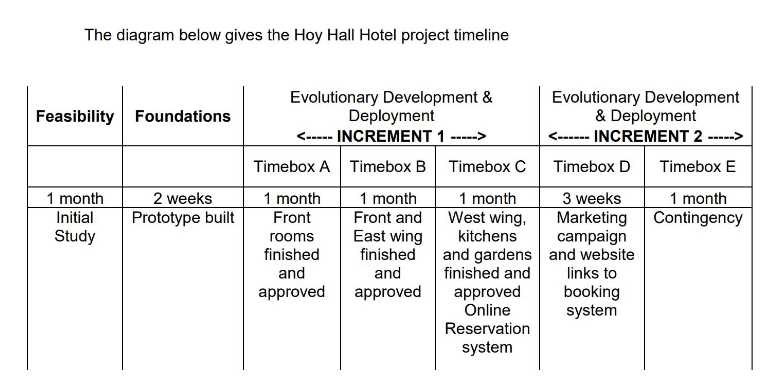


How should the lack of provision of a fire escape from the upstairs of the building in Timebox B initially be dealt with?

  1. The Solution Development Team should revise the Timebox Plans for Timeboxes B and C.
  2. The Solution Development Team should commence understanding and delivering the new requirement.
  3. The Architect, in the role of Technical Co-ordinator, should escalate the issue to Architecture Angels' Senior Management Team.
  4. The Project Manager should escalate the issue to the Marketing Director, who is in the role of Business Visionary.

Answer(s): C

Explanation:

The initial action to deal with the lack of provision of a fire escape from the upstairs of the building in Timebox B should be:
C: The Architect, in the role of Technical Co-ordinator, should escalate the issue to Architecture Angels' Senior Management Team.
This is because the lack of a fire escape is a significant safety concern that could have legal and regulatory implications. It's important that the Senior Management Team is aware of this issue so they can make informed decisions about how to address it. The Architect, in the role of Technical Co- ordinator, is well-positioned to understand the technical implications of this issue and communicate them to the Senior Management Team.
While revising the Timebox Plans (option A) or commencing understanding and delivering the new requirement (option B) could be part of the solution, these actions should be taken after the issue has been escalated and discussed with the Senior Management Team. Escalating the issue to the Marketing Director (option D) may not be the most effective course of action, as this is primarily a technical and safety issue, not a marketing one.


Overview
Scenario:

Hoy Hall Hotel Refurbishment Project

Note:
Hoy Hall, a historic, timber-framed building dating from the 17th century, was originally the residence of the Lords of the Manor of Hoytown. The building is registered as a Heritage Building of Special Interest and is subject to restrictions in terms of development. Used as a hotel for over a century, it has recently fallen into disrepair, and for two years it has been completely unused, accelerating its deterioration. The local community has formed the Action Group "Hoy for Hoy Hall" to save the building, and wants to be closely involved in its future success.

After much discussion Hoy Hall has been purchased by Architecture Angels (AA), a small company whose directors are experienced hoteliers. Five years ago they decided to move into the property renovation business and have recently restored two other similarly-endangered buildings for use as hotels.

Architecture Angels are keen to both support local businesses and to have local people run their hotels, giving them a significant amount of autonomy to do this. To maintain core consistency, the hotels use Architecture Angels' Head Office services, such as IT operations, accounting, payroll, stocktaking, compliance, human resources and property management. The Head Office is based 80 miles from Hoy Hall.

Recently Architecture Angels commenced an Agile project to renovate Hoy Hall, which has a large downstairs hall and reception area, and 20 potential bedrooms upstairs. The roof requires extensive repairs and the electrical and plumbing installations require complete replacement. The 40 acres of land around the site are overgrown and need to be restored, and the driveway needs re-laying.

In the hotel industry, the trend for direct customer bookings via the internet has had a major impact on the growth of those hotels with this facility. Online booking now accounts for around 80% of room bookings, with only 20% being made via walk-in and telephone enquiries. Before Hoy Hall can open for business, a reservation system must be fully operational.

Architecture Angels use contractors to manage such work and have good relationships with two local companies: Timber Tigers (TT) who will handle the internal works, and Earth Excavations (EE) who will handle the gardens.

A Project Manager, who has since left the company, started the Feasibility phase. This phase has been continued by the Senior Management Team, which consists of the Sales, Marketing, and Finance Directors and the Chief Executive. This was scheduled to take a month and has almost been completed. A Feasibility Assessment has been produced. An Outline Business Case has been completed which assessed the project as being viable.

The Architecture Angels Senior Management Team will be responsible for Steering the project.

The table below shows the appointments planned for the project team and is subject to change.


Additional Information:
The project is approaching the end of Feasibility. The original Project Manager was involved in drafting a Delivery Plan for the project but not in the outline refurbishment options.

The Senior Management Team generated several options for the refurbishment. All the options included a landscaping solution for the gardens and re-laying of the driveway, as the solution will not be acceptable without these. However, the best solution for the refurbishment is still under debate. The new Project Manager has suggested that a Feasibility Prototype could consist of paper-based drawings for each option. The "Hoy for Hoy Hall" Action Group thinks that a physically-built representation is mandatory for a prototype and wants a small-scale model of the recommendation for the building. The time available to produce this, however, is limited.

Contracts for resources have not yet been signed and will be postponed until the chosen outline solution has been agreed.


What should be done to allow the requirement for a secondary exit from the upstairs of the building to be changed into a Must Have priority and moved into Timebox B?

  1. The Project Manager should extend the timescale of Timebox B and shorten Timebox C.
  2. The Solution Development Team should change a Must Have requirement into a Should Have in the Prioritised Requirements List.
  3. The Business Visionary, Business Sponsor and Solution Development Team should reassess the Prioritised Requirements List and its priorities.
  4. The Project Manager should move a Must Have requirement from Timebox B into Timebox C.

Answer(s): C

Explanation:

C: The Business Visionary, Business Sponsor and Solution Development Team should reassess the Prioritised Requirements List and its priorities.
Rationale:
In Agile Project Management, priorities are often reassessed and reprioritized based on new information or changes in the project's context. The need for a secondary exit due to compliance with fire safety regulations would necessitate such a reassessment. The Business Visionary and Business Sponsor, who provide the vision and funding for the project, together with the Solution Development Team, who are responsible for implementing solutions, should collaboratively review the Prioritised Requirements List to reflect this new priority. This change must be agreed upon by these key stakeholders to ensure that it aligns with the business needs and project goals.


Overview
Scenario:

Hoy Hall Hotel Refurbishment Project

Note:
Hoy Hall, a historic, timber-framed building dating from the 17th century, was originally the residence of the Lords of the Manor of Hoytown. The building is registered as a Heritage Building of Special Interest and is subject to restrictions in terms of development. Used as a hotel for over a century, it has recently fallen into disrepair, and for two years it has been completely unused, accelerating its deterioration. The local community has formed the Action Group "Hoy for Hoy Hall" to save the building, and wants to be closely involved in its future success.

After much discussion Hoy Hall has been purchased by Architecture Angels (AA), a small company whose directors are experienced hoteliers. Five years ago they decided to move into the property renovation business and have recently restored two other similarly-endangered buildings for use as hotels.

Architecture Angels are keen to both support local businesses and to have local people run their hotels, giving them a significant amount of autonomy to do this. To maintain core consistency, the hotels use Architecture Angels' Head Office services, such as IT operations, accounting, payroll, stocktaking, compliance, human resources and property management. The Head Office is based 80 miles from Hoy Hall.

Recently Architecture Angels commenced an Agile project to renovate Hoy Hall, which has a large downstairs hall and reception area, and 20 potential bedrooms upstairs. The roof requires extensive repairs and the electrical and plumbing installations require complete replacement. The 40 acres of land around the site are overgrown and need to be restored, and the driveway needs re-laying.

In the hotel industry, the trend for direct customer bookings via the internet has had a major impact on the growth of those hotels with this facility. Online booking now accounts for around 80% of room bookings, with only 20% being made via walk-in and telephone enquiries. Before Hoy Hall can open for business, a reservation system must be fully operational.

Architecture Angels use contractors to manage such work and have good relationships with two local companies: Timber Tigers (TT) who will handle the internal works, and Earth Excavations (EE) who will handle the gardens.

A Project Manager, who has since left the company, started the Feasibility phase. This phase has been continued by the Senior Management Team, which consists of the Sales, Marketing, and Finance Directors and the Chief Executive. This was scheduled to take a month and has almost been completed. A Feasibility Assessment has been produced. An Outline Business Case has been completed which assessed the project as being viable.

The Architecture Angels Senior Management Team will be responsible for Steering the project.

The table below shows the appointments planned for the project team and is subject to change.


Additional Information:
The project is approaching the end of Feasibility. The original Project Manager was involved in drafting a Delivery Plan for the project but not in the outline refurbishment options.

The Senior Management Team generated several options for the refurbishment. All the options included a landscaping solution for the gardens and re-laying of the driveway, as the solution will not be acceptable without these. However, the best solution for the refurbishment is still under debate. The new Project Manager has suggested that a Feasibility Prototype could consist of paper-based drawings for each option. The "Hoy for Hoy Hall" Action Group thinks that a physically-built representation is mandatory for a prototype and wants a small-scale model of the recommendation for the building. The time available to produce this, however, is limited.

Contracts for resources have not yet been signed and will be postponed until the chosen outline solution has been agreed.


Who is responsible for approving that the change in priority of the requirement for a secondary exit from the upstairs of the building accurately reflects the scope of the project in the Prioritised Requirements List?

  1. Marketing Director, in the role of Business Visionary.
  2. Project Manager and Solution Development Team.
  3. Project Manager and Architect, in the role of Technical Co-ordinator.
  4. Architecture Angels' Senior Management Team.

Answer(s): D

Explanation:

The Senior Management Team, which includes the roles of the Sales, Marketing, and Finance Directors, and the Chief Executive, is typically responsible for steering the project and making decisions that reflect the overall scope and objectives of the project. They would be the appropriate body to approve changes in the project scope as represented in the Prioritised Requirements List, especially for a requirement that has legal and safety implications, such as a secondary fire exit. This team would ensure that such a change aligns with the strategic goals and compliance requirements of the project.


Overview
Scenario:

Hoy Hall Hotel Refurbishment Project

Note:
Hoy Hall, a historic, timber-framed building dating from the 17th century, was originally the residence of the Lords of the Manor of Hoytown. The building is registered as a Heritage Building of Special Interest and is subject to restrictions in terms of development. Used as a hotel for over a century, it has recently fallen into disrepair, and for two years it has been completely unused, accelerating its deterioration. The local community has formed the Action Group "Hoy for Hoy Hall" to save the building, and wants to be closely involved in its future success.

After much discussion Hoy Hall has been purchased by Architecture Angels (AA), a small company whose directors are experienced hoteliers. Five years ago they decided to move into the property renovation business and have recently restored two other similarly-endangered buildings for use as hotels.

Architecture Angels are keen to both support local businesses and to have local people run their hotels, giving them a significant amount of autonomy to do this. To maintain core consistency, the hotels use Architecture Angels' Head Office services, such as IT operations, accounting, payroll, stocktaking, compliance, human resources and property management. The Head Office is based 80 miles from Hoy Hall.

Recently Architecture Angels commenced an Agile project to renovate Hoy Hall, which has a large downstairs hall and reception area, and 20 potential bedrooms upstairs. The roof requires extensive repairs and the electrical and plumbing installations require complete replacement. The 40 acres of land around the site are overgrown and need to be restored, and the driveway needs re-laying.

In the hotel industry, the trend for direct customer bookings via the internet has had a major impact on the growth of those hotels with this facility. Online booking now accounts for around 80% of room bookings, with only 20% being made via walk-in and telephone enquiries. Before Hoy Hall can open for business, a reservation system must be fully operational.

Architecture Angels use contractors to manage such work and have good relationships with two local companies: Timber Tigers (TT) who will handle the internal works, and Earth Excavations (EE) who will handle the gardens.

A Project Manager, who has since left the company, started the Feasibility phase. This phase has been continued by the Senior Management Team, which consists of the Sales, Marketing, and Finance Directors and the Chief Executive. This was scheduled to take a month and has almost been completed. A Feasibility Assessment has been produced. An Outline Business Case has been completed which assessed the project as being viable.

The Architecture Angels Senior Management Team will be responsible for Steering the project.

The table below shows the appointments planned for the project team and is subject to change.


Additional Information:
The project is approaching the end of Feasibility. The original Project Manager was involved in drafting a Delivery Plan for the project but not in the outline refurbishment options.

The Senior Management Team generated several options for the refurbishment. All the options included a landscaping solution for the gardens and re-laying of the driveway, as the solution will not be acceptable without these. However, the best solution for the refurbishment is still under debate. The new Project Manager has suggested that a Feasibility Prototype could consist of paper-based drawings for each option. The "Hoy for Hoy Hall" Action Group thinks that a physically-built representation is mandatory for a prototype and wants a small-scale model of the recommendation for the building. The time available to produce this, however, is limited.

Contracts for resources have not yet been signed and will be postponed until the chosen outline solution has been agreed.


Once the change of priority has been approved, who is then responsible for including the requirement for a secondary exit from the upstairs of the building to the Timebox Plan for Timebox B?

  1. Marketing Director, in the role of Business Visionary.
  2. Team Leader.
  3. Project Manager and Architect, in the role of Technical Co-ordinator.
  4. Architecture Angels' Senior Management Team.

Answer(s): B


Overview
Scenario:

Hoy Hall Hotel Refurbishment Project

Note:
Hoy Hall, a historic, timber-framed building dating from the 17th century, was originally the residence of the Lords of the Manor of Hoytown. The building is registered as a Heritage Building of Special Interest and is subject to restrictions in terms of development. Used as a hotel for over a century, it has recently fallen into disrepair, and for two years it has been completely unused, accelerating its deterioration. The local community has formed the Action Group "Hoy for Hoy Hall" to save the building, and wants to be closely involved in its future success.

After much discussion Hoy Hall has been purchased by Architecture Angels (AA), a small company whose directors are experienced hoteliers. Five years ago they decided to move into the property renovation business and have recently restored two other similarly-endangered buildings for use as hotels.

Architecture Angels are keen to both support local businesses and to have local people run their hotels, giving them a significant amount of autonomy to do this. To maintain core consistency, the hotels use Architecture Angels' Head Office services, such as IT operations, accounting, payroll, stocktaking, compliance, human resources and property management. The Head Office is based 80 miles from Hoy Hall.

Recently Architecture Angels commenced an Agile project to renovate Hoy Hall, which has a large downstairs hall and reception area, and 20 potential bedrooms upstairs. The roof requires extensive repairs and the electrical and plumbing installations require complete replacement. The 40 acres of land around the site are overgrown and need to be restored, and the driveway needs re-laying.

In the hotel industry, the trend for direct customer bookings via the internet has had a major impact on the growth of those hotels with this facility. Online booking now accounts for around 80% of room bookings, with only 20% being made via walk-in and telephone enquiries. Before Hoy Hall can open for business, a reservation system must be fully operational.

Architecture Angels use contractors to manage such work and have good relationships with two local companies: Timber Tigers (TT) who will handle the internal works, and Earth Excavations (EE) who will handle the gardens.

A Project Manager, who has since left the company, started the Feasibility phase. This phase has been continued by the Senior Management Team, which consists of the Sales, Marketing, and Finance Directors and the Chief Executive. This was scheduled to take a month and has almost been completed. A Feasibility Assessment has been produced. An Outline Business Case has been completed which assessed the project as being viable.

The Architecture Angels Senior Management Team will be responsible for Steering the project.

The table below shows the appointments planned for the project team and is subject to change.


Additional Information:
The project is approaching the end of Feasibility. The original Project Manager was involved in drafting a Delivery Plan for the project but not in the outline refurbishment options.

The Senior Management Team generated several options for the refurbishment. All the options included a landscaping solution for the gardens and re-laying of the driveway, as the solution will not be acceptable without these. However, the best solution for the refurbishment is still under debate. The new Project Manager has suggested that a Feasibility Prototype could consist of paper-based drawings for each option. The "Hoy for Hoy Hall" Action Group thinks that a physically-built representation is mandatory for a prototype and wants a small-scale model of the recommendation for the building. The time available to produce this, however, is limited.

Contracts for resources have not yet been signed and will be postponed until the chosen outline solution has been agreed.


HOTSPOT (Drag and Drop is not supported)

Using the project timeline given in the Project Scenario, answer the following question about application of Timeboxing on the Hoy Hall project.

Lines 1 to 5 in the table below consist of an assertion statement and a reason statement. For each line identify the appropriate option, from options A to E, that applies. Each option can be used once, more than once or not at all.


Assertion :

1. All internal works to be assigned to Timber Tigers throughout the project should be consolidated into one Structured Timebox.

BECAUSE

The Investigation step within each Structured Timebox requires everyone working within the team to jointly agree how the requirements of the Timebox will be met.

2. Acceptance criteria for the front rooms to be developed in Timebox A should be described in detail and agreed during the Timebox Kick-Off

BECAUSE

The aim of the Investigation step within each Timebox is to complete as much of the development work as possible.

3. It is appropriate that both the Evolutionary Development phase and Deployment phase are shown in the first Project Increment.

BECAUSE

Each Timebox should comprise an Evolutionary Development phase and Deployment phase.

4. It is appropriate that the outputs of Timebox C are scheduled for deployment at the end of the first Project Increment.

BECAUSE

A typical Timebox Plan should provide a schedule of high-level activities for the imminent Project Increment.

5. It is appropriate that Earth Excavations create a detailed plan of activities they will complete during Timebox C.

Reason

BECAUSE

The Solution Development Team is responsible for planning the detail of all the work of each Timebox.


  1. See Explanation section for answer.

Answer(s): A

Explanation:

For each line, here is the appropriate option from A to E that applies:
All internal works to be assigned to Timber Tigers throughout the project should be consolidated into one Structured Timebox.
E. False (Assertion) False (Reason)
Rationale: It is not practical or in line with Agile principles to consolidate all internal works into one Structured Timebox, as the work will likely need to be spread over multiple Timeboxes. Additionally, the Investigation step involves agreeing on how to meet the requirements of the Timebox, not necessarily consolidating all work into one.
Acceptance criteria for the front rooms to be developed in Timebox A should be described in detail and agreed during the Timebox Kick-Off
B: True (Assertion) True (Reason) BUT the reason does not explain the assertion Rationale: While it is true that acceptance criteria should be agreed upon during the Timebox Kick- Off, the reason given is incorrect because the aim of the Investigation step is not necessarily to complete as much development work as possible but to plan and understand the work that will be carried out.
It is appropriate that both the Evolutionary Development phase and Deployment phase are shown in the first Project Increment.
A: True (Assertion) True (Reason) AND the reason explains the assertion Rationale: Each Timebox should indeed include both Evolutionary Development and a Deployment phase. This assertion and reason correctly align with the concept of Timeboxing in Agile. It is appropriate that the outputs of Timebox C are scheduled for deployment at the end of the first Project Increment.

A: True (Assertion) True (Reason) AND the reason explains the assertion Rationale: The typical Timebox Plan does provide a schedule of high-level activities for the imminent Project Increment, which would include planning for deployment. It is appropriate that Earth Excavations create a detailed plan of activities they will complete during Timebox C.
C: True (Assertion) False (Reason)
Rationale: While it is true that Earth Excavations should create a detailed plan for their activities in Timebox C, the reason is incorrect as the Solution Development Team is not solely responsible for planning all work details within a Timebox. This task would typically be a collaborative effort involving all relevant parties.


Share your comments for APMG International AgilePM-Practitioner exam with other users:

A
AI Tutor Explanation
9/3/2026 5:25:59 AM

Question 1:
Correct answer: B — Clustering keys
Snowflake automatically organizes table data into micro-partitions and uses natural clustering based on how data is loaded. However, for large tables where query performance depends on particular columns, you can define a clustering key.
A clustering key:

  • Specifies one or more columns or expressions Snowflake should use when organizing table data.
  • Helps Snowflake’s automatic reclustering keep related rows grouped together.
  • Can improve pruning for queries that frequently filter or join on those columns.

Why the others are incorrect:
  • Micro-partitions: Snowflake’s storage units; users do not directly define them as an override mechanism.
  • Key partitions: Not a Snowflake feature.
  • Clustered partitions: Not the name of the customer-defined mechanism.

The answer key’s B is correct.

A
AI Tutor Explanation
9/1/2026 11:22:20 AM

Question 2:
For Question 2, the intended answer is C and D:

  • C. Generate a summary of the key points in your document — clearly supported by Copilot in Word.
  • D. Insert a custom watermark that has specific text and formatting — likely intended to represent Copilot-assisted formatting and visual customization.

A is a standard Word capability: Word can generate a table of contents from heading styles without Copilot. B is also ordinary page-layout formatting.
Important caveat: D is less clearly documented as a dedicated Copilot feature than C. The answer key’s C, D is likely the exam author’s intended selection, but the question is imperfect because watermark creation is traditionally handled through Word’s built-in commands.

A
AI Tutor Explanation
9/1/2026 11:20:15 AM

Question 2:
Question 2 tests what Copilot in Word can do, rather than ordinary Word features.

  • C. Generate a summary of the key points in your document — Correct.
Copilot can analyze a document and provide a concise summary of its main ideas, decisions, or action items.
  • D. Insert a custom watermark — The answer key is questionable.
Word supports watermarks, but inserting a specifically formatted custom watermark is normally a standard Word formatting task—not a documented core Copilot capability. The explanation’s claim that Copilot can “add formatting/visuals” does not clearly establish that it can create custom watermarks.
  • A. Insert a table of contents and B. Customize page margins are also long-standing Word features, generally performed through Word’s commands rather than Copilot.

So, C is clearly valid, but I would not confidently accept D as a reliable Copilot capability. This question may be poorly written or based on a broader interpretation of Copilot’s formatting abilities. The official Microsoft objectives should take priority over this community answer key.

A
AI Tutor Explanation
9/1/2026 4:45:47 AM

Question 25:
Correct answer: A — Read Table3.
Why:

  • Table3 is a managed lakehouse table, so it is exposed through the lakehouse SQL analytics endpoint and can be queried with read-only T-SQL.
  • The SQL endpoint is read-only. Therefore, you cannot update Table3 or any other table through it.
  • A table created as an external Spark table (Table2) isn’t available for querying through the SQL endpoint in this scenario.
  • Although Table1 is a Delta table based on a shortcut, the SQL endpoint does not provide an update operation for shortcut data. In any case, “Update the data in Table1” is invalid because the endpoint is read-only.

Exam rule: Treat the lakehouse SQL endpoint as a read-only relational interface, primarily used to query supported managed Delta tables. Use Spark, pipelines, or other write-capable tools to modify lakehouse data.

A
AI Tutor Explanation
8/28/2026 11:39:56 AM

Question 17:
Correct answer: D — To accommodate a more complex workload.
Increasing a Virtual Warehouse from X-Small to Medium is vertical scaling. The larger warehouse provides more compute resources, which can improve performance for:

  • Complex queries
  • Large scans or joins
  • Resource-intensive transformations
  • Queries involving substantial processing

Why the others are less appropriate:
  • More users / more queries: This usually calls for multi-cluster warehouses, which add clusters to handle concurrency.
  • Fluctuations in workload: This is typically addressed with auto-suspend/auto-resume or multi-cluster scaling, rather than simply choosing a larger warehouse.

Thus, warehouse size primarily affects the compute power available to individual workloads.

A
AI Tutor Explanation
8/28/2026 3:59:41 AM

Question 1:
Correct answer: Buffer overflow (C).
The program copies a user-controlled string into buffer1, which can store only 10 bytes. If the input exceeds that capacity, the extra data may overwrite adjacent memory, such as other variables, control data, or the return address.
That condition is a buffer overflow vulnerability. It can cause:

  • Program crashes or denial of service
  • Corruption of data
  • Potential execution of attacker-controlled code

Why the other options do not fit:
  • SQL injection: Requires unsanitized input being used in a database query.
  • Denial-of-Service: Describes an impact, not the specific vulnerability shown.
  • Cross-site scripting: Involves injecting scripts into web pages viewed by other users.

The key exam clue is copying unrestricted user input into a fixed-size character buffer.

A
AI Tutor Explanation
8/27/2026 12:05:49 AM

Question 5:
The correct answer is A: Prepare the training data.
Even when the data is consistent and uniform, it must be made ready for machine learning. This usually includes:

  • Verifying the data format and schema
  • Selecting relevant features and the target column
  • Handling missing or invalid values, if present
  • Splitting the data into training and evaluation sets
  • Registering or making the data available as an Azure Machine Learning data asset

The typical sequence is:
  1. Prepare the training data
  2. Train the model
  3. Evaluate the model
  4. Tune hyperparameters, if needed
  5. Deploy the model

You cannot reliably train or evaluate a model until the data has been prepared and organized. “Consistent and uniform” reduces cleaning work, but it does not remove the need for preparation.

A
AI Tutor Explanation
8/27/2026 12:00:36 AM

Question 1:
The answer key shows C, but I believe the best answer is A: Provides a scalable platform for developing and deploying generative AI solutions.
Why A is correct:

  • Microsoft Foundry is an enterprise platform aimed mainly at developers, data scientists, and IT teams.
  • It supports the full lifecycle: selecting models, connecting enterprise data, evaluating solutions, deploying applications, and monitoring them.
  • It is designed to scale a generative AI solution from experimentation to production.

Why the other options are weaker:
  • B: You still need to select and configure an appropriate model; Foundry provides model choices rather than eliminating that requirement.
  • C: Business users can use some visual tools, but they are not the primary target audience for building complete solutions.
  • D: Foundry may include low-code or visual experiences, but it is not primarily a low-code platform.

So, A best matches Microsoft Foundry’s central benefit.

A
AI Tutor Explanation
8/26/2026 6:04:00 AM

Question 1:
Correct answers: C and D

  • C. Generate a summary of key insights from your data
Copilot in Excel can analyze a table or dataset, identify trends and outliers, and summarize important findings using natural-language prompts. For example: “Summarize the main trends in this sales data.”
  • D. Build a pivot table based on your data
Copilot can help analyze structured data and create a PivotTable to organize information by categories, totals, or other fields.
Why the other options are less suitable:
  • A. Customize conditional formatting rules — Excel already provides conditional-formatting tools, but highly specific rule customization is generally a standard Excel task rather than a core Copilot capability tested here.
  • B. Insert a custom chart with specific formatting — Copilot can assist with charts and visualizations, but precise, custom formatting is normally completed manually in Excel.

The answer key’s C and D is consistent with Copilot’s main Excel strengths: data analysis and visualization/structured summarization.

A
AI Tutor Explanation
8/24/2026 9:10:14 AM

Question 2:
Answer: B — Add-AzVhd
Add-AzVhd uploads a local, generalized .vhd file to an Azure Storage account as a fixed VHD. This was the traditional process for making an on-premises Hyper-V image available in Azure.
Why the other options are not correct:

  • Add-AzVM creates or configures a virtual machine; it does not upload a VHD.
  • Add-AzImage creates an Azure VM image resource from an existing managed disk or snapshot. It does not upload the local VHD itself.
  • Add-AzImageDataDisk is used for adding data disks to an image, not for uploading the operating-system VHD.

In a complete older workflow, you would typically:
  1. Generalize the VM with Sysprep.
  2. Upload the VHD using Add-AzVhd.
  3. Create an Azure image from that uploaded VHD.

So the answer key’s B is correct for the upload step. Modern Azure deployments commonly use managed images, Azure Compute Gallery, or direct managed-disk upload workflows instead.

A
AI Tutor Explanation
8/24/2026 9:08:47 AM

Question 1:
Correct answer: A — Configure a SetupComplete.cmd file in %windir%\setup\scripts.
SetupComplete.cmd runs automatically near the end of Windows Setup, after the operating system has been installed. It is suitable for running initial configuration scripts on newly deployed VMs.
The batch file can invoke your PowerShell scripts, for example:

cmd 
powershell.exe -ExecutionPolicy Bypass -File C:\Scripts\ConfigureVM.ps1

Why the other options are less suitable:
  • Logon GPO: Runs when a user logs on, so it is not guaranteed to perform initial VM configuration before use.
  • Startup GPO: Runs during startup and may run repeatedly. It also depends on the VM being able to contact the domain.
  • Place scripts in a VHD: Merely storing scripts in a disk does not execute them automatically.

The answer key’s choice A is reasonable, but its explanation is misleading: it discusses the Azure Custom Script Extension, which applies to Azure VMs, while this question describes on-premises Hyper-V VMs.

A
AI Tutor Explanation
8/23/2026 6:47:51 AM

Question 5:
Correct answer: A — The steps
In Value Stream Mapping, you first identify the sequence of steps that work passes through—from the initial request or idea to delivery of value. This establishes the workflow being analyzed.
Once the steps are mapped, the team can then identify:

  • People and roles involved
  • Wait time and processing time
  • Bottlenecks and delays
  • Active Time, Flow Time, and % Complete and Accurate (%C&A)

Why the other options are not first:
  • People who supervise the work: roles are relevant, but they do not define the value flow.
  • Bottlenecks: these are discovered by analyzing the mapped steps and flow data.
  • Active Time, Flow Time, and %C&A: these metrics are collected for the steps after the workflow is understood.

The exam principle is: map the work first, then analyze how efficiently it flows.

A
AI Tutor Explanation
8/20/2026 11:18:56 AM

price
I don’t have current pricing information. The full version provides a larger question bank with verified answers. I can also explain any existing Microsoft Fabric exam question or concept from this page.

A
AI Tutor Explanation
8/19/2026 12:31:46 PM

What are incident response processes?
Incident response processes are the organized steps an organization follows to identify, manage, and recover from a security incident.
Typical stages are:

  1. Preparation – Create policies, response plans, communication procedures, tools, backups, and training.
  2. Detection and analysis – Identify suspicious activity through alerts, logs, monitoring, or user reports, then determine whether an incident occurred and assess its scope.
  3. Containment – Limit the incident’s impact, such as isolating an affected system or blocking malicious traffic.
  4. Eradication – Remove the root cause, such as malware, compromised accounts, or unauthorized persistence.
  5. Recovery – Restore systems to normal operation, validate that they are secure, and monitor for recurrence.
  6. Lessons learned / post-incident activity – Document what happened, preserve evidence, update controls, and improve the response plan.

For the page’s Question 209, Detection is the first active response stage listed among the choices. However, many formal incident-response frameworks place Preparation before detection as part of the overall lifecycle.

A
AI Tutor Explanation
8/17/2026 11:28:11 AM

Question 22:
Correct answer: D — It involves bespoke services with a focus on innovation and growth.
In ITIL, a partnership relationship is a close, strategic relationship between organizations. The parties typically:

  • Collaborate toward shared objectives
  • Adapt services to specific needs rather than using only standardized offerings
  • Focus on long-term value, innovation, and mutual growth
  • Share knowledge, risks, and sometimes investment

Why the other options are less suitable:
  • A: Standardized contracts and operational efficiency are more typical of a transactional supplier relationship.
  • B: A partnership can operate at the strategic level, so excluding strategy is incorrect.
  • C: Commercial off-the-shelf services for many consumers describe a more standardized supplier relationship, not a bespoke partnership.

The key distinction is that partnerships are collaborative and strategic, while ordinary supplier relationships are usually more transactional and standardized.

R
RK
8/17/2026 11:22:18 AM

Valid to test it

A
AI Tutor Explanation
8/17/2026 10:31:48 AM

Question 142:
Correct answer: A — Determining the root cause of the incident
The post-incident review—also called a lessons-learned review—analyzes what happened and why. Determining the root cause helps the organization fix the underlying weakness and prevent recurrence.
Why the other options are less suitable:

  • B: Developing steps to mitigate risks — May result from the review, but mitigation planning is generally part of remediation and corrective action.
  • C: Validating evidence accuracy — Occurs during the investigation, before the post-incident review.
  • D: Reestablishing system configuration — This is part of recovery and restoration.

A useful sequence is:
  1. Investigate and validate evidence.
  2. Contain and eradicate the threat.
  3. Recover systems.
  4. Conduct a post-incident review, including root-cause analysis.

T
Tester
8/17/2026 10:28:35 AM

fdfdfdfdfdfdf

A
AI Tutor Explanation
8/8/2026 9:47:28 AM

Question 26:
Correct answer: C — No, it is the top management’s responsibility to allocate the resources needed for the BCMS.
The answer key shows A, but this appears incorrect.
Under ISO 22301:

  • Top management must demonstrate leadership and commitment to the BCMS.
  • Top management must determine and provide the resources needed to establish, implement, maintain, and continually improve the BCMS.
  • A project manager such as Rebecca may coordinate or distribute resources as part of implementation, but she does not hold the organization’s ultimate responsibility for ensuring those resources are available.

Therefore, Rebecca can perform operational resource allocation, but the formal ISO 22301 responsibility rests with top management.

A
AI Tutor Explanation
8/8/2026 5:49:22 AM

Question 1:
Correct answer: A
The Lambda function should:

  1. Write a structured log entry to CloudWatch Logs containing:
- API operation - Response code - Application version extracted from the User-Agent header
  1. Configure a CloudWatch Logs metric filter to match those log entries and publish a metric.

  1. Use response code and application version as metric dimensions. This lets the company view metrics separately for each application version and response code, such as:
- GetUser / 200 / v2 - GetUser / 500 / v3
Why the other options are incorrect:
  • B: CloudWatch Logs Insights is for querying and analyzing logs; it does not directly populate CloudWatch metrics this way.
  • C: ALB access logs do not automatically contain custom Lambda response metadata in the required form.
  • D: X-Ray Insights is intended for tracing and anomaly analysis, not extracting arbitrary business metrics with these dimensions.

The key concept is using structured application logs plus CloudWatch Logs metric filters to turn log fields into CloudWatch metrics.

A
AI Tutor Explanation
8/7/2026 2:43:45 AM

Question 2:
Question 2 is about tasks that Microsoft 365 Copilot can perform in Word.

  • C. Generate a summary of the key points in your document — Correct.
Copilot can analyze a document and produce a concise summary, key points, action items, or answers about the document’s content.
  • D. Insert a custom watermark with specific text and formatting — Questionable.
The answer key lists D, but Copilot’s documented Word capabilities focus on drafting, rewriting, summarizing, transforming text, and applying general formatting. Creating a precisely customized watermark is normally a standard Word operation, not a clearly documented Copilot task.
  • A. Insert a table of contents — Not a strong Copilot choice.
Word can generate a table of contents automatically from heading styles without Copilot.
  • B. Customize page margins — Not a Copilot-specific task.
This is standard document formatting performed through Word’s layout controls.
Important: The key’s C,D answer appears unreliable. C is clearly correct, but the question may be poorly written if D is intended as the second answer.

S
Samuele
8/6/2026 6:06:02 AM

question 99 solution is wrong, the correct answer is A (Yes) event the explanation conflict with the solution

A
AI Tutor Explanation
8/5/2026 7:26:53 PM

Question 2:
Correct answer: C — Use Amazon Athena directly with Amazon S3.
Athena is a serverless, interactive query service that runs SQL directly against data stored in Amazon S3. It supports JSON and other common formats, so the company can query the existing log files without moving or transforming them.
Why this minimizes operational overhead:

  • No servers or clusters to provision.
  • No data-loading process required.
  • Pay primarily for the data scanned by each query.
  • The existing S3-based architecture remains unchanged.
  • A table definition can be created in Athena, either manually or through the Glue Data Catalog, to describe the JSON structure.

Why the other options are less suitable:
  • A: Redshift requires loading data into a data warehouse and managing additional infrastructure.
  • B: CloudWatch Logs is intended for log collection and monitoring, not direct SQL analysis of existing S3 JSON files.
  • D: Glue plus EMR introduces a data catalog, cluster, and Spark-job management, which is excessive for simple, occasional queries.

The key exam clue is “simple, on-demand queries” + “logs already in S3” + “least operational overhead”—this points to Amazon Athena.

A
AI Tutor Explanation
8/5/2026 7:21:57 PM

Question 802:
Yes—if the port is a trunk carrying 802.1Q VLANs (e.g., a server NIC configured for VLAN tagging), the per-port option is:

  • switch(config-if)# spanning-tree portfast trunk

This applies PortFast to that specific trunk interface.
Notes:
  • For a typical edge/access port (PC), the usual per-interface command is simply switch(config-if)# spanning-tree portfast, but that exact command isn’t in your list.
  • Global default (option A) affects all ports, not just one.
  • PortFast on trunks bypasses some STP protections, so use with caution and consider BPDU Guard where appropriate.

If you want, I can walk through when to prefer portfast on access vs trunk ports and the associated risks.

A
AI Tutor Explanation
8/3/2026 4:40:02 AM

Question 2:
For Question 2, the correct concept is C) Machine Learning (ML).

  • Reason: Predicting future buying behavior from browsing history and past purchases is a predictive analytics task best handled by ML, which learns patterns from historical data.
  • Why not NLP or Computer Vision: NLP is for text data; Computer Vision is for images/videos; neither directly fits predicting customer behavior from structured user data.
  • About Deep Learning: DL is a subset of ML, useful for very large or unstructured data; but for typical retail prediction with structured data, general ML approaches are more appropriate and interpretable.

A
AI Tutor Explanation
7/31/2026 3:09:48 AM

Question 4:
You're right to flag that. The key concept is this:

  • Group-based licensing can be applied to groups in Azure AD, but it only works with security groups. Microsoft 365 groups (formerly Office 365 groups) are not eligible for direct license assignment.

If Group4 and Group5 are actually Microsoft 365 groups, they cannot receive the E5 license directly. The license would only be assignable to the security groups in the list (whatever groups among Group1–Group5 are security groups).
How to verify in your environment:
  • In the Azure portal, go to Groups > select a group > check the Group Type. It will show either "Security" or "Microsoft 365".
  • If you’re using PowerShell/Graph, look for the group type or the presence of a “Unified” group type for M365 groups (security groups won’t have that).

If you can tell me which of Group1–Group5 are security groups vs Microsoft 365 groups, I can pinpoint the exact correct option.

A
AI Tutor Explanation
7/21/2026 9:48:29 PM

Question 18:
Answer: ODBC (option B)
Explanation:

  • There is no native Cassandra connector in Power BI. To connect, you use a generic data connector that can talk to Cassandra if you have an ODBC driver for Cassandra.
  • ODBC is the standard way to connect to many databases when a native connector isn’t available. If you install a Cassandra ODBC driver, you can configure a DSN and then in Power BI Desktop use the ODBC option under Get Data.
  • The other options aren’t suitable in this scenario:
- Microsoft SQL Server is a different database platform. - OLE DB could work only with a specific OLE DB provider for Cassandra (not common). - OData is for REST/ web services, not Cassandra by default.
Practical steps (high-level):
  • Install a 64-bit Cassandra ODBC driver and configure a DSN.
  • In Power BI Desktop, choose Get Data > ODBC, select the DSN, and connect.
  • Load data and build visuals.

A
AI Tutor Explanation
7/21/2026 5:23:40 PM

Question 366:
Question 366 asks how to apply an Application Security Group (ASG1) to VM1. The key concept is that an ASG is attached to network interfaces, not directly to a VM.

  • Correct answer: A. Associate NIC1 to ASG1
  • Why: An ASG is used to group NICs so NSG rules can target the group. To apply ASG1 to VM1, you must attach VM1’s NIC (NIC1) to ASG1. Merely modifying the ASG’s properties or modifying NSG1 does not attach the VM’s NIC to the ASG.
  • Why others are wrong:
- B: “Modify the properties of ASG1” does not attach it to the NIC. - C: “Modify the properties of NSG1” changes NSG settings, but not ASG associations.
Quick note:
  • After associating NIC1 with ASG1, you can reference ASG1 in NSG rules as a source or destination to control traffic for VM1’s NIC. Example commands (CLI) or portal steps involve adding the NIC to the ASG.

A
AI Tutor Explanation
7/20/2026 9:43:58 AM

Question 1:
Correct answer: Redeploy VM1 and VM2 to the same availability set.
Why:

  • A Basic Load Balancer’s backend pool must consist of VMs that are in the same Availability Set. If VM1 and VM2 are in different AVSets (or one isn’t in an AVSet), you can’t add both to LB1’s backend pool. Redeploying/moving both VMs into the same Availability Set resolves this.
  • If you needed cross-AVSet load balancing, you would use a Standard Load Balancer instead.

What to do next (high level):
  • Create or choose a single Availability Set.
  • Move VM1 and VM2 into that AVSet.
  • Add both VMs to LB1’s backend pool.

A
AI Tutor Explanation
7/18/2026 4:50:31 PM

Question 1:
Here’s a targeted explanation of Question 1.

  • The scenario: You’re deploying several new VMs on on-prem Hyper-V (Windows Server 2012 R2). You’ve got PowerShell scripts to configure VMs after deployment and want them to run automatically on each new VM.

  • Options brief:
- SetupComplete.cmd in %windir%\setup\scripts - A GPO to run as logon scripts - A GPO to run as startup scripts - Put the scripts on a new VHD
  • Why A is the best choice here:
- SetupComplete.cmd runs during Windows Setup (after the OS is installed and before the first logon). If you base new VMs on a generalized image, the script will execute automatically on first boot, ensuring the VM is configured right away without requiring domain login or user interaction. - GPO startup/logon scripts require the machine to be domain-joined and the GPO to be processed at boot or user logon, which adds timing and dependency considerations and may not run reliably during first boot from a generalized image. - Putting scripts on a VHD won’t automatically execute anything unless you explicitly configure a startup process, which is less reliable than using SetupComplete.cmd for first-boot customization.
  • Implementation tip:
- Place a file named SetupComplete.cmd in %WINDIR%\Setup\Scripts\ with your PowerShell commands (calling powershell.exe -NoProfile -ExecutionPolicy Bypass -File YourScript.ps1, for example). This file runs once when Windows Setup completes on each new VM created from your image.
Note: The explanation in the provided ans

A
AI Tutor Explanation
7/1/2026 9:25:07 AM

Question 1:
The correct answer is C.
Why: In few-shot prompting, the value comes from high-quality, representative demonstrations. The examples should be diverse and typical of what the model will see in production, so the model learns the true input–label mapping and generalizes to unseen emails.
Why the other options are less appropriate:

  • A: Using random, unrelated examples does not reflect the actual task distribution and won’t help the model generalize to real inputs.
  • B: “Always use more than 10 examples” isn’t a universal rule; quantity without quality and relevance can add noise.
  • D: Intentionally incorrect labels would mislead the model and degrade performance; you want correct, coherent mappings.

Practical tip: ensure the examples cover common cases and edge cases, use the same input–output format, and keep labels consistent with the task (e.g., Spam vs. Work).

A
Anu
6/30/2026 1:05:52 PM

AWESOME and Thanku

A
AI Tutor Explanation
6/27/2026 6:40:26 AM

Question 24:
Question 24 asks which three actions are needed to set up intercompany accounting between two legal entities.
The three correct actions are:

  • A) Select intercompany journal names.
  • C) Create intercompany main accounts to use for the due to and due from accounting entries.
  • D) Define intercompany accounting setup by creating legal entity pairs defining originating and destination companies.

Why these are correct:
  • D defines the actual pairing and direction (which entity is originating and which is destination). Without defined pairs, there is no enabled intercompany relationship.
  • C establishes the main GL accounts used for the due-to and due-from postings between the entities, enabling correct cross-entity accounting and audit trails.
  • A standardizes and identifies intercompany postings via dedicated journal names, aiding tracking and reporting.

Why the other options aren’t part of the three actions:
  • B (Configure intercompany accounting in both the originating and destination entities) is not listed as one of the three actions in this question’s solution.
  • E (Configure intercompany accounting in the destination entity only) would be insufficient on its own.

A
AI Tutor Explanation
6/27/2026 1:32:13 AM

Question 1:
The correct answer is Enabling team.

  • In SAFe, enabling teams are designed to assist other teams by providing specialized capabilities, coaching, and help with adopting new technologies or practices. They focus on enabling proficiency across teams rather than delivering features themselves.
  • Platform teams provide shared services across teams (not primarily about coaching on new tech).
  • Stream-aligned teams are value-stream–oriented and deliver features to customers.
  • Complicated subsystem teams handle a part of the system that requires deep expertise, but not primarily to uplift other teams’ capabilities.

AI Tutor 👋 I’m here to help!