Microsoft SC-401 Exam (page: 1)
Microsoft Administering Information Security in 365
Updated on: 11-Dec-2025

Viewing Page 1 of 27

Case Study

Instructions

This is a case study. Case studies are not timed separately from other exam sections. You can use as much exam time as you would like to complete each case study. However, there might be additional case studies or other exam sections. Manage your time to ensure that you can complete all the exam sections in the time provided. Pay attention to the Exam Progress at the top of the screen so you have sufficient time to complete any exam sections that follow this case study.

To answer the case study questions, you will need to reference information that is provided in the case. Case studies and associated questions might contain exhibits or other resources that provide more information about the scenario described in the case. Information provided in an individual question does not apply to the other questions in the case study.

A Review Screen will appear at the end of this case study. From the Review Screen, you can review and change your answers before you move to the next exam section. After you leave this case study, you will NOT be able to return to it.

To start the case study

To display the first question in this case study, select the "Next" button. To the left of the question, a menu provides links to information such as business requirements, the existing environment, and problem statements. Please read through all this information before answering any questions.
When you are ready to answer a question, select the "Question" button to return to the question.

Overview

Contoso, Ltd. is a consulting company that has a main office in Montreal and three branch offices in Seattle, Boston, and Johannesburg.

Existing Environment

Microsoft 365 Environment

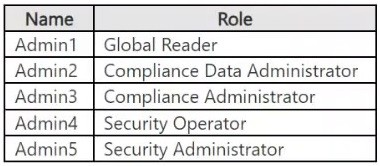
Contoso has a Microsoft 365 E5 tenant. The tenant contains the administrative user accounts shown in the following table.


Users store data in the following locations:

SharePoint sites

OneDrive accounts
Exchange email
Exchange public folders
Teams chats
Teams channel messages

When users in the research department create documents, they must add a 10-digit project code to each document. Project codes that start with the digits 999 are confidential.

SharePoint Online Environment

Contoso has four Microsoft SharePoint Online sites named Site1, Site2, Site3, and Site4.

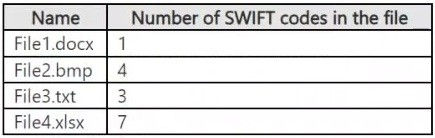
Site2 contains the files shown in the following table.


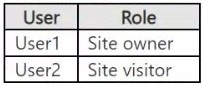
Two users named User1 and User2 are assigned roles for Site2 as shown in the following table.


Site3 stores documents related to the company's projects. The documents are organized in a folder hierarchy based on the project.

Site4 has the following two retention policies applied:

Name: Site4RetentionPolicy1
Locations to apply the policy: Site4
Delete items older than: 2 years
Delete content based on: When items were created

Name: Site4RetentionPolicy2
Locations to apply the policy: Site4
Retain items for a specific period: 4 years
Start the retention period based on: When items were created At the end of the retention period: Do nothing

Problem Statements

Management at Contoso is concerned about data leaks. On several occasions, confidential research department documents were leaked.

Requirements

Planned Changes

Contoso plans to create the following data loss prevention (DLP) policy:

Name: DLPpolicy1
Locations to apply the policy: Site2
Conditions:
Content contains any of these sensitive info types: SWIFT Code Instance count: 2 to any
Actions: Restrict access to the content

Technical Requirements

Contoso must meet the following technical requirements:

All administrative users must be able to review DLP reports.
Whenever possible, the principle of least privilege must be used. For all users, all Microsoft 365 data must be retained for at least one year. Confidential documents must be detected and protected by using Microsoft 365. Site1 documents that include credit card numbers must be labeled automatically. All administrative users must be able to create Microsoft 365 sensitivity labels. After a project is complete, the documents in Site3 that relate to the project must be retained for 10 years.

DRAG DROP (Drag and Drop is not supported)

You need to meet the technical requirements for the Site1 documents.

Which three actions should you perform in sequence? To answer, move the appropriate actions from the list of actions to the answer area and arrange them in the correct order.

Select and Place:

  1. See Explanation section for answer.

Answer(s): A

Explanation:


The goal is to automatically label documents in Site1 that contain credit card numbers. To achieve this, we need a sensitivity label with an auto-labeling policy based on a sensitive info type that detects credit card numbers.

Step 1: Create a Sensitive Info Type
A sensitive info type is needed to detect credit card numbers in documents. Microsoft Purview includes built-in sensitive info types for credit card numbers, but we can also create a custom one if necessary.

Step 2: Create a Sensitivity Label
A sensitivity label is required to classify and protect documents containing sensitive information. This label can apply encryption, watermarking, or access controls to credit card data.

Step 3: Create an Auto-Labeling Policy
An auto-labeling policy ensures that the sensitivity label is applied automatically when credit card numbers are detected in Site1.
This policy is configured to scan files and automatically apply the correct sensitivity label.


Case Study

Instructions

This is a case study. Case studies are not timed separately from other exam sections. You can use as much exam time as you would like to complete each case study. However, there might be additional case studies or other exam sections. Manage your time to ensure that you can complete all the exam sections in the time provided. Pay attention to the Exam Progress at the top of the screen so you have sufficient time to complete any exam sections that follow this case study.

To answer the case study questions, you will need to reference information that is provided in the case. Case studies and associated questions might contain exhibits or other resources that provide more information about the scenario described in the case. Information provided in an individual question does not apply to the other questions in the case study.

A Review Screen will appear at the end of this case study. From the Review Screen, you can review and change your answers before you move to the next exam section. After you leave this case study, you will NOT be able to return to it.

To start the case study

To display the first question in this case study, select the "Next" button. To the left of the question, a menu provides links to information such as business requirements, the existing environment, and problem statements. Please read through all this information before answering any questions.
When you are ready to answer a question, select the "Question" button to return to the question.

Overview

Contoso, Ltd. is a consulting company that has a main office in Montreal and three branch offices in Seattle, Boston, and Johannesburg.

Existing Environment

Microsoft 365 Environment

Contoso has a Microsoft 365 E5 tenant. The tenant contains the administrative user accounts shown in the following table.


Users store data in the following locations:

SharePoint sites

OneDrive accounts
Exchange email
Exchange public folders
Teams chats
Teams channel messages

When users in the research department create documents, they must add a 10-digit project code to each document. Project codes that start with the digits 999 are confidential.

SharePoint Online Environment

Contoso has four Microsoft SharePoint Online sites named Site1, Site2, Site3, and Site4.

Site2 contains the files shown in the following table.


Two users named User1 and User2 are assigned roles for Site2 as shown in the following table.


Site3 stores documents related to the company's projects. The documents are organized in a folder hierarchy based on the project.

Site4 has the following two retention policies applied:

Name: Site4RetentionPolicy1
Locations to apply the policy: Site4
Delete items older than: 2 years
Delete content based on: When items were created

Name: Site4RetentionPolicy2
Locations to apply the policy: Site4
Retain items for a specific period: 4 years
Start the retention period based on: When items were created At the end of the retention period: Do nothing

Problem Statements

Management at Contoso is concerned about data leaks. On several occasions, confidential research department documents were leaked.

Requirements

Planned Changes

Contoso plans to create the following data loss prevention (DLP) policy:

Name: DLPpolicy1
Locations to apply the policy: Site2
Conditions:
Content contains any of these sensitive info types: SWIFT Code Instance count: 2 to any
Actions: Restrict access to the content

Technical Requirements

Contoso must meet the following technical requirements:

All administrative users must be able to review DLP reports.
Whenever possible, the principle of least privilege must be used. For all users, all Microsoft 365 data must be retained for at least one year. Confidential documents must be detected and protected by using Microsoft 365. Site1 documents that include credit card numbers must be labeled automatically. All administrative users must be able to create Microsoft 365 sensitivity labels. After a project is complete, the documents in Site3 that relate to the project must be retained for 10 years.

You need to meet the technical requirements for the creation of the sensitivity labels.

To which user or users must you assign the Sensitivity Label Administrator role?

  1. Admin1 only
  2. Admin1 and Admin4 only
  3. Admin1 and Admin5 only
  4. Admin1, Admin2, and Admin3 only
  5. Admin1, Admin2, Admin4, and Admin5 only

Answer(s): D

Explanation:

To meet the requirement that all administrative users must be able to create Microsoft 365 sensitivity labels, we need to assign the Sensitivity Label Administrator role to the correct users.
Sensitivity Label Administrator Role Responsibilities
This role allows users to:
Create and manage sensitivity labels in Microsoft Purview.
Publish and configure auto-labeling policies.
Modify label encryption and content marking settings.
Review of Admin Roles from the Table:


Users that must be assigned the Sensitivity Label Administrator role:
Admin2 (Compliance Data Administrator)
Admin3 (Compliance Administrator)
Admin1 (Global Reader) (should be assigned this role to fulfill the requirement that all admins can create labels).
Implement information protection
Question Set 2


Case Study

Instructions

This is a case study. Case studies are not timed separately from other exam sections. You can use as much exam time as you would like to complete each case study. However, there might be additional case studies or other exam sections. Manage your time to ensure that you can complete all the exam sections in the time provided. Pay attention to the Exam Progress at the top of the screen so you have sufficient time to complete any exam sections that follow this case study.

To answer the case study questions, you will need to reference information that is provided in the case. Case studies and associated questions might contain exhibits or other resources that provide more information about the scenario described in the case. Information provided in an individual question does not apply to the other questions in the case study.

A Review Screen will appear at the end of this case study. From the Review Screen, you can review and change your answers before you move to the next exam section. After you leave this case study, you will NOT be able to return to it.

To start the case study

To display the first question in this case study, select the "Next" button. To the left of the question, a menu provides links to information such as business requirements, the existing environment, and problem statements. Please read through all this information before answering any questions.
When you are ready to answer a question, select the "Question" button to return to the question.

Overview

Contoso, Ltd. is a consulting company that has a main office in Montreal and three branch offices in Seattle, Boston, and Johannesburg.

Existing Environment

Microsoft 365 Environment

Contoso has a Microsoft 365 E5 tenant. The tenant contains the administrative user accounts shown in the following table.


Users store data in the following locations:

SharePoint sites

OneDrive accounts
Exchange email
Exchange public folders
Teams chats
Teams channel messages

When users in the research department create documents, they must add a 10-digit project code to each document. Project codes that start with the digits 999 are confidential.

SharePoint Online Environment

Contoso has four Microsoft SharePoint Online sites named Site1, Site2, Site3, and Site4.

Site2 contains the files shown in the following table.


Two users named User1 and User2 are assigned roles for Site2 as shown in the following table.


Site3 stores documents related to the company's projects. The documents are organized in a folder hierarchy based on the project.

Site4 has the following two retention policies applied:

Name: Site4RetentionPolicy1
Locations to apply the policy: Site4
Delete items older than: 2 years
Delete content based on: When items were created

Name: Site4RetentionPolicy2
Locations to apply the policy: Site4
Retain items for a specific period: 4 years
Start the retention period based on: When items were created At the end of the retention period: Do nothing

Problem Statements

Management at Contoso is concerned about data leaks. On several occasions, confidential research department documents were leaked.

Requirements

Planned Changes

Contoso plans to create the following data loss prevention (DLP) policy:

Name: DLPpolicy1
Locations to apply the policy: Site2
Conditions:
Content contains any of these sensitive info types: SWIFT Code Instance count: 2 to any
Actions: Restrict access to the content

Technical Requirements

Contoso must meet the following technical requirements:

All administrative users must be able to review DLP reports.
Whenever possible, the principle of least privilege must be used. For all users, all Microsoft 365 data must be retained for at least one year. Confidential documents must be detected and protected by using Microsoft 365. Site1 documents that include credit card numbers must be labeled automatically. All administrative users must be able to create Microsoft 365 sensitivity labels. After a project is complete, the documents in Site3 that relate to the project must be retained for 10 years.

You have a Microsoft 365 E5 subscription that contains a Microsoft Teams channel named Channel1.
Channel1 contains research and development documents.

You plan to implement Microsoft 365 Copilot for the subscription.

You need to prevent the contents of files stored in Channel1 from being included in answers generated by Copilot and shown to unauthorized users.

What should you use?

  1. data loss prevention (DLP)
  2. Microsoft Purview insider risk management
  3. Microsoft Purview Information Barriers (IBs)
  4. sensitivity labels

Answer(s): D

Explanation:

To prevent the contents of files stored in Channel1 from being included in Microsoft 365 Copilot responses and ensure unauthorized users cannot access them, you should use Microsoft Purview Sensitivity Labels.
Sensitivity labels allow you to classify, protect, and restrict access to sensitive files. You can configure label- based encryption and access control policies to ensure that only authorized users can access or interact with the files in Channel1. Microsoft 365 Copilot respects sensitivity labels, meaning if a file is labeled with restricted permissions, Copilot will not use it in generated responses for unauthorized users.


Case Study

Instructions

This is a case study. Case studies are not timed separately from other exam sections. You can use as much exam time as you would like to complete each case study. However, there might be additional case studies or other exam sections. Manage your time to ensure that you can complete all the exam sections in the time provided. Pay attention to the Exam Progress at the top of the screen so you have sufficient time to complete any exam sections that follow this case study.

To answer the case study questions, you will need to reference information that is provided in the case. Case studies and associated questions might contain exhibits or other resources that provide more information about the scenario described in the case. Information provided in an individual question does not apply to the other questions in the case study.

A Review Screen will appear at the end of this case study. From the Review Screen, you can review and change your answers before you move to the next exam section. After you leave this case study, you will NOT be able to return to it.

To start the case study

To display the first question in this case study, select the "Next" button. To the left of the question, a menu provides links to information such as business requirements, the existing environment, and problem statements. Please read through all this information before answering any questions.
When you are ready to answer a question, select the "Question" button to return to the question.

Overview

Contoso, Ltd. is a consulting company that has a main office in Montreal and three branch offices in Seattle, Boston, and Johannesburg.

Existing Environment

Microsoft 365 Environment

Contoso has a Microsoft 365 E5 tenant. The tenant contains the administrative user accounts shown in the following table.


Users store data in the following locations:

SharePoint sites

OneDrive accounts
Exchange email
Exchange public folders
Teams chats
Teams channel messages

When users in the research department create documents, they must add a 10-digit project code to each document. Project codes that start with the digits 999 are confidential.

SharePoint Online Environment

Contoso has four Microsoft SharePoint Online sites named Site1, Site2, Site3, and Site4.

Site2 contains the files shown in the following table.


Two users named User1 and User2 are assigned roles for Site2 as shown in the following table.


Site3 stores documents related to the company's projects. The documents are organized in a folder hierarchy based on the project.

Site4 has the following two retention policies applied:

Name: Site4RetentionPolicy1
Locations to apply the policy: Site4
Delete items older than: 2 years
Delete content based on: When items were created

Name: Site4RetentionPolicy2
Locations to apply the policy: Site4
Retain items for a specific period: 4 years
Start the retention period based on: When items were created At the end of the retention period: Do nothing

Problem Statements

Management at Contoso is concerned about data leaks. On several occasions, confidential research department documents were leaked.

Requirements

Planned Changes

Contoso plans to create the following data loss prevention (DLP) policy:

Name: DLPpolicy1
Locations to apply the policy: Site2
Conditions:
Content contains any of these sensitive info types: SWIFT Code Instance count: 2 to any
Actions: Restrict access to the content

Technical Requirements

Contoso must meet the following technical requirements:

All administrative users must be able to review DLP reports.
Whenever possible, the principle of least privilege must be used. For all users, all Microsoft 365 data must be retained for at least one year. Confidential documents must be detected and protected by using Microsoft 365. Site1 documents that include credit card numbers must be labeled automatically. All administrative users must be able to create Microsoft 365 sensitivity labels. After a project is complete, the documents in Site3 that relate to the project must be retained for 10 years.

DRAG DROP (Drag and Drop is not supported)

You have a Microsoft 365 E5 subscription that uses Microsoft Defender for Cloud Apps.

You plan to deploy a Defender for Cloud Apps file policy that will be triggered when the following conditions are met:

A file is shared externally.
A file is labeled as internal only.

Which filter should you use for each condition? To answer, drag the appropriate filters to the correct conditions. Each filter may be used once, more than once, or not at all. You may need to drag the split bar between panes or scroll to view content.

Note: Each correct selection is worth one point.

Select and Place:

  1. See Explanation section for answer.

Answer(s): A

Explanation:


The "Access level" filter in Microsoft Defender for Cloud Apps helps identify how a file is shared, including whether it is shared externally outside the organization.

The "Sensitivity label" filter is used to track files that have been classified with specific Microsoft Purview sensitivity labels, such as Internal only, ensuring that files with internal classifications are properly monitored and protected.

The "Collaborators" filter tracks users who have access but does not indicate external sharing. The "Matched policy" filter identifies files based on predefined policies but does not directly filter for external sharing or sensitivity labels.


Case Study

Instructions

This is a case study. Case studies are not timed separately from other exam sections. You can use as much exam time as you would like to complete each case study. However, there might be additional case studies or other exam sections. Manage your time to ensure that you can complete all the exam sections in the time provided. Pay attention to the Exam Progress at the top of the screen so you have sufficient time to complete any exam sections that follow this case study.

To answer the case study questions, you will need to reference information that is provided in the case. Case studies and associated questions might contain exhibits or other resources that provide more information about the scenario described in the case. Information provided in an individual question does not apply to the other questions in the case study.

A Review Screen will appear at the end of this case study. From the Review Screen, you can review and change your answers before you move to the next exam section. After you leave this case study, you will NOT be able to return to it.

To start the case study

To display the first question in this case study, select the "Next" button. To the left of the question, a menu provides links to information such as business requirements, the existing environment, and problem statements. Please read through all this information before answering any questions.
When you are ready to answer a question, select the "Question" button to return to the question.

Overview

Contoso, Ltd. is a consulting company that has a main office in Montreal and three branch offices in Seattle, Boston, and Johannesburg.

Existing Environment

Microsoft 365 Environment

Contoso has a Microsoft 365 E5 tenant. The tenant contains the administrative user accounts shown in the following table.


Users store data in the following locations:

SharePoint sites

OneDrive accounts
Exchange email
Exchange public folders
Teams chats
Teams channel messages

When users in the research department create documents, they must add a 10-digit project code to each document. Project codes that start with the digits 999 are confidential.

SharePoint Online Environment

Contoso has four Microsoft SharePoint Online sites named Site1, Site2, Site3, and Site4.

Site2 contains the files shown in the following table.


Two users named User1 and User2 are assigned roles for Site2 as shown in the following table.


Site3 stores documents related to the company's projects. The documents are organized in a folder hierarchy based on the project.

Site4 has the following two retention policies applied:

Name: Site4RetentionPolicy1
Locations to apply the policy: Site4
Delete items older than: 2 years
Delete content based on: When items were created

Name: Site4RetentionPolicy2
Locations to apply the policy: Site4
Retain items for a specific period: 4 years
Start the retention period based on: When items were created At the end of the retention period: Do nothing

Problem Statements

Management at Contoso is concerned about data leaks. On several occasions, confidential research department documents were leaked.

Requirements

Planned Changes

Contoso plans to create the following data loss prevention (DLP) policy:

Name: DLPpolicy1
Locations to apply the policy: Site2
Conditions:
Content contains any of these sensitive info types: SWIFT Code Instance count: 2 to any
Actions: Restrict access to the content

Technical Requirements

Contoso must meet the following technical requirements:

All administrative users must be able to review DLP reports.
Whenever possible, the principle of least privilege must be used. For all users, all Microsoft 365 data must be retained for at least one year. Confidential documents must be detected and protected by using Microsoft 365. Site1 documents that include credit card numbers must be labeled automatically. All administrative users must be able to create Microsoft 365 sensitivity labels. After a project is complete, the documents in Site3 that relate to the project must be retained for 10 years.

HOTSPOT (Drag and Drop is not supported)

You have a Microsoft 365 E5 subscription that contains three DOCX files named File1, File2, and File3.

You create the sensitivity labels shown in the following table.


You apply the labels to the files as shown in the following table.


You ask Microsoft 365 Copilot to summarize the files, and you receive the results shown in the following table.


For each of the following statements, select Yes if the statement is true. Otherwise, select No.

Note: Each correct selection is worth one point.

Hot Area:

  1. See Explanation section for answer.

Answer(s): A

Explanation:


Summary1 is based on File1 and File3. File3 has Label2 applied, and Label2 has content marking enabled, meaning the label persists in derived content. Since File3 contributes to Summary1, Summary1 inherits the sensitivity label from File3.

Summary2 is based on File2, which has Label1 applied. Label1 grants viewer permissions to authenticated users, but content marking is disabled. Since the label still applies to the content, Summary2 inherits Label1.

Summary3 is based on File1, File2, and File3. File2 has Label1 applied, and File3 has Label2 applied, meaning the summary will inherit at least one of these labels. Since at least one labeled file is used, the summary inherits a sensitivity label.


Case Study

Instructions

This is a case study. Case studies are not timed separately from other exam sections. You can use as much exam time as you would like to complete each case study. However, there might be additional case studies or other exam sections. Manage your time to ensure that you can complete all the exam sections in the time provided. Pay attention to the Exam Progress at the top of the screen so you have sufficient time to complete any exam sections that follow this case study.

To answer the case study questions, you will need to reference information that is provided in the case. Case studies and associated questions might contain exhibits or other resources that provide more information about the scenario described in the case. Information provided in an individual question does not apply to the other questions in the case study.

A Review Screen will appear at the end of this case study. From the Review Screen, you can review and change your answers before you move to the next exam section. After you leave this case study, you will NOT be able to return to it.

To start the case study

To display the first question in this case study, select the "Next" button. To the left of the question, a menu provides links to information such as business requirements, the existing environment, and problem statements. Please read through all this information before answering any questions.
When you are ready to answer a question, select the "Question" button to return to the question.

Overview

Contoso, Ltd. is a consulting company that has a main office in Montreal and three branch offices in Seattle, Boston, and Johannesburg.

Existing Environment

Microsoft 365 Environment

Contoso has a Microsoft 365 E5 tenant. The tenant contains the administrative user accounts shown in the following table.


Users store data in the following locations:

SharePoint sites

OneDrive accounts
Exchange email
Exchange public folders
Teams chats
Teams channel messages

When users in the research department create documents, they must add a 10-digit project code to each document. Project codes that start with the digits 999 are confidential.

SharePoint Online Environment

Contoso has four Microsoft SharePoint Online sites named Site1, Site2, Site3, and Site4.

Site2 contains the files shown in the following table.


Two users named User1 and User2 are assigned roles for Site2 as shown in the following table.


Site3 stores documents related to the company's projects. The documents are organized in a folder hierarchy based on the project.

Site4 has the following two retention policies applied:

Name: Site4RetentionPolicy1
Locations to apply the policy: Site4
Delete items older than: 2 years
Delete content based on: When items were created

Name: Site4RetentionPolicy2
Locations to apply the policy: Site4
Retain items for a specific period: 4 years
Start the retention period based on: When items were created At the end of the retention period: Do nothing

Problem Statements

Management at Contoso is concerned about data leaks. On several occasions, confidential research department documents were leaked.

Requirements

Planned Changes

Contoso plans to create the following data loss prevention (DLP) policy:

Name: DLPpolicy1
Locations to apply the policy: Site2
Conditions:
Content contains any of these sensitive info types: SWIFT Code Instance count: 2 to any
Actions: Restrict access to the content

Technical Requirements

Contoso must meet the following technical requirements:

All administrative users must be able to review DLP reports.
Whenever possible, the principle of least privilege must be used. For all users, all Microsoft 365 data must be retained for at least one year. Confidential documents must be detected and protected by using Microsoft 365. Site1 documents that include credit card numbers must be labeled automatically. All administrative users must be able to create Microsoft 365 sensitivity labels. After a project is complete, the documents in Site3 that relate to the project must be retained for 10 years.

You have a Microsoft 365 E5 subscription.

You need to create a sensitivity label named Label1. The solution must ensure that users can use Microsoft 365 Copilot to summarize files that have Label1 applied.

Which permission should you select for Label1?

  1. Export content(EXPORT)
  2. Copy and extract content(EXTRACT)
  3. Edit content(DOCEDIT)
  4. View rights(VIEW)

Answer(s): B

Explanation:

To allow Microsoft 365 Copilot to summarize files that have Label1 applied, the label must grant permission to extract content from the document. The correct permission for this is Copy and extract content (EXTRACT).
Microsoft 365 Copilot requires access to read and process content in documents to generate summaries. The EXTRACT permission allows users (and AI tools like Copilot) to copy and extract content for processing while still maintaining the protection applied by the sensitivity label.


Case Study

Instructions

This is a case study. Case studies are not timed separately from other exam sections. You can use as much exam time as you would like to complete each case study. However, there might be additional case studies or other exam sections. Manage your time to ensure that you can complete all the exam sections in the time provided. Pay attention to the Exam Progress at the top of the screen so you have sufficient time to complete any exam sections that follow this case study.

To answer the case study questions, you will need to reference information that is provided in the case. Case studies and associated questions might contain exhibits or other resources that provide more information about the scenario described in the case. Information provided in an individual question does not apply to the other questions in the case study.

A Review Screen will appear at the end of this case study. From the Review Screen, you can review and change your answers before you move to the next exam section. After you leave this case study, you will NOT be able to return to it.

To start the case study

To display the first question in this case study, select the "Next" button. To the left of the question, a menu provides links to information such as business requirements, the existing environment, and problem statements. Please read through all this information before answering any questions.
When you are ready to answer a question, select the "Question" button to return to the question.

Overview

Contoso, Ltd. is a consulting company that has a main office in Montreal and three branch offices in Seattle, Boston, and Johannesburg.

Existing Environment

Microsoft 365 Environment

Contoso has a Microsoft 365 E5 tenant. The tenant contains the administrative user accounts shown in the following table.


Users store data in the following locations:

SharePoint sites

OneDrive accounts
Exchange email
Exchange public folders
Teams chats
Teams channel messages

When users in the research department create documents, they must add a 10-digit project code to each document. Project codes that start with the digits 999 are confidential.

SharePoint Online Environment

Contoso has four Microsoft SharePoint Online sites named Site1, Site2, Site3, and Site4.

Site2 contains the files shown in the following table.


Two users named User1 and User2 are assigned roles for Site2 as shown in the following table.


Site3 stores documents related to the company's projects. The documents are organized in a folder hierarchy based on the project.

Site4 has the following two retention policies applied:

Name: Site4RetentionPolicy1
Locations to apply the policy: Site4
Delete items older than: 2 years
Delete content based on: When items were created

Name: Site4RetentionPolicy2
Locations to apply the policy: Site4
Retain items for a specific period: 4 years
Start the retention period based on: When items were created At the end of the retention period: Do nothing

Problem Statements

Management at Contoso is concerned about data leaks. On several occasions, confidential research department documents were leaked.

Requirements

Planned Changes

Contoso plans to create the following data loss prevention (DLP) policy:

Name: DLPpolicy1
Locations to apply the policy: Site2
Conditions:
Content contains any of these sensitive info types: SWIFT Code Instance count: 2 to any
Actions: Restrict access to the content

Technical Requirements

Contoso must meet the following technical requirements:

All administrative users must be able to review DLP reports.
Whenever possible, the principle of least privilege must be used. For all users, all Microsoft 365 data must be retained for at least one year. Confidential documents must be detected and protected by using Microsoft 365. Site1 documents that include credit card numbers must be labeled automatically. All administrative users must be able to create Microsoft 365 sensitivity labels. After a project is complete, the documents in Site3 that relate to the project must be retained for 10 years.

HOTSPOT (Drag and Drop is not supported)

You have a Microsoft 365 sensitivity label that is published to all the users in your Microsoft Entra tenant as shown in the following exhibit.

For each of the following statements, select Yes if the statement is true. Otherwise, select No.

Hot Area:

  1. See Explanation section for answer.

Answer(s): A

Explanation:


Statement 1 - No. The sensitivity label includes content marking (watermark: INTERNAL), but it only applies to documents where the label is manually or automatically applied, not to all documents by default.

Statement 2 - No. The sensitivity label only specifies a watermark, not a header. If a header marking was configured, it would explicitly appear in the label settings.

Statement 3 - No. There is no indication that auto-labeling is configured to apply the label only to documents with the word "rebranding". Auto-labeling is an optional setting that needs explicit configuration.


Case Study

Instructions

This is a case study. Case studies are not timed separately from other exam sections. You can use as much exam time as you would like to complete each case study. However, there might be additional case studies or other exam sections. Manage your time to ensure that you can complete all the exam sections in the time provided. Pay attention to the Exam Progress at the top of the screen so you have sufficient time to complete any exam sections that follow this case study.

To answer the case study questions, you will need to reference information that is provided in the case. Case studies and associated questions might contain exhibits or other resources that provide more information about the scenario described in the case. Information provided in an individual question does not apply to the other questions in the case study.

A Review Screen will appear at the end of this case study. From the Review Screen, you can review and change your answers before you move to the next exam section. After you leave this case study, you will NOT be able to return to it.

To start the case study

To display the first question in this case study, select the "Next" button. To the left of the question, a menu provides links to information such as business requirements, the existing environment, and problem statements. Please read through all this information before answering any questions.
When you are ready to answer a question, select the "Question" button to return to the question.

Overview

Contoso, Ltd. is a consulting company that has a main office in Montreal and three branch offices in Seattle, Boston, and Johannesburg.

Existing Environment

Microsoft 365 Environment

Contoso has a Microsoft 365 E5 tenant. The tenant contains the administrative user accounts shown in the following table.


Users store data in the following locations:

SharePoint sites

OneDrive accounts
Exchange email
Exchange public folders
Teams chats
Teams channel messages

When users in the research department create documents, they must add a 10-digit project code to each document. Project codes that start with the digits 999 are confidential.

SharePoint Online Environment

Contoso has four Microsoft SharePoint Online sites named Site1, Site2, Site3, and Site4.

Site2 contains the files shown in the following table.


Two users named User1 and User2 are assigned roles for Site2 as shown in the following table.


Site3 stores documents related to the company's projects. The documents are organized in a folder hierarchy based on the project.

Site4 has the following two retention policies applied:

Name: Site4RetentionPolicy1
Locations to apply the policy: Site4
Delete items older than: 2 years
Delete content based on: When items were created

Name: Site4RetentionPolicy2
Locations to apply the policy: Site4
Retain items for a specific period: 4 years
Start the retention period based on: When items were created At the end of the retention period: Do nothing

Problem Statements

Management at Contoso is concerned about data leaks. On several occasions, confidential research department documents were leaked.

Requirements

Planned Changes

Contoso plans to create the following data loss prevention (DLP) policy:

Name: DLPpolicy1
Locations to apply the policy: Site2
Conditions:
Content contains any of these sensitive info types: SWIFT Code Instance count: 2 to any
Actions: Restrict access to the content

Technical Requirements

Contoso must meet the following technical requirements:

All administrative users must be able to review DLP reports.
Whenever possible, the principle of least privilege must be used. For all users, all Microsoft 365 data must be retained for at least one year. Confidential documents must be detected and protected by using Microsoft 365. Site1 documents that include credit card numbers must be labeled automatically. All administrative users must be able to create Microsoft 365 sensitivity labels. After a project is complete, the documents in Site3 that relate to the project must be retained for 10 years.

HOTSPOT (Drag and Drop is not supported)

You have a Microsoft 365 E5 tenant that contains a sensitivity label named label1.

You plan to enable co-authoring for encrypted files.

You need to ensure that files that have label1 applied support co-authoring.

Which two settings should you modify? To answer, select the settings in the answer area.

Note: Each correct selection is worth one point.

Hot Area:

  1. See Explanation section for answer.

Answer(s): A

Explanation:


Double Key Encryption (DKE) prevents co-authoring because Microsoft 365 services cannot process encrypted content. You must disable this setting to allow real-time collaboration.

Co-authoring requires that permissions are explicitly assigned to users or groups. Without defined permissions, users won't be able to access or co-author the document.


Viewing Page 1 of 27


Share your comments for Microsoft SC-401 exam with other users:

thomas 9/12/2023 4:28:00 AM

great simulation
Anonymous


Sandhya 12/9/2023 12:57:00 AM

very g inood
Anonymous


Agathenta 12/16/2023 1:36:00 PM

q35 should be a
Anonymous


MD. SAIFUL ISLAM 6/22/2023 5:21:00 AM

sap c_ts450_2021
Anonymous


Satya 7/24/2023 3:18:00 AM

nice questions
UNITED STATES


sk 5/13/2023 2:10:00 AM

ecellent materil for unserstanding
INDIA


Gerard 6/29/2023 11:14:00 AM

good so far
Anonymous


Limbo 10/9/2023 3:08:00 AM

this is way too informative
BOTSWANA


Tejasree 8/26/2023 1:46:00 AM

very helpfull
UNITED STATES


Yolostar Again 10/12/2023 3:02:00 PM

q.189 - answers are incorrect.
Anonymous


Shikha Bakra 9/10/2023 5:16:00 PM

awesome job in getting these questions
AUSTRALIA


Kevin 10/20/2023 2:01:00 AM

i cant find aws certified practitioner clf-c01 exam in aws website but i found aws certified practitioner clf-c02 exam. can everyone please verify the difference between the two clf-c01 and clf-c02? thank you
UNITED STATES


D Mario 6/19/2023 10:38:00 PM

grazie mille. i got a satisfactory mark in my exam test today because of this exam dumps. sorry for my english.
ITALY


Bharat Kumar Saraf 10/31/2023 4:36:00 AM

some of the answers are incorrect. need to be reviewed.
HONG KONG


JP 7/13/2023 12:21:00 PM

so far so good
Anonymous


Kiky V 8/8/2023 6:32:00 PM

i am really liking it
Anonymous


trying 7/28/2023 12:37:00 PM

thanks good stuff
UNITED STATES


exampei 10/4/2023 2:40:00 PM

need dump c_tadm_23
Anonymous


Eman Sawalha 6/10/2023 6:18:00 AM

next time i will write a full review
GREECE


johnpaul 11/15/2023 7:55:00 AM

first time using this site
ROMANIA


omiornil@gmail.com 7/25/2023 9:36:00 AM

please sent me oracle 1z0-1105-22 pdf
BANGLADESH


John 8/29/2023 8:59:00 PM

very helpful
Anonymous


Kvana 9/28/2023 12:08:00 PM

good info about oml
UNITED STATES


Checo Lee 7/3/2023 5:45:00 PM

very useful to practice
UNITED STATES


dixitdnoh@gmail.com 8/27/2023 2:58:00 PM

this website is very helpful.
UNITED STATES


Sanjay 8/14/2023 8:07:00 AM

good content
INDIA


Blessious Phiri 8/12/2023 2:19:00 PM

so challenging
Anonymous


PAYAL 10/17/2023 7:14:00 AM

17 should be d ,for morequery its scale out
Anonymous


Karthik 10/12/2023 10:51:00 AM

nice question
Anonymous


Godmode 5/7/2023 10:52:00 AM

yes.
NETHERLANDS


Bhuddhiman 7/30/2023 1:18:00 AM

good mateial
Anonymous


KJ 11/17/2023 3:50:00 PM

good practice exam
Anonymous


sowm 10/29/2023 2:44:00 PM

impressivre qustion
Anonymous


CW 7/6/2023 7:06:00 PM

questions seem helpful
Anonymous