Microsoft Designing and Implementing Cloud-Native Applications Using Azure Cosmos DB DP-420 Dumps in PDF

Free Microsoft DP-420 Real Questions (page: 25)


Case Study
This is a case study. Case studies are not timed separately. You can use as much exam time as you would like to complete each case. However, there may be additional case studies and sections on this exam. You must manage your time to ensure that you are able to complete all questions included on this exam in the time provided.
To answer the questions included in a case study, you will need to reference information that is provided in the case study. Case studies might contain exhibits and other resources that provide more information about the scenario that is described in the case study. Each question is independent of the other questions in this case study.
At the end of this case study, a review screen will appear. This screen allows you to review your answers and to make changes before you move to the next section of the exam. After you begin a new section, you cannot return to this section.
To start the case study
To display the first question in this case study, click the Next button. Use the buttons in the left pane to explore the content of the case study before you answer the questions. Clicking these buttons displays information such as business requirements, existing environment, and problem statements. If the case study has an All Information tab, note that the information displayed is identical to the information displayed on the subsequent tabs.
When you are ready to answer a question, click the Question button to return to the question.
Overview
Litware, Inc. is a United States-based grocery retailer. Litware has a main office and a primary datacenter in Seattle. The company has 50 retail stores across the United States and an emerging online presence. Each store connects directly to the internet.
Existing environment. Cloud and Data Service Environments.
Litware has an Azure subscription that contains the resources shown in the following table.
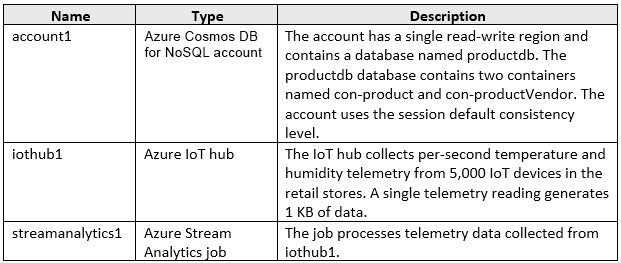
Each container in productdb is configured for manual throughput.
The con-product container stores the company's product catalog data. Each document in con-product includes a con-productVendor value. Most queries targeting the data in con-product are in the following format. SELECT * FROM con-product p WHERE p.con-productVendor = 'name'
Most queries targeting the data in the con-productVendor container are in the following format.
SELECT * FROM con-productVendor pv
ORDER BY pv.creditRating, pv.yearFounded
Existing environment. Current Problems.
Litware identifies the following issues:
-Updates to product categories in the con-productVendor container do not propagate automatically to documents in the con-product container.
-Application updates in con-product frequently cause HTTP status code 429 "Too many requests". You discover that the 429 status code relates to excessive request unit (RU) consumption during the updates.
Requirements. Planned Changes
Litware plans to implement a new Azure Cosmos DB for NoSQL account named account2 that will contain a database named iotdb. The iotdb database will contain two containers named con-iot1 and con-iot2.
Litware plans to make the following changes:
-Store the telemetry data in account2.
-Configure account1 to support multiple read-write regions.
-Implement referential integrity for the con-product container.
-Use Azure Functions to send notifications about product updates to different recipients.
-Develop an app named App1 that will run from all locations and query the data in account1.
-Develop an app named App2 that will run from the retail stores and query the data in account2. App2 must be limited to a single HTTPS endpoint when accessing account2.
Requirements. Business Requirements
Litware identifies the following business requirements:
-Whenever there are multiple solutions for a requirement, select the solution that provides the best performance, as long as there are no additional costs associated.
-Ensure that Azure Cosmos DB costs for IoT-related processing are predictable.
-Minimize the number of firewall changes in the retail stores.
Requirements. IoT Telemetry Requirements
Litware identifies the following IoT telemetry requirements:
-Write the telemetry data from streamanalytics1 to the con-iot1 container as the data arrives. Use streamanalytics1 to create hopping window aggregated telemetry readings once per hour and write the data to con-iot2.
-Automatically delete items in con-iot1 after one hour unless a per-item time to live is set.
-Optimize the partitioning of con-iot1 for queries that support historical data of a specific device.
-Aggregate the telemetry data by device by using streamanalytics1 and write the aggregate data to con-iot2.
-Ensure that the items in con-iot2 persist regardless of the per-item time to live setting.
Requirements. Product Catalog Requirements
Litware identifies the following requirements for the product catalog:
-Implement a custom conflict resolution policy for the product catalog data.
-Minimize the frequency of errors during updates of the con-product container.
-Once multi-region writes are configured, maximize the performance of App1 queries against the data in account1.
-Trigger the execution of two Azure functions following every update to any document in the con-product container.
-

HOTSPOT (Drag and Drop is not supported)
You have a container in an Azure Cosmos DB for NoSQL account.
You need to use the Azure Cosmos DB SDK to replace a document by using optimistic concurrency.
What should you include in the code? To answer, select the appropriate options in the answer area.
Note: Each correct selection is worth one point.
Hot Area:

  1. See Explanation section for answer.

Answer(s): A

Explanation:


Box 1: ConsistencyLevel
The ItemRequestOptions Class ConsistencyLevel property gets or sets the consistency level required for the request in the Azure Cosmos DB service.
Azure Cosmos DB offers 5 different consistency levels. Strong, Bounded Staleness, Session, Consistent Prefix and Eventual - in order of strongest to weakest consistency.
Box 2: _etag
The ItemRequestOptions class helped us implement optimistic concurrency by specifying that we wanted the SDK to use the If-Match header to allow the server to decide whether a resource should be updated. The If-Match value is the ETag value to be checked against. If the ETag value matches the server ETag value, the resource is updated.


Reference:

https://docs.microsoft.com/en-us/dotnet/api/microsoft.azure.cosmos.itemrequestoptions https://cosmosdb.github.io/labs/dotnet/labs/10-concurrency-control.html


Case Study
This is a case study. Case studies are not timed separately. You can use as much exam time as you would like to complete each case. However, there may be additional case studies and sections on this exam. You must manage your time to ensure that you are able to complete all questions included on this exam in the time provided.
To answer the questions included in a case study, you will need to reference information that is provided in the case study. Case studies might contain exhibits and other resources that provide more information about the scenario that is described in the case study. Each question is independent of the other questions in this case study.
At the end of this case study, a review screen will appear. This screen allows you to review your answers and to make changes before you move to the next section of the exam. After you begin a new section, you cannot return to this section.
To start the case study
To display the first question in this case study, click the Next button. Use the buttons in the left pane to explore the content of the case study before you answer the questions. Clicking these buttons displays information such as business requirements, existing environment, and problem statements. If the case study has an All Information tab, note that the information displayed is identical to the information displayed on the subsequent tabs.
When you are ready to answer a question, click the Question button to return to the question.
Overview
Litware, Inc. is a United States-based grocery retailer. Litware has a main office and a primary datacenter in Seattle. The company has 50 retail stores across the United States and an emerging online presence. Each store connects directly to the internet.
Existing environment. Cloud and Data Service Environments.
Litware has an Azure subscription that contains the resources shown in the following table.

Each container in productdb is configured for manual throughput.
The con-product container stores the company's product catalog data. Each document in con-product includes a con-productVendor value. Most queries targeting the data in con-product are in the following format. SELECT * FROM con-product p WHERE p.con-productVendor = 'name'
Most queries targeting the data in the con-productVendor container are in the following format.
SELECT * FROM con-productVendor pv
ORDER BY pv.creditRating, pv.yearFounded
Existing environment. Current Problems.
Litware identifies the following issues:
-Updates to product categories in the con-productVendor container do not propagate automatically to documents in the con-product container.
-Application updates in con-product frequently cause HTTP status code 429 "Too many requests". You discover that the 429 status code relates to excessive request unit (RU) consumption during the updates.
Requirements. Planned Changes
Litware plans to implement a new Azure Cosmos DB for NoSQL account named account2 that will contain a database named iotdb. The iotdb database will contain two containers named con-iot1 and con-iot2.
Litware plans to make the following changes:
-Store the telemetry data in account2.
-Configure account1 to support multiple read-write regions.
-Implement referential integrity for the con-product container.
-Use Azure Functions to send notifications about product updates to different recipients.
-Develop an app named App1 that will run from all locations and query the data in account1.
-Develop an app named App2 that will run from the retail stores and query the data in account2. App2 must be limited to a single HTTPS endpoint when accessing account2.
Requirements. Business Requirements
Litware identifies the following business requirements:
-Whenever there are multiple solutions for a requirement, select the solution that provides the best performance, as long as there are no additional costs associated.
-Ensure that Azure Cosmos DB costs for IoT-related processing are predictable.
-Minimize the number of firewall changes in the retail stores.
Requirements. IoT Telemetry Requirements
Litware identifies the following IoT telemetry requirements:
-Write the telemetry data from streamanalytics1 to the con-iot1 container as the data arrives. Use streamanalytics1 to create hopping window aggregated telemetry readings once per hour and write the data to con-iot2.
-Automatically delete items in con-iot1 after one hour unless a per-item time to live is set.
-Optimize the partitioning of con-iot1 for queries that support historical data of a specific device.
-Aggregate the telemetry data by device by using streamanalytics1 and write the aggregate data to con-iot2.
-Ensure that the items in con-iot2 persist regardless of the per-item time to live setting.
Requirements. Product Catalog Requirements
Litware identifies the following requirements for the product catalog:
-Implement a custom conflict resolution policy for the product catalog data.
-Minimize the frequency of errors during updates of the con-product container.
-Once multi-region writes are configured, maximize the performance of App1 queries against the data in account1.
-Trigger the execution of two Azure functions following every update to any document in the con-product container.
-

You are developing a new app named App1 by using the .NET Aspire Azure Cosmos DB integration. App1 will add data to an Azure Cosmos DB database.
You need to validate the functionality of App1 by using a CI/CD workflow. The solution must minimize administrative effort.
What should you use?

  1. Azure Cosmos DB diagnostic logs
  2. Azure Cosmos DB Data Explorer
  3. the Azure Cosmos DB Emulator
  4. Azure Storage Emulator

Answer(s): C

Explanation:

To keep administrative effort low while validating your .NET Aspire app in a CI/CD workflow, you should use the Azure Cosmos DB Emulator.
When utilizing the .NET Aspire Azure Cosmos DB hosting integration, calling the built-in emulator features allows you to run your integration tests without provisioning actual cloud infrastructure or managing complex connection credentials.


Reference:

https://learn.microsoft.com/en-us/azure/cosmos-db/how-to-develop-emulator


Case Study
This is a case study. Case studies are not timed separately. You can use as much exam time as you would like to complete each case. However, there may be additional case studies and sections on this exam. You must manage your time to ensure that you are able to complete all questions included on this exam in the time provided.
To answer the questions included in a case study, you will need to reference information that is provided in the case study. Case studies might contain exhibits and other resources that provide more information about the scenario that is described in the case study. Each question is independent of the other questions in this case study.
At the end of this case study, a review screen will appear. This screen allows you to review your answers and to make changes before you move to the next section of the exam. After you begin a new section, you cannot return to this section.
To start the case study
To display the first question in this case study, click the Next button. Use the buttons in the left pane to explore the content of the case study before you answer the questions. Clicking these buttons displays information such as business requirements, existing environment, and problem statements. If the case study has an All Information tab, note that the information displayed is identical to the information displayed on the subsequent tabs.
When you are ready to answer a question, click the Question button to return to the question.
Overview
Litware, Inc. is a United States-based grocery retailer. Litware has a main office and a primary datacenter in Seattle. The company has 50 retail stores across the United States and an emerging online presence. Each store connects directly to the internet.
Existing environment. Cloud and Data Service Environments.
Litware has an Azure subscription that contains the resources shown in the following table.

Each container in productdb is configured for manual throughput.
The con-product container stores the company's product catalog data. Each document in con-product includes a con-productVendor value. Most queries targeting the data in con-product are in the following format. SELECT * FROM con-product p WHERE p.con-productVendor = 'name'
Most queries targeting the data in the con-productVendor container are in the following format.
SELECT * FROM con-productVendor pv
ORDER BY pv.creditRating, pv.yearFounded
Existing environment. Current Problems.
Litware identifies the following issues:
-Updates to product categories in the con-productVendor container do not propagate automatically to documents in the con-product container.
-Application updates in con-product frequently cause HTTP status code 429 "Too many requests". You discover that the 429 status code relates to excessive request unit (RU) consumption during the updates.
Requirements. Planned Changes
Litware plans to implement a new Azure Cosmos DB for NoSQL account named account2 that will contain a database named iotdb. The iotdb database will contain two containers named con-iot1 and con-iot2.
Litware plans to make the following changes:
-Store the telemetry data in account2.
-Configure account1 to support multiple read-write regions.
-Implement referential integrity for the con-product container.
-Use Azure Functions to send notifications about product updates to different recipients.
-Develop an app named App1 that will run from all locations and query the data in account1.
-Develop an app named App2 that will run from the retail stores and query the data in account2. App2 must be limited to a single HTTPS endpoint when accessing account2.
Requirements. Business Requirements
Litware identifies the following business requirements:
-Whenever there are multiple solutions for a requirement, select the solution that provides the best performance, as long as there are no additional costs associated.
-Ensure that Azure Cosmos DB costs for IoT-related processing are predictable.
-Minimize the number of firewall changes in the retail stores.
Requirements. IoT Telemetry Requirements
Litware identifies the following IoT telemetry requirements:
-Write the telemetry data from streamanalytics1 to the con-iot1 container as the data arrives. Use streamanalytics1 to create hopping window aggregated telemetry readings once per hour and write the data to con-iot2.
-Automatically delete items in con-iot1 after one hour unless a per-item time to live is set.
-Optimize the partitioning of con-iot1 for queries that support historical data of a specific device.
-Aggregate the telemetry data by device by using streamanalytics1 and write the aggregate data to con-iot2.
-Ensure that the items in con-iot2 persist regardless of the per-item time to live setting.
Requirements. Product Catalog Requirements
Litware identifies the following requirements for the product catalog:
-Implement a custom conflict resolution policy for the product catalog data.
-Minimize the frequency of errors during updates of the con-product container.
-Once multi-region writes are configured, maximize the performance of App1 queries against the data in account1.
-Trigger the execution of two Azure functions following every update to any document in the con-product container.
-

You have an Azure Cosmos DB for NoSQL account.
You run the following query against a container in the account.

What is the output of the query?

  1. [{"A": false, "B": true, "C": false}]
  2. [{"A": true, "B": false, "C": true}]
  3. [{"A": true, "B": true, "C": false}]
  4. [{"A": true, "B": true, "C": true}]

Answer(s): A

Explanation:

IS_NUMBER returns a Boolean value indicating if the type of the specified expression is a number. "1234" is a string, not a number.


Reference:

https://docs.microsoft.com/en-us/azure/cosmos-db/sql/sql-query-is-number


Case Study
This is a case study. Case studies are not timed separately. You can use as much exam time as you would like to complete each case. However, there may be additional case studies and sections on this exam. You must manage your time to ensure that you are able to complete all questions included on this exam in the time provided.
To answer the questions included in a case study, you will need to reference information that is provided in the case study. Case studies might contain exhibits and other resources that provide more information about the scenario that is described in the case study. Each question is independent of the other questions in this case study.
At the end of this case study, a review screen will appear. This screen allows you to review your answers and to make changes before you move to the next section of the exam. After you begin a new section, you cannot return to this section.
To start the case study
To display the first question in this case study, click the Next button. Use the buttons in the left pane to explore the content of the case study before you answer the questions. Clicking these buttons displays information such as business requirements, existing environment, and problem statements. If the case study has an All Information tab, note that the information displayed is identical to the information displayed on the subsequent tabs.
When you are ready to answer a question, click the Question button to return to the question.
Overview
Litware, Inc. is a United States-based grocery retailer. Litware has a main office and a primary datacenter in Seattle. The company has 50 retail stores across the United States and an emerging online presence. Each store connects directly to the internet.
Existing environment. Cloud and Data Service Environments.
Litware has an Azure subscription that contains the resources shown in the following table.

Each container in productdb is configured for manual throughput.
The con-product container stores the company's product catalog data. Each document in con-product includes a con-productVendor value. Most queries targeting the data in con-product are in the following format. SELECT * FROM con-product p WHERE p.con-productVendor = 'name'
Most queries targeting the data in the con-productVendor container are in the following format.
SELECT * FROM con-productVendor pv
ORDER BY pv.creditRating, pv.yearFounded
Existing environment. Current Problems.
Litware identifies the following issues:
-Updates to product categories in the con-productVendor container do not propagate automatically to documents in the con-product container.
-Application updates in con-product frequently cause HTTP status code 429 "Too many requests". You discover that the 429 status code relates to excessive request unit (RU) consumption during the updates.
Requirements. Planned Changes
Litware plans to implement a new Azure Cosmos DB for NoSQL account named account2 that will contain a database named iotdb. The iotdb database will contain two containers named con-iot1 and con-iot2.
Litware plans to make the following changes:
-Store the telemetry data in account2.
-Configure account1 to support multiple read-write regions.
-Implement referential integrity for the con-product container.
-Use Azure Functions to send notifications about product updates to different recipients.
-Develop an app named App1 that will run from all locations and query the data in account1.
-Develop an app named App2 that will run from the retail stores and query the data in account2. App2 must be limited to a single HTTPS endpoint when accessing account2.
Requirements. Business Requirements
Litware identifies the following business requirements:
-Whenever there are multiple solutions for a requirement, select the solution that provides the best performance, as long as there are no additional costs associated.
-Ensure that Azure Cosmos DB costs for IoT-related processing are predictable.
-Minimize the number of firewall changes in the retail stores.
Requirements. IoT Telemetry Requirements
Litware identifies the following IoT telemetry requirements:
-Write the telemetry data from streamanalytics1 to the con-iot1 container as the data arrives. Use streamanalytics1 to create hopping window aggregated telemetry readings once per hour and write the data to con-iot2.
-Automatically delete items in con-iot1 after one hour unless a per-item time to live is set.
-Optimize the partitioning of con-iot1 for queries that support historical data of a specific device.
-Aggregate the telemetry data by device by using streamanalytics1 and write the aggregate data to con-iot2.
-Ensure that the items in con-iot2 persist regardless of the per-item time to live setting.
Requirements. Product Catalog Requirements
Litware identifies the following requirements for the product catalog:
-Implement a custom conflict resolution policy for the product catalog data.
-Minimize the frequency of errors during updates of the con-product container.
-Once multi-region writes are configured, maximize the performance of App1 queries against the data in account1.
-Trigger the execution of two Azure functions following every update to any document in the con-product container.
-

HOTSPOT (Drag and Drop is not supported)
You have an Azure subscription that contains an Azure Cosmos DB for NoSQL account. The account hosts a container named Container1.
Items are stored in Container1 in the following format.

You need to query name, sizeInGb, and currentStockLevel for items that have a value of currentStockLevel that is greater than 100.
How should you complete the query? To answer, select the appropriate options in the answer area.
Note: Each correct selection is worth one point.
Hot Area:

  1. See Explanation section for answer.

Answer(s): A

Explanation:


Self-joins in Azure Cosmos DB for NoSQL
In Azure Cosmos DB for NoSQL, data is schema-free and typically denormalized. Instead of joining data across entities and sets, like you would in a relational database, joins occur within a single item. Specifically, joins are scoped to that item and can't occur across multiple items and containers.
Box 1: JOIN
In a traditional relational database, the tags would be separated into a separate table and a cross-table join is performed with a filter applied to the results. In the API for NoSQL, we can perform a self-join operation within the item using the JOIN keyword.
Box 2: IN
Example:
SELECT p.sku, t.name AS tag
FROM
products p
JOIN
t IN p.tags
WHERE p.categoryName = "Sleeping Bags" AND t.slug = "bag-shape-mummy"


Reference:

https://learn.microsoft.com/en-us/azure/cosmos-db/nosql/query/join


Case Study
This is a case study. Case studies are not timed separately. You can use as much exam time as you would like to complete each case. However, there may be additional case studies and sections on this exam. You must manage your time to ensure that you are able to complete all questions included on this exam in the time provided.
To answer the questions included in a case study, you will need to reference information that is provided in the case study. Case studies might contain exhibits and other resources that provide more information about the scenario that is described in the case study. Each question is independent of the other questions in this case study.
At the end of this case study, a review screen will appear. This screen allows you to review your answers and to make changes before you move to the next section of the exam. After you begin a new section, you cannot return to this section.
To start the case study
To display the first question in this case study, click the Next button. Use the buttons in the left pane to explore the content of the case study before you answer the questions. Clicking these buttons displays information such as business requirements, existing environment, and problem statements. If the case study has an All Information tab, note that the information displayed is identical to the information displayed on the subsequent tabs.
When you are ready to answer a question, click the Question button to return to the question.
Overview
Litware, Inc. is a United States-based grocery retailer. Litware has a main office and a primary datacenter in Seattle. The company has 50 retail stores across the United States and an emerging online presence. Each store connects directly to the internet.
Existing environment. Cloud and Data Service Environments.
Litware has an Azure subscription that contains the resources shown in the following table.

Each container in productdb is configured for manual throughput.
The con-product container stores the company's product catalog data. Each document in con-product includes a con-productVendor value. Most queries targeting the data in con-product are in the following format. SELECT * FROM con-product p WHERE p.con-productVendor = 'name'
Most queries targeting the data in the con-productVendor container are in the following format.
SELECT * FROM con-productVendor pv
ORDER BY pv.creditRating, pv.yearFounded
Existing environment. Current Problems.
Litware identifies the following issues:
-Updates to product categories in the con-productVendor container do not propagate automatically to documents in the con-product container.
-Application updates in con-product frequently cause HTTP status code 429 "Too many requests". You discover that the 429 status code relates to excessive request unit (RU) consumption during the updates.
Requirements. Planned Changes
Litware plans to implement a new Azure Cosmos DB for NoSQL account named account2 that will contain a database named iotdb. The iotdb database will contain two containers named con-iot1 and con-iot2.
Litware plans to make the following changes:
-Store the telemetry data in account2.
-Configure account1 to support multiple read-write regions.
-Implement referential integrity for the con-product container.
-Use Azure Functions to send notifications about product updates to different recipients.
-Develop an app named App1 that will run from all locations and query the data in account1.
-Develop an app named App2 that will run from the retail stores and query the data in account2. App2 must be limited to a single HTTPS endpoint when accessing account2.
Requirements. Business Requirements
Litware identifies the following business requirements:
-Whenever there are multiple solutions for a requirement, select the solution that provides the best performance, as long as there are no additional costs associated.
-Ensure that Azure Cosmos DB costs for IoT-related processing are predictable.
-Minimize the number of firewall changes in the retail stores.
Requirements. IoT Telemetry Requirements
Litware identifies the following IoT telemetry requirements:
-Write the telemetry data from streamanalytics1 to the con-iot1 container as the data arrives. Use streamanalytics1 to create hopping window aggregated telemetry readings once per hour and write the data to con-iot2.
-Automatically delete items in con-iot1 after one hour unless a per-item time to live is set.
-Optimize the partitioning of con-iot1 for queries that support historical data of a specific device.
-Aggregate the telemetry data by device by using streamanalytics1 and write the aggregate data to con-iot2.
-Ensure that the items in con-iot2 persist regardless of the per-item time to live setting.
Requirements. Product Catalog Requirements
Litware identifies the following requirements for the product catalog:
-Implement a custom conflict resolution policy for the product catalog data.
-Minimize the frequency of errors during updates of the con-product container.
-Once multi-region writes are configured, maximize the performance of App1 queries against the data in account1.
-Trigger the execution of two Azure functions following every update to any document in the con-product container.
-

You have a container in an Azure Cosmos DB for NoSQL account. The container stores data about families. Data about parents, children, and pets are stored as separate documents.
Each document contains the address of each family. Members of the same family share the same partition key named familyId.
You need to update the address for each member of the same family that share the same address. The solution must meet the following requirements:
-Be atomic, consistent, isolated, and durable (ACID).
-Provide the lowest latency.
What should you do?

  1. Update the document of each family member separately by using a patch operation
  2. Update the document of each family member separately and set the consistency level to strong
  3. Update the document of each family member by using a transactional batch operation

Answer(s): C

Explanation:

Each transaction provides ACID (Atomicity, Consistency, Isolation, Durability) property guarantees. Transactional batch operations offer reduced latency on equivalent operations.
Note: Transactional batch describes a group of point operations that need to either succeed or fail together with the same partition key in a container. In the .NET SDK, the TransactionalBatch class is used to define this batch of operations. If all operations succeed in the order they are described within the transactional batch operation, the transaction will be committed. However, if any operation fails, the entire transaction is rolled back.


Reference:

https://docs.microsoft.com/en-us/azure/cosmos-db/sql/transactional-batch


Case Study
This is a case study. Case studies are not timed separately. You can use as much exam time as you would like to complete each case. However, there may be additional case studies and sections on this exam. You must manage your time to ensure that you are able to complete all questions included on this exam in the time provided.
To answer the questions included in a case study, you will need to reference information that is provided in the case study. Case studies might contain exhibits and other resources that provide more information about the scenario that is described in the case study. Each question is independent of the other questions in this case study.
At the end of this case study, a review screen will appear. This screen allows you to review your answers and to make changes before you move to the next section of the exam. After you begin a new section, you cannot return to this section.
To start the case study
To display the first question in this case study, click the Next button. Use the buttons in the left pane to explore the content of the case study before you answer the questions. Clicking these buttons displays information such as business requirements, existing environment, and problem statements. If the case study has an All Information tab, note that the information displayed is identical to the information displayed on the subsequent tabs.
When you are ready to answer a question, click the Question button to return to the question.
Overview
Litware, Inc. is a United States-based grocery retailer. Litware has a main office and a primary datacenter in Seattle. The company has 50 retail stores across the United States and an emerging online presence. Each store connects directly to the internet.
Existing environment. Cloud and Data Service Environments.
Litware has an Azure subscription that contains the resources shown in the following table.

Each container in productdb is configured for manual throughput.
The con-product container stores the company's product catalog data. Each document in con-product includes a con-productVendor value. Most queries targeting the data in con-product are in the following format. SELECT * FROM con-product p WHERE p.con-productVendor = 'name'
Most queries targeting the data in the con-productVendor container are in the following format.
SELECT * FROM con-productVendor pv
ORDER BY pv.creditRating, pv.yearFounded
Existing environment. Current Problems.
Litware identifies the following issues:
-Updates to product categories in the con-productVendor container do not propagate automatically to documents in the con-product container.
-Application updates in con-product frequently cause HTTP status code 429 "Too many requests". You discover that the 429 status code relates to excessive request unit (RU) consumption during the updates.
Requirements. Planned Changes
Litware plans to implement a new Azure Cosmos DB for NoSQL account named account2 that will contain a database named iotdb. The iotdb database will contain two containers named con-iot1 and con-iot2.
Litware plans to make the following changes:
-Store the telemetry data in account2.
-Configure account1 to support multiple read-write regions.
-Implement referential integrity for the con-product container.
-Use Azure Functions to send notifications about product updates to different recipients.
-Develop an app named App1 that will run from all locations and query the data in account1.
-Develop an app named App2 that will run from the retail stores and query the data in account2. App2 must be limited to a single HTTPS endpoint when accessing account2.
Requirements. Business Requirements
Litware identifies the following business requirements:
-Whenever there are multiple solutions for a requirement, select the solution that provides the best performance, as long as there are no additional costs associated.
-Ensure that Azure Cosmos DB costs for IoT-related processing are predictable.
-Minimize the number of firewall changes in the retail stores.
Requirements. IoT Telemetry Requirements
Litware identifies the following IoT telemetry requirements:
-Write the telemetry data from streamanalytics1 to the con-iot1 container as the data arrives. Use streamanalytics1 to create hopping window aggregated telemetry readings once per hour and write the data to con-iot2.
-Automatically delete items in con-iot1 after one hour unless a per-item time to live is set.
-Optimize the partitioning of con-iot1 for queries that support historical data of a specific device.
-Aggregate the telemetry data by device by using streamanalytics1 and write the aggregate data to con-iot2.
-Ensure that the items in con-iot2 persist regardless of the per-item time to live setting.
Requirements. Product Catalog Requirements
Litware identifies the following requirements for the product catalog:
-Implement a custom conflict resolution policy for the product catalog data.
-Minimize the frequency of errors during updates of the con-product container.
-Once multi-region writes are configured, maximize the performance of App1 queries against the data in account1.
-Trigger the execution of two Azure functions following every update to any document in the con-product container.
-

You have an Azure Cosmos DB for NoSQL account that hosts a container named Container1.
The DefaultTimeToLive property of Container1 is set to 500.
Container1 contains an item that has a ttl property of 1000.
The item in Container1 is modified.
When will the item be deleted automatically?

  1. in 1,000 hours
  2. in 500 hours
  3. in 1,000 seconds
  4. in 500 seconds

Answer(s): C

Explanation:

The item will be automatically deleted 1,000 seconds after its last modification time.
How Time to Live (TTL) Evaluation Works
Item-Level Override: In Azure Cosmos DB, when a container has a valid DefaultTimeToLive configured (in this case, 1000 seconds), any individual item can override this value by declaring its own ttl property. Because the item's ttl is explicitly set to 1000, the container's default of 500 is completely ignored for this specific item.
Resetting the Clock: TTL expiration calculations are tied directly to the item's system-generated _ts (timestamp) property, which records the last modified time. Every time an item is created or updated, Azure Cosmos DB updates _ts to the current Unix epoch time.
Consequently, modifying the item resets its lifespan, and the system will automatically purge it exactly §,000 seconds after that modification occurred.


Reference:

https://learn.microsoft.com/en-us/cosmos-db/time-to-live


Case Study
This is a case study. Case studies are not timed separately. You can use as much exam time as you would like to complete each case. However, there may be additional case studies and sections on this exam. You must manage your time to ensure that you are able to complete all questions included on this exam in the time provided.
To answer the questions included in a case study, you will need to reference information that is provided in the case study. Case studies might contain exhibits and other resources that provide more information about the scenario that is described in the case study. Each question is independent of the other questions in this case study.
At the end of this case study, a review screen will appear. This screen allows you to review your answers and to make changes before you move to the next section of the exam. After you begin a new section, you cannot return to this section.
To start the case study
To display the first question in this case study, click the Next button. Use the buttons in the left pane to explore the content of the case study before you answer the questions. Clicking these buttons displays information such as business requirements, existing environment, and problem statements. If the case study has an All Information tab, note that the information displayed is identical to the information displayed on the subsequent tabs.
When you are ready to answer a question, click the Question button to return to the question.
Overview
Litware, Inc. is a United States-based grocery retailer. Litware has a main office and a primary datacenter in Seattle. The company has 50 retail stores across the United States and an emerging online presence. Each store connects directly to the internet.
Existing environment. Cloud and Data Service Environments.
Litware has an Azure subscription that contains the resources shown in the following table.

Each container in productdb is configured for manual throughput.
The con-product container stores the company's product catalog data. Each document in con-product includes a con-productVendor value. Most queries targeting the data in con-product are in the following format. SELECT * FROM con-product p WHERE p.con-productVendor = 'name'
Most queries targeting the data in the con-productVendor container are in the following format.
SELECT * FROM con-productVendor pv
ORDER BY pv.creditRating, pv.yearFounded
Existing environment. Current Problems.
Litware identifies the following issues:
-Updates to product categories in the con-productVendor container do not propagate automatically to documents in the con-product container.
-Application updates in con-product frequently cause HTTP status code 429 "Too many requests". You discover that the 429 status code relates to excessive request unit (RU) consumption during the updates.
Requirements. Planned Changes
Litware plans to implement a new Azure Cosmos DB for NoSQL account named account2 that will contain a database named iotdb. The iotdb database will contain two containers named con-iot1 and con-iot2.
Litware plans to make the following changes:
-Store the telemetry data in account2.
-Configure account1 to support multiple read-write regions.
-Implement referential integrity for the con-product container.
-Use Azure Functions to send notifications about product updates to different recipients.
-Develop an app named App1 that will run from all locations and query the data in account1.
-Develop an app named App2 that will run from the retail stores and query the data in account2. App2 must be limited to a single HTTPS endpoint when accessing account2.
Requirements. Business Requirements
Litware identifies the following business requirements:
-Whenever there are multiple solutions for a requirement, select the solution that provides the best performance, as long as there are no additional costs associated.
-Ensure that Azure Cosmos DB costs for IoT-related processing are predictable.
-Minimize the number of firewall changes in the retail stores.
Requirements. IoT Telemetry Requirements
Litware identifies the following IoT telemetry requirements:
-Write the telemetry data from streamanalytics1 to the con-iot1 container as the data arrives. Use streamanalytics1 to create hopping window aggregated telemetry readings once per hour and write the data to con-iot2.
-Automatically delete items in con-iot1 after one hour unless a per-item time to live is set.
-Optimize the partitioning of con-iot1 for queries that support historical data of a specific device.
-Aggregate the telemetry data by device by using streamanalytics1 and write the aggregate data to con-iot2.
-Ensure that the items in con-iot2 persist regardless of the per-item time to live setting.
Requirements. Product Catalog Requirements
Litware identifies the following requirements for the product catalog:
-Implement a custom conflict resolution policy for the product catalog data.
-Minimize the frequency of errors during updates of the con-product container.
-Once multi-region writes are configured, maximize the performance of App1 queries against the data in account1.
-Trigger the execution of two Azure functions following every update to any document in the con-product container.
-

HOTSPOT (Drag and Drop is not supported)
You plan to create an Azure Cosmos DB for NoSQL container that will contain items in the following format.

You need to define a query that will return the userid values of all the users who purchased an item that has a sku value of 11111.
How should you compete the query? To answer, select the appropriate options in the answer area.
Note: Each correct selection is worth one point.
Hot Area:

  1. See Explanation section for answer.

Answer(s): A

Explanation:


Box 1: n in c.items
Define n as c.items
Example of subquery with the EXISTS predicate:
SELECT p.name, p.tags
FROM
products p
WHERE
EXISTS (SELECT VALUE t FROM t IN p.tags WHERE t = "outerwear")
Box 2: n.sku
The sku is defined within the items construct.
Note: Subqueries in Azure Cosmos DB for NoSQL
A subquery is a query nested within another query within Azure Cosmos DB for NoSQL. A subquery is also called an inner query or inner SELECT. The statement that contains a subquery is typically called an outer query.


Reference:

https://learn.microsoft.com/en-us/azure/cosmos-db/nosql/query/subquery


Case Study
This is a case study. Case studies are not timed separately. You can use as much exam time as you would like to complete each case. However, there may be additional case studies and sections on this exam. You must manage your time to ensure that you are able to complete all questions included on this exam in the time provided.
To answer the questions included in a case study, you will need to reference information that is provided in the case study. Case studies might contain exhibits and other resources that provide more information about the scenario that is described in the case study. Each question is independent of the other questions in this case study.
At the end of this case study, a review screen will appear. This screen allows you to review your answers and to make changes before you move to the next section of the exam. After you begin a new section, you cannot return to this section.
To start the case study
To display the first question in this case study, click the Next button. Use the buttons in the left pane to explore the content of the case study before you answer the questions. Clicking these buttons displays information such as business requirements, existing environment, and problem statements. If the case study has an All Information tab, note that the information displayed is identical to the information displayed on the subsequent tabs.
When you are ready to answer a question, click the Question button to return to the question.
Overview
Litware, Inc. is a United States-based grocery retailer. Litware has a main office and a primary datacenter in Seattle. The company has 50 retail stores across the United States and an emerging online presence. Each store connects directly to the internet.
Existing environment. Cloud and Data Service Environments.
Litware has an Azure subscription that contains the resources shown in the following table.

Each container in productdb is configured for manual throughput.
The con-product container stores the company's product catalog data. Each document in con-product includes a con-productVendor value. Most queries targeting the data in con-product are in the following format. SELECT * FROM con-product p WHERE p.con-productVendor = 'name'
Most queries targeting the data in the con-productVendor container are in the following format.
SELECT * FROM con-productVendor pv
ORDER BY pv.creditRating, pv.yearFounded
Existing environment. Current Problems.
Litware identifies the following issues:
-Updates to product categories in the con-productVendor container do not propagate automatically to documents in the con-product container.
-Application updates in con-product frequently cause HTTP status code 429 "Too many requests". You discover that the 429 status code relates to excessive request unit (RU) consumption during the updates.
Requirements. Planned Changes
Litware plans to implement a new Azure Cosmos DB for NoSQL account named account2 that will contain a database named iotdb. The iotdb database will contain two containers named con-iot1 and con-iot2.
Litware plans to make the following changes:
-Store the telemetry data in account2.
-Configure account1 to support multiple read-write regions.
-Implement referential integrity for the con-product container.
-Use Azure Functions to send notifications about product updates to different recipients.
-Develop an app named App1 that will run from all locations and query the data in account1.
-Develop an app named App2 that will run from the retail stores and query the data in account2. App2 must be limited to a single HTTPS endpoint when accessing account2.
Requirements. Business Requirements
Litware identifies the following business requirements:
-Whenever there are multiple solutions for a requirement, select the solution that provides the best performance, as long as there are no additional costs associated.
-Ensure that Azure Cosmos DB costs for IoT-related processing are predictable.
-Minimize the number of firewall changes in the retail stores.
Requirements. IoT Telemetry Requirements
Litware identifies the following IoT telemetry requirements:
-Write the telemetry data from streamanalytics1 to the con-iot1 container as the data arrives. Use streamanalytics1 to create hopping window aggregated telemetry readings once per hour and write the data to con-iot2.
-Automatically delete items in con-iot1 after one hour unless a per-item time to live is set.
-Optimize the partitioning of con-iot1 for queries that support historical data of a specific device.
-Aggregate the telemetry data by device by using streamanalytics1 and write the aggregate data to con-iot2.
-Ensure that the items in con-iot2 persist regardless of the per-item time to live setting.
Requirements. Product Catalog Requirements
Litware identifies the following requirements for the product catalog:
-Implement a custom conflict resolution policy for the product catalog data.
-Minimize the frequency of errors during updates of the con-product container.
-Once multi-region writes are configured, maximize the performance of App1 queries against the data in account1.
-Trigger the execution of two Azure functions following every update to any document in the con-product container.
-

You have an Azure Cosmos DB for NoSQL account that contains a database named DB1 and a container named Container1.
You need to manage the account by using the Azure Cosmos DB SDK.
What should you do?

  1. Create a container in DB1.
  2. List the physical partitions of Container1.
  3. Read a stored procedure in Container1.
  4. Create a user defined function (UDF) in Container1.

Answer(s): D

Explanation:

How to register and use stored procedures, triggers, and user-defined functions in Azure Cosmos DB
How to work with user-defined functions
The following examples show how to register a user-defined function by using the Azure Cosmos DB SDKs.
The following code shows how to register a user-defined function using the .NET SDK v2:
string udfId = "Tax";
var udfTax = new UserDefinedFunction
{
Id = udfId,
Body = File.ReadAllText($@"..\js\{udfId}.js")
};
Uri containerUri = UriFactory.CreateDocumentCollectionUri("myDatabase", "myContainer");
await client.CreateUserDefinedFunctionAsync(containerUri, udfTax);
Note: Azure Cosmos DB provides language-integrated, transactional execution of JavaScript.
When using the API for NoSQL in Azure Cosmos DB, you can write stored procedures, triggers, and user-defined functions (UDFs) in the JavaScript language. You can write your logic in JavaScript that executed inside the database engine. You can create and execute triggers, stored procedures, and UDFs by using Azure portal, the JavaScript language integrated query API in Azure Cosmos DB or the Azure Cosmos DB for NoSQL client SDKs.


Reference:

https://learn.microsoft.com/en-us/azure/cosmos-db/nosql/how-to-use-stored-procedures-triggers-udfs


Share your comments for Microsoft DP-420 exam with other users:

A
AI Tutor Explanation
4/21/2026 8:48:36 AM

Question 3:

  • False is the correct answer (Option B).

Why:
  • In Snowflake, a database is a metadata object that exists within a single Snowflake account. Accounts are isolated—there isn’t one database that lives in multiple accounts.
  • You can access data across accounts via data sharing or database replication, but these create separate database objects in the other accounts (e.g., a database in the consumer account created from a share), not a single shared database across accounts.

So a single database cannot exist in more than one Snowflake account.

A
Anonymous User
4/16/2026 10:54:18 AM

Question 1:

  • Correct answer: E — date = sys.argv[1]
  • Why this is correct:
- When a Databricks Job passes parameters to a notebook, those parameters are supplied to the notebook's Python process as command-line arguments. The first argument after the script name is sys.argv[1], so date = sys.argv[1] captures the passed date value directly.
  • How it compares to other options:
- date = spark.conf.get("date") reads from Spark config, not from job parameters. - input() waits for user input at runtime, which isn’t how job parameters are provided. - date = dbutils.notebooks.getParam("date") would work if the notebook were invoked via dbutils.notebook.run with parameters, not

A
Anonymous User
4/15/2026 4:42:07 AM

Question 528:

  • Correct answer: NSG flow logs for NSG1 (Option B)

  • Why:
- Traffic Analytics uses NSG flow logs to analyze traffic patterns. You must have NSG flow logs enabled for the NSGs you want to monitor. - An Azure Log Analytics workspace is also required to store and query the traffic data. - Network Watcher must be available in the subscription for traffic analytics to function.
  • What to configure (brief steps):
- Ensure Network Watcher is enabled in the East US region (for the subscription/region). - Enable NSG flow logs on NSG1. - Ensure a Log Analytics workspace exists and is accessible (read/write) so Traffic Analytics can store and query logs.
  • Why other options aren’t correct:
- “Diagnostic settings for VM1” or “Diagnostic settings for NSG1” alone don’t guarantee flow logs are captured and sent to Log Analytics, which Traffic Analytics relies on. - “Insights for VM1” is not how Traffic Analytics collects traffic data.

A
Anonymous User
4/15/2026 2:43:53 AM

Question 23:
The correct answer is Domain admin (option B), not Fabric admin.

  • Domain admin provides domain-level management: create domains/subdomains and assign workspaces within those domains, which matches the tasks while following least privilege.
  • Fabric admin is global-level access and is more privileges than needed for this scenario (it would grant broader control across the Fabric environment).

A
Anonymous User
4/14/2026 12:31:34 PM

Question 2:
For question 2, the key concept is the Longest Prefix Match. Routers pick the route whose subnet mask is the most specific (largest prefix length) that still matches the destination IP.
From the options:

  • A) 10.10.10.0/28 ? 10.10.10.0–10.10.10.15
  • B) 10.10.13.0/25 ? 10.10.13.0–10.10.13.127
  • C) 10.10.13.144/28 ? 10.10.13.144–10.10.13.159
  • D) 10.10.13.208/29 ? 10.10.13.208–10.10.13.215

The destination Host A’s IP must fall within 10.10.13.208–10.10.13.215 for the /29 to be the best match. Since /29 is the longest prefix among the matching options, Router1 will use 10.10.13.208/29.
Thus, the correct answer is D.

S
srameh
4/14/2026 10:09:29 AM

Question 3:

  • Correct answer: Phase 4, Post Accreditation

  • Explanation:
- In DITSCAP, the four phases are: - Phase 1: Definition (concept and requirements) - Phase 2: Verification (design and testing) - Phase 3: Validation (fielding and evaluation) - Phase 4: Post Accreditation (ongoing operations and lifecycle management) - The description—continuing operation of an accredited IT system and addressing changing threats throughout its life cycle—fits the Post Accreditation phase, which covers operations, maintenance, monitoring, and reauthorization as threats and environment evolve.

O
onibokun10
4/13/2026 7:50:14 PM

Question 129:
Correct answer: CNAME

  • A CNAME record creates an alias for a domain, so newapplication.comptia.org will resolve to whatever IP address www.comptia.org resolves to. This ensures both names point to the same resource without duplicating the IP.
  • Why not the others:
- SOA defines authoritative information for a zone. - MX specifies mail exchange servers. - NS designates name servers for a zone.
  • Notes: The alias name (newapplication.comptia.org) should not have other records if you use a CNAME for it, and CNAMEs aren’t used for the zone apex (root) domain. This scenario uses a subdomain, so a CNAME is appropriate.

A
Anonymous User
4/13/2026 6:29:58 PM

Question 1:

  • Correct answer: C

  • Why this is best:
- Uses OS Login with IAM, so SSH access is granted via Google accounts rather than distributing per-user SSH keys. - Granting the compute.osAdminLogin role to a Google group gives admin access to all team members in a centralized, auditable way. - Access is auditable: Cloud Audit Logs show who accessed which VM, satisfying the security requirement to determine who accessed a given instance.
  • How it works:
- Enable OS Login on the project/instances (enable-oslogin metadata). - Add the team’s

A
Anonymous User
4/13/2026 1:00:51 PM

Question 2:

  • Answer: D. Azure Advisor

  • Why: To view security-related recommendations for resources in the Compute and Apps area (including App Service Web Apps and Functions), you use Azure Advisor. Advisor surfaces personalized best-practice recommendations across resources, including security, and shows which resources are affected and the severity.

  • Why not the others:
- Azure Log Analytics is for ad-hoc querying of telemetry, not for viewing security recommendations. - Azure Event Hubs is for streaming telemetry data, not for security recommendations.
  • Quick tip: In the portal, navigate to Azure Advisor and check the Security recommendations for App Services to see actionable items and affe

D
Don
4/11/2026 5:36:42 AM

Recommend using AI for Solutions rather the Answer(s) submitted here

M
Mogae Malapela
4/8/2026 6:37:56 AM

This is very interesting

A
Anon
4/6/2026 5:22:54 PM

Are these the same questions you have to pay for in ExamTopics?

L
LRK
3/22/2026 2:38:08 PM

For Question 7 - while the answer description indicates the correct answer, the option no. mentioned is incorrect. Nice and Comprehensive. Thankyou

R
Rian
3/19/2026 9:12:10 AM

This is very good and accurate. Explanation is very helpful even thou some are not 100% right but good enough to pass.

G
Gerrard
3/18/2026 6:58:37 AM

The DP-900 exam can be tricky if you aren't familiar with Microsoft’s specific cloud terminology. I used the practice questions from free-braindumps.com and found them incredibly helpful. The site breaks down core data concepts and Azure services in a way that actually mirrors the real test. As a resutl I passed my exam.

V
Vineet Kumar
3/6/2026 5:26:16 AM

interesting

J
Joe
1/20/2026 8:25:24 AM

Passed this exam 2 days ago. These questions are in the exam. You are safe to use them.

N
NJ
12/24/2025 10:39:07 AM

Helpful to test your preparedness before giving exam

A
Ashwini
12/17/2025 8:24:45 AM

Really helped

J
Jagadesh
12/16/2025 9:57:10 AM

Good explanation

S
shobha
11/29/2025 2:19:59 AM

very helpful

P
Pandithurai
11/12/2025 12:16:21 PM

Question 1, Ans is - Developer,Standard,Professional Direct and Premier

E
Einstein
11/8/2025 4:13:37 AM

Passed this exam in first appointment. Great resource and valid exam dump.

D
David
10/31/2025 4:06:16 PM

Today I wrote this exam and passed, i totally relay on this practice exam. The questions were very tough, these questions are valid and I encounter the same.

T
Thor
10/21/2025 5:16:29 AM

Anyone used this dump recently?

V
Vladimir
9/25/2025 9:11:14 AM

173 question is A not D

K
khaos
9/21/2025 7:07:26 AM

nice questions

K
Katiso Lehasa
9/15/2025 11:21:52 PM

Thanks for the practice questions they helped me a lot.

E
Einstein
9/2/2025 7:42:00 PM

Passed this exam today. All questions are valid and this is not something you can find in ChatGPT.

V
vito
8/22/2025 4:16:51 AM

i need to pass exam for VMware 2V0-11.25

M
Matt
7/31/2025 11:44:40 PM

Great questions.

O
OLERATO
7/1/2025 5:44:14 AM

great dumps to practice for the exam

A
Adekunle willaims
6/9/2025 7:37:29 AM

How reliable and relevant are these questions?? also i can see the last update here was January and definitely new questions would have emerged.

A
Alex
5/24/2025 12:54:15 AM

Can I trust to this source?

AI Tutor 👋 I’m here to help!