CFA Level III Chartered Financial Analyst CFA-Level-III Dumps in PDF

Free CFA CFA-Level-III Real Questions (page: 8)

Hilda Olson covers the chemical industry for Bern Securities. Based on conversations with two executives of InterChem, a major producer of synthetic fabrics, she issues a generalized sector report claiming that "according to a survey of industry executives, rayon feedstocks will be in short supply for at least the next 12 months." In addition, Olson recommends Han Chemical, a major producer of rayon, which has routinely reported higher profits than its competitors and should be well positioned to gain further from reduced supply. In her efforts to learn more about Han Chemical and support her recommendation, Olson scrambles to compile a research report on the firm. She reproduces financial data provided in a research report by Standard & Poor's (S&P) and the Bank of Korea (BOK), the Korean government's central bank. She also obtains two research reports from brokerage firms with operations in Korea, and incorporates portions of the text and charts from these reports into her research report.
Olson describes Han Chemical in her research report as "low risk," even though she knows that the operating risk of the chemical industry is above average and that Han has a higher debt-to-equity ratio than its average competitor. She justifies this to her supervisor by saying that since the market for rayon feedstocks is tight, an investment in Han has a very low risk of suffering a loss in the near term. Olson's supervisor accepts her explanation as valid and the report is issued to the firm's clients.
Shortly after issuing her research report, Olson visited Han Chemical's operations in New Jersey. During her conversation with the firm's vice president of operations, who is also one of Bern's personal trust clients, she was told in confidence that Han Chemical's profit margins are higher than its competitors, partly because they routinely discharge untreated chemical waste into the Delaware River in order to reduce production costs. Such action is a direct violation of U.S. environmental laws.
When Olson returns from her trip to New Jersey, Wolfgang Hundt, director of research at Bern Securities, requests a meeting. Hundt has developed a compliance procedure and has provided relevant written information to employees. Every quarter, he issues written reminders regarding the program to Olson and her peers, so when Olson tells Hundt of Han's chemical dumping, he immediately begins an investigation into the violation.
Olson is concerned that Hundt's compliance actions as director of the firm's research department are inconsistent with CFA Institute Standards. Which of the following properly characterize Hundt's compliance activities? Hundt's actions are:

  1. consistent with CFA Institute Standards.
  2. improper with respect to both the investigation procedures and the periodic reminders.
  3. improper regarding the periodic reminders, as these do not constitute regular training.

Answer(s): A

Explanation:

All of Hundt's actions are consistent with CFA Institute Standard IV(C) Responsibilities of Supervisors. According to this Standard, supervisors exercise reasonable supervision by ensuring that employees follow the written compliance procedures established by their supervisor. Supervisors have a responsibility to disseminate the compliance procedures to employees and it is recommended that they regularly update procedures and continually educate personnel subject to the procedures- If a supervisor knows of a violation, he or she must promptly begin an investigation into the matter. (Study Session 1, LOS l.b)
Sample Scoring Key: 3 points for each correct response.


Dynamic Investment Services (DIS) is a global, full-service investment advisory firm based in the United States. Although the firm provides numerous investment services, DIS specializes in portfolio management for individual and institutional clients and only deals in publicly traded debt, equity, and derivative instruments.
Walter Fried, CFA, is a portfolio manager and the director of DIS's offices in Austria. For several years, Fried has maintained a relationship with a local tax consultant. The consultant provides a DIS marketing brochure with Fried's contact information to his clients seeking investment advisory services, and in return. Fried manages the consultant's personal portfolio and informs the consultant of potential tax issues in the referred clients' portfolios as they occur. Because he cannot personally manage all of the inquiring clients' assets, Fried generally passes the client information along to one of his employees but never discloses his relationship with the tax accountant. Fried recently forwarded information on the prospective Jones Family Trust account to Beverly Ulster, CFA, one of his newly hired portfolio managers.

Upon receiving the information, Ulster immediately set up a meeting with Terrence Phillips, the trustee of the Jones Family Trust. Ulster began the meeting by explaining DIS's investment services as detailed in the firm's approved marketing and public relations literature. Ulster also had Phillips complete a very detailed questionnaire regarding the risk and return objectives, investment constraints, and other information related to the trust beneficiaries, which Phillips is not. While reading the questionnaire, Ulster learned that Phillips heard about DIS's services through a referral from his tax consultant. Upon further investigation, Ulster discovered the agreement set up between Fried and the tax consultant, which is legal according to Austrian law but was not disclosed by either party Ulster took a break from the meeting to get more details from Fried. With full information on the referral arrangement, Ulster immediately makes full disclosure to the Phillips. Before the meeting with Phillips concluded, Ulster began formalizing the investment policy statement (IPS) for the Jones Family Trust and agreed to Phillips' request that the IPS should explicitly forbid derivative positions in the Trust portfolio.
A few hours after meeting with the Jones Family Trust representative, Ulster accepted another new referral client, Steven West, from Fried. Following DIS policy, Ulster met with West to address his investment objectives and constraints and explain the firm's services. During the meeting, Ulster informed West that DIS offers three levels of account status, each with an increasing fee based on the account's asset value. The first level has the lowest account fees but receives oversubscribed domestic IPO allocations only after the other two levels receive IPO allocations. The second-level clients have the same priority as third-level clients with respect to oversubscribed domestic IPO allocations and receive research with significantly greater detail than first-level clients. Clients who subscribe to the third level of DIS services receive the most detailed research reports and are allowed to participate in both domestic and international IPOs. All clients receive research and recommendations at approximately the same lime. West decided to engage DIS's services as a second-level client. While signing the enrollment papers, West told Ulster, "If you can give me the kind of performance I am looking for, I may move the rest of my assets to DIS." When Ulster inquired about the other accounts, West would not specify how much or what type of assets he held in other accounts. West also noted that a portion of the existing assets to be transferred to Ulster's control were private equity investments in small start-up companies, which DIS would need to manage. Ulster assured him that DIS would have no problem managing the private equity investments.

After her meeting with West, Ulster attended a weekly strategy session held by DIS. All managers were
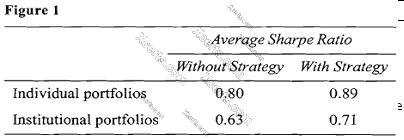
required to attend this particular meeting since the focus was on a new strategy designed to reduce portfolio volatility while slightly enhancing return using a combination of futures and options on various asset classes. Intrigued by the idea, Ulster implemented the strategy for all of her clients and achieved positive results for all portfolios. Ulster's average performance results after one year of using the new strategy are presented in Figure 1. For comparative purposes, performance figures without the new strategy are also presented.

At the latest strategy meeting, DIS economists were extremely pessimistic about emerging market economies and suggested that the firm's portfolio managers consider selling emerging market securities out of their portfolios and avoid these investments for the next 12 to 15 months. Fried placed a limit order to sell his personal holdings of an emerging market fund at a price 5% higher than the market price at the time. He then began selling his clients' (all of whom have discretionary accounts with DIS) holdings of the same emerging market fund using market orders. All of his clients' trade orders were completed just before the price of the fund declined sharply by 13%, causing Fried's order to remain unfilled.

Did Ulster violate CFA Institute Standards of Professional Conduct by accepting either Phillips or West as new clients?

  1. Standards were violated in accepting both Phillips and West as clients.
  2. There was no violation in accepting Phillips, but there was a violation in accepting West.
  3. There were no Standards violations in accepting either client.

Answer(s): B

Explanation:

Ai the time Ulster accepted Phillips (and the Jones Family Trust) as a client, she was unaware of the referral arrangement between Fried and the tax consultant. In addition, Ulster informed the client of the referral agreement terms after being fully briefed on the matter. No other information in the case indicates that her acceptance of Phillips as a client violated the Standards. Given the full disclosure, it is understood that Phillips approves of Fried's need to periodically advise the tax consultant of potential tax issues relating to the client's portfolio. After discovering, however, that Fried has been violating Standard V1(C) Referral Fees by not disclosing the arrangement with the tax consultant, she should not have accepted additional clients from Fried. Standard 1(A) Knowledge of the Law requires that members and candidates not knowingly participate or assist in any activity that violates applicable law, rules, and regulations, including the Code and Standards. If a member or candidate knows of a violation, they must dissociate from the activity. Members and candidates may find it necessary to report the violation to their supervisor or compliance officer as part of their attempt to dissociate from the violating activity. By accepting West as a client, Ulster has violated Standard 1(A). (Study Session l,LOS2.a)


Dynamic Investment Services (DIS) is a global, full-service investment advisory firm based in the United States. Although the firm provides numerous investment services, DIS specializes in portfolio management for individual and institutional clients and only deals in publicly traded debt, equity, and derivative instruments.

Walter Fried, CFA, is a portfolio manager and the director of DIS's offices in Austria. For several years, Fried has maintained a relationship with a local tax consultant. The consultant provides a DIS marketing brochure with Fried's contact information to his clients seeking investment advisory services, and in return. Fried manages the consultant's personal portfolio and informs the consultant of potential tax issues in the referred clients' portfolios as they occur. Because he cannot personally manage all of the inquiring clients' assets, Fried generally passes the client information along to one of his employees but never discloses his relationship with the tax accountant. Fried recently forwarded information on the prospective Jones Family Trust account to Beverly Ulster, CFA, one of his newly hired portfolio managers.

Upon receiving the information, Ulster immediately set up a meeting with Terrence Phillips, the trustee of the Jones Family Trust. Ulster began the meeting by explaining DIS's investment services as detailed in the firm's approved marketing and public relations literature. Ulster also had Phillips complete a very detailed questionnaire regarding the risk and return objectives, investment constraints, and other information related to the trust beneficiaries, which Phillips is not. While reading the questionnaire, Ulster learned that Phillips heard about DIS's services through a referral from his tax consultant. Upon further investigation, Ulster discovered the agreement set up between Fried and the tax consultant, which is legal according to Austrian law but was not disclosed by either party Ulster took a break from the meeting to get more details from Fried. With full information on the referral arrangement, Ulster immediately makes full disclosure to the Phillips. Before the meeting with Phillips concluded, Ulster began formalizing the investment policy statement (IPS) for the Jones Family Trust and agreed to Phillips' request that the IPS should explicitly forbid derivative positions in the Trust portfolio.
A few hours after meeting with the Jones Family Trust representative, Ulster accepted another new referral client, Steven West, from Fried. Following DIS policy, Ulster met with West to address his investment objectives and constraints and explain the firm's services. During the meeting, Ulster informed West that DIS offers three levels of account status, each with an increasing fee based on the account's asset value. The first level has the lowest account fees but receives oversubscribed domestic IPO allocations only after the other two levels receive IPO allocations. The second-level clients have the same priority as third-level clients with respect to oversubscribed domestic IPO allocations and receive research with significantly greater detail than first-level clients. Clients who subscribe to the third level of DIS services receive the most detailed research reports and are allowed to participate in both domestic and international IPOs. All clients receive research and recommendations at approximately the same lime. West decided to engage DIS's services as a second-level client. While signing the enrollment papers, West told Ulster, "If you can give me the kind of performance I am looking for, I may move the rest of my assets to DIS." When Ulster inquired about the other accounts, West would not specify how much or what type of assets he held in other accounts. West also noted that a portion of the existing assets to be transferred to Ulster's control were private equity investments in small start-up companies, which DIS would need to manage. Ulster assured him that DIS would have no problem managing the private equity investments.

After her meeting with West, Ulster attended a weekly strategy session held by DIS. All managers were
required to attend this particular meeting since the focus was on a new strategy designed to reduce portfolio volatility while slightly enhancing return using a combination of futures and options on various asset classes. Intrigued by the idea, Ulster implemented the strategy for all of her clients and achieved positive results for all portfolios. Ulster's average performance results after one year of using the new strategy are presented in Figure 1. For comparative purposes, performance figures without the new strategy are also presented.


At the latest strategy meeting, DIS economists were extremely pessimistic about emerging market economies and suggested that the firm's portfolio managers consider selling emerging market securities out of their portfolios and avoid these investments for the next 12 to 15 months. Fried placed a limit order to sell his personal holdings of an emerging market fund at a price 5% higher than the market price at the time. He then began selling his clients' (all of whom have discretionary accounts with DIS) holdings of the same emerging market fund using market orders. All of his clients' trade orders were completed just before the price of the fund declined sharply by 13%, causing Fried's order to remain unfilled.

Does the referral agreement between Fried and the tax consultant violate any CFA Institute Standards of Professional Conduct?

  1. No.
  2. Yes, because client confidentiality is being undermined by the arrangement.
  3. Yes, because it involves non-monetary compensation with no observable cost.

Answer(s): B

Explanation:

As part of the referral arrangement, Fried is obligated to inform the tax consultant of potential tax issues that arise as a result of managing the portfolios of the referred clients. This is a violation of Standard III(E) Preservation of Confidentiality. Members and candidates are required to keep client information (such as tax status) confidential unless the information involves illegal activities, in which case the member or candidate may have a legal obligation 10 disclose the information. This is an especially relevant issue in this case since the referral arrangement has not been disclosed and the client has had no opportunity to allow or refuse the communication of her portfolio tax status to the consultant. (Study Session 1, LOS 2.a)


Dynamic Investment Services (DIS) is a global, full-service investment advisory firm based in the United States. Although the firm provides numerous investment services, DIS specializes in portfolio management for individual and institutional clients and only deals in publicly traded debt, equity, and derivative instruments.

Walter Fried, CFA, is a portfolio manager and the director of DIS's offices in Austria. For several years, Fried has maintained a relationship with a local tax consultant. The consultant provides a DIS marketing brochure with Fried's contact information to his clients seeking investment advisory services, and in return. Fried manages the consultant's personal portfolio and informs the consultant of potential tax issues in the referred clients' portfolios as they occur. Because he cannot personally manage all of the inquiring clients' assets, Fried generally passes the client information along to one of his employees but never discloses his relationship with the tax accountant. Fried recently forwarded information on the prospective Jones Family Trust account to Beverly Ulster, CFA, one of his newly hired portfolio managers.

Upon receiving the information, Ulster immediately set up a meeting with Terrence Phillips, the trustee of the Jones Family Trust. Ulster began the meeting by explaining DIS's investment services as detailed in the firm's approved marketing and public relations literature. Ulster also had Phillips complete a very detailed questionnaire regarding the risk and return objectives, investment constraints, and other information related to the trust beneficiaries, which Phillips is not. While reading the questionnaire, Ulster learned that Phillips heard about DIS's services through a referral from his tax consultant. Upon further investigation, Ulster discovered the agreement set up between Fried and the tax consultant, which is legal according to Austrian law but was not disclosed by either party Ulster took a break from the meeting to get more details from Fried. With full information on the referral arrangement, Ulster immediately makes full disclosure to the Phillips. Before the meeting with Phillips concluded, Ulster began formalizing the investment policy statement (IPS) for the Jones Family Trust and agreed to Phillips' request that the IPS should explicitly forbid derivative positions in the Trust portfolio.
A few hours after meeting with the Jones Family Trust representative, Ulster accepted another new referral client, Steven West, from Fried. Following DIS policy, Ulster met with West to address his investment objectives and constraints and explain the firm's services. During the meeting, Ulster informed West that DIS offers three levels of account status, each with an increasing fee based on the account's asset value. The first level has the lowest account fees but receives oversubscribed domestic IPO allocations only after the other two levels receive IPO allocations. The second-level clients have the same priority as third-level clients with respect to oversubscribed domestic IPO allocations and receive research with significantly greater detail than first-level clients. Clients who subscribe to the third level of DIS services receive the most detailed research reports and are allowed to participate in both domestic and international IPOs. All clients receive research and recommendations at approximately the same lime. West decided to engage DIS's services as a second-level client. While signing the enrollment papers, West told Ulster, "If you can give me the kind of performance I am looking for, I may move the rest of my assets to DIS." When Ulster inquired about the other accounts, West would not specify how much or what type of assets he held in other accounts. West also noted that a portion of the existing assets to be transferred to Ulster's control were private equity investments in small start-up companies, which DIS would need to manage. Ulster assured him that DIS would have no problem managing the private equity investments.

After her meeting with West, Ulster attended a weekly strategy session held by DIS. All managers were required to attend this particular meeting since the focus was on a new strategy designed to reduce portfolio volatility while slightly enhancing return using a combination of futures and options on various asset classes. Intrigued by the idea, Ulster implemented the strategy for all of her clients and achieved positive results for all portfolios. Ulster's average performance results after one year of using the new strategy are presented in Figure 1. For comparative purposes, performance figures without the new strategy are also presented.


At the latest strategy meeting, DIS economists were extremely pessimistic about emerging market economies and suggested that the firm's portfolio managers consider selling emerging market securities out of their portfolios and avoid these investments for the next 12 to 15 months. Fried placed a limit order to sell his personal holdings of an emerging market fund at a price 5% higher than the market price at the time. He then began selling his clients' (all of whom have discretionary accounts with DIS) holdings of the same emerging market fund using market orders. All of his clients' trade orders were completed just before the price of the fund declined sharply by 13%, causing Fried's order to remain unfilled.

During her initial meeting with West, did Ulster violate any CFA Institute Standards of Professional Conduct?

  1. Yes.
  2. No, because she developed a detailed investment policy to ensure the suitability of investment choices for the client's account.
  3. No, because she ensured that all conflicts of interest were disclosed to the client before the investment policy statement was created.

Answer(s): A

Explanation:

During the meeting, Ulster describes the services the firm can provide. However, she neglected to mention that her firm has no experience managing private equity investments and even assures West that DIS will have no problem managing this portion of the portfolio. Thus, Ulster has misrepresented the services that her firm can provide to the client in violation of Standard 1(C) Misrepresentation. (Study Session 1, LOS 2.a)


Dynamic Investment Services (DIS) is a global, full-service investment advisory firm based in the United States. Although the firm provides numerous investment services, DIS specializes in portfolio management for individual and institutional clients and only deals in publicly traded debt, equity, and derivative instruments.

Walter Fried, CFA, is a portfolio manager and the director of DIS's offices in Austria. For several years, Fried has maintained a relationship with a local tax consultant. The consultant provides a DIS marketing brochure with Fried's contact information to his clients seeking investment advisory services, and in return. Fried manages the consultant's personal portfolio and informs the consultant of potential tax issues in the referred clients' portfolios as they occur. Because he cannot personally manage all of the inquiring clients' assets, Fried generally passes the client information along to one of his employees but never discloses his relationship with the tax accountant. Fried recently forwarded information on the prospective Jones Family Trust account to Beverly Ulster, CFA, one of his newly hired portfolio managers.

Upon receiving the information, Ulster immediately set up a meeting with Terrence Phillips, the trustee of the Jones Family Trust. Ulster began the meeting by explaining DIS's investment services as detailed in the firm's approved marketing and public relations literature. Ulster also had Phillips complete a very detailed questionnaire regarding the risk and return objectives, investment constraints, and other information related to the trust beneficiaries, which Phillips is not. While reading the questionnaire, Ulster learned that Phillips heard about DIS's services through a referral from his tax consultant. Upon further investigation, Ulster discovered the agreement set up between Fried and the tax consultant, which is legal according to Austrian law but was not disclosed by either party Ulster took a break from the meeting to get more details from Fried. With full information on the referral arrangement, Ulster immediately makes full disclosure to the Phillips. Before the meeting with Phillips concluded, Ulster began formalizing the investment policy statement (IPS) for the Jones Family Trust and agreed to Phillips' request that the IPS should explicitly forbid derivative positions in the Trust portfolio.
A few hours after meeting with the Jones Family Trust representative, Ulster accepted another new referral client, Steven West, from Fried. Following DIS policy, Ulster met with West to address his investment objectives and constraints and explain the firm's services. During the meeting, Ulster informed West that DIS offers three levels of account status, each with an increasing fee based on the account's asset value. The first level has the lowest account fees but receives oversubscribed domestic IPO allocations only after the other two levels receive IPO allocations. The second-level clients have the same priority as third-level clients with respect to oversubscribed domestic IPO allocations and receive research with significantly greater detail than first-level clients. Clients who subscribe to the third level of DIS services receive the most detailed research reports and are allowed to participate in both domestic and international IPOs. All clients receive research and recommendations at approximately the same lime. West decided to engage DIS's services as a second-level client. While signing the enrollment papers, West told Ulster, "If you can give me the kind of performance I am looking for, I may move the rest of my assets to DIS." When Ulster inquired about the other accounts, West would not specify how much or what type of assets he held in other accounts. West also noted that a portion of the existing assets to be transferred to Ulster's control were private equity investments in small start-up companies, which DIS would need to manage. Ulster assured him that DIS would have no problem managing the private equity investments.

After her meeting with West, Ulster attended a weekly strategy session held by DIS. All managers were
required to attend this particular meeting since the focus was on a new strategy designed to reduce portfolio volatility while slightly enhancing return using a combination of futures and options on various asset classes. Intrigued by the idea, Ulster implemented the strategy for all of her clients and achieved positive results for all portfolios. Ulster's average performance results after one year of using the new strategy are presented in Figure 1. For comparative purposes, performance figures without the new strategy are also presented.


At the latest strategy meeting, DIS economists were extremely pessimistic about emerging market economies and suggested that the firm's portfolio managers consider selling emerging market securities out of their portfolios and avoid these investments for the next 12 to 15 months. Fried placed a limit order to sell his personal holdings of an emerging market fund at a price 5% higher than the market price at the time. He then began selling his clients' (all of whom have discretionary accounts with DIS) holdings of the same emerging market fund using market orders. All of his clients' trade orders were completed just before the price of the fund declined sharply by 13%, causing Fried's order to remain unfilled.

According to CFA Institute Standards of Professional Conduct, which of the following statements regarding Ulster's meeting with West is most accurate? Ulster may:

  1. offer the different service levels and may accept the account without full knowledge of West's other accounts.
  2. not offer the different service levels but may accept the account without full knowledge of West's other accounts.
  3. not offer the different service levels and may not accept the account without full knowledge of West's other accounts.

Answer(s): B

Explanation:

According to Standard III(B) Fair Dealing, members and candidates must deal fairly with all clients. This applies to recommendations made by the member or candidate and investment action taken by the member or candidate on behalf of the client. Different service levels are acceptable as long as they are offered to all clients. In this scenario, it is not the existence of different service levels that violates Standard 111(B) but the fact that trade allocation policies between the service levels ate unfair. Clients who enroll for the least expensive services are put at a great disadvantage to other clients. Disclosure of the unfair policy does not absolve the member or candidate from their responsibility to treat clients fairly. (Study Session 1, LOS 2.a)


Share your comments for CFA CFA-Level-III exam with other users:

S
Saint Pierre
10/24/2023 6:21:00 AM

i would give 5 stars to this website as i studied for az-800 exam from here. it has all the relevant material available for preparation. i got 890/1000 on the test.

R
Rose
7/24/2023 2:16:00 PM

this is nice.

A
anon
10/15/2023 12:21:00 PM

q55- the ridac workflow can be modified using flow designer, correct answer is d not a

N
NanoTek3
6/13/2022 10:44:00 PM

by far this is the most accurate exam dumps i have ever purchased. all questions are in the exam. i saw almost 90% of the questions word by word.

E
eriy
11/9/2023 5:12:00 AM

i cleared the az-104 exam by scoring 930/1000 on the exam. it was all possible due to this platform as it provides premium quality service. thank you!

M
Muhammad Rawish Siddiqui
12/8/2023 8:12:00 PM

question # 232: accessibility, privacy, and innovation are not data quality dimensions.

V
Venkat
12/27/2023 9:04:00 AM

looks wrong answer for 443 question, please check and update

V
Varun
10/29/2023 9:11:00 PM

great question

D
Doc
10/29/2023 9:36:00 PM

question: a user wants to start a recruiting posting job posting. what must occur before the posting process can begin? 3 ans: comment- option e is incorrect reason: as part of enablement steps, sap recommends that to be able to post jobs to a job board, a user need to have the correct permission and secondly, be associated with one posting profile at minimum

I
It‘s not A
9/17/2023 5:31:00 PM

answer to question 72 is d [sys_user_role]

I
indira m
8/14/2023 12:15:00 PM

please provide the pdf

R
ribrahim
8/1/2023 6:05:00 AM

hey guys, just to let you all know that i cleared my 312-38 today within 1 hr with 100 questions and passed. thank you so much brain-dumps.net all the questions that ive studied in this dump came out exactly the same word for word "verbatim". you rock brain-dumps.net!!! section name total score gained score network perimeter protection 16 11 incident response 10 8 enterprise virtual, cloud, and wireless network protection 12 8 application and data protection 13 10 network défense management 10 9 endpoint protection 15 12 incident d

A
Andrew
8/23/2023 6:02:00 PM

very helpful

L
latha
9/7/2023 8:14:00 AM

useful questions

I
ibrahim
11/9/2023 7:57:00 AM

page :20 https://exam-dumps.com/snowflake/free-cof-c02-braindumps.html?p=20#collapse_453 q 74: true or false: pipes can be suspended and resumed. true. desc.: pausing or resuming pipes in addition to the pipe owner, a role that has the following minimum permissions can pause or resume the pipe https://docs.snowflake.com/en/user-guide/data-load-snowpipe-intro

F
Franklin Allagoa
7/5/2023 5:16:00 AM

i want hcia exam dumps

S
SSA
12/24/2023 1:18:00 PM

good training

B
BK
8/11/2023 12:23:00 PM

very useful

D
Deepika Narayanan
7/13/2023 11:05:00 PM

yes need this exam dumps

B
Blessious Phiri
8/15/2023 3:31:00 PM

these questions are a great eye opener

J
Jagdesh
9/8/2023 8:17:00 AM

thank you for providing these questions and answers. they helped me pass my exam. you guys are great.

T
TS
7/18/2023 3:32:00 PM

good knowledge

A
Asad Khan
11/1/2023 2:44:00 AM

answer 10 should be a because only a new project will be created & the organization is the same.

R
Raj
9/12/2023 3:49:00 PM

can you please upload the dump again

C
Christian Klein
6/23/2023 1:32:00 PM

is it legit questions from sap certifications ?

A
anonymous
1/12/2024 3:34:00 PM

question 16 should be b (changing the connector settings on the monitor) pc and monitor were powered on. the lights on the pc are on indicating power. the monitor is showing an error text indicating that it is receiving power too. this is a clear sign of having the wrong input selected on the monitor. thus, the "connector setting" needs to be switched from hdmi to display port on the monitor so it receives the signal from the pc, or the other way around (display port to hdmi).

N
NSPK
1/18/2024 10:26:00 AM

q 10. ans is d (in the target org: open deployment settings, click edit next to the source org. select allow inbound changes and save

M
mohamed abdo
9/1/2023 4:59:00 AM

very useful

T
Tom
3/18/2022 8:00:00 PM

i purchased this exam dumps from another website with way more questions but they were all invalid and outdate. this exam dumps was right to the point and all from recent exam. it was a hard pass.

E
Edrick GOP
10/24/2023 6:00:00 AM

it was a good experience and i got 90% in the 200-901 exam.

A
anonymous
8/10/2023 2:28:00 AM

hi please upload this

B
Bakir
7/6/2023 7:24:00 AM

please upload it

A
Aman
6/18/2023 1:27:00 PM

really need this dump. can you please help.

N
Neela Para
1/8/2024 6:39:00 PM

really good and covers many areas explaining the answer.

AI Tutor 👋 I’m here to help!