CFA® CFA-Level-II Exam (page: 5)
CFA® Level II Chartered Financial Analyst
Updated on: 25-Dec-2025

Viewing Page 5 of 145

High Plains Tubular Company is a leading manufacturer and distributor of quality steel products used in energy, industrial, and automotive applications worldwide.

The U.S. steel industry has been challenged by competition from foreign producers located primarily in Asia. All of the U.S. producers are experiencing declining margins as labor costs continue to increase. In addition, the U.S. steel mills arc technologically inferior to the foreign competitors. Also, the U.S. producers have significant environmental issues that remain unresolved.

High Plains is not immune from the problems of the industry and is currently in technical default under its bond covenants. The default is a result of the failure to meet certain coverage and turnover ratios. Earlier this year, High Plains and its bondholders entered into an agreement that will allow High Plains time to become compliant with the covenants. If High Plains is not in compliance by year end, the bondholders can immediately accelerate the maturity date of the bonds. In this case. High Plains would have no choice but to file bankruptcy.

High Plains follows U.S. GAAP. For the year ended 2008, High Plains received an unqualified opinion from its independent auditor. However, the auditor's opinion included an explanatory paragraph about High Plains' inability to continue as a going concern in the event its bonds remain in technical default.

At the end of 2008, High Plains' Chief Executive Officer (CEO) and Chief Financial Officer (CFO) filed the necessary certifications required by the Securities and Exchange Commission (SEC).
To get a better understanding of High Plains' financial situation, it is helpful to review High Plains' cash flow statement found in Exhibit 1 and selected financial footnotes found in Exhibit 2.
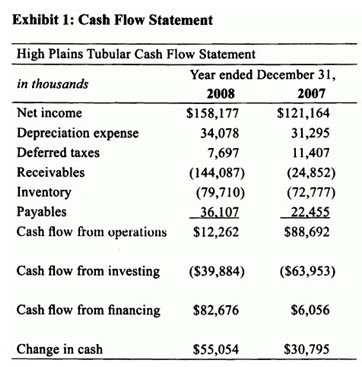


Exhibit 2: Selected Financial Footnotes

1. During 2008, High Plains' sales increased 27% over 2007. Its sales growth continues to significantly exceed the industry average. Sales are recognized when a firm order is received from the customer, the sales price is fixed and determinable, and collectability is reasonably assured.
2. The cost of inventories is determined using the last-in, first-out (LIFO) method. Had the first-in, first-out method been used, inventories would have been $152 million and $143 million higher as of December 31,2008 and 2007, respectively.
3. Effective January 1, 2008, High Plains changed its depreciation method from the double- declining balance method to the straight-line method in order to be more comparable with the accounting practices of other firms within its industry. The change was not retroactively applied and only affects assets that were acquired on or after January 1,2008.
4. High Plains made the following discretionary expenditures for maintenance and repair of plant and equipment and for advertising and marketing:



5. During the fiscal year ended December 31, 2008, High Plains sold $50 million of its accounts receivable, with recourse, to an unrelated entity. All of the receivables were still outstanding at year end.
6. High Plains conducts some of its operations in facilities leased under noncancelable capital leases. Certain leases include renewal options with provisions for increased lease payments during the renewal term.
7. High Plains' average net operating assets at the end of 2008 and 2007 was $977.89 million and $642.83 million, respectively.

What is the most likely effect of High Plains' revenue recognition policy on net income and inventory turnover?

  1. Net income and inventory turnover are overstated.
  2. Only net income is overstated.
  3. Only inventory turnover is overstated.

Answer(s): A

Explanation:

Revenue should be recognized when earned and payment is assured. High Plains is recognizing revenue as orders are received. Since High Plains still has an obligation to deliver the goods, revenue is not yet earned. By recognizing revenue too soon, net income is overstated and ending inventory is understated. Understated ending inventory would result in an overstated inventory turnover ratio. (Study Session 7, LOS 25.0


High Plains Tubular Company is a leading manufacturer and distributor of quality steel products used in energy, industrial, and automotive applications worldwide.

The U.S. steel industry has been challenged by competition from foreign producers located primarily in Asia. All of the U.S. producers are experiencing declining margins as labor costs continue to increase. In addition, the U.S. steel mills arc technologically inferior to the foreign competitors. Also, the U.S. producers have significant environmental issues that remain unresolved.

High Plains is not immune from the problems of the industry and is currently in technical default under its bond covenants. The default is a result of the failure to meet certain coverage and turnover ratios. Earlier this year, High Plains and its bondholders entered into an agreement that will allow High Plains time to become compliant with the covenants. If High Plains is not in compliance by year end, the bondholders can immediately accelerate the maturity date of the bonds. In this case. High Plains would have no choice but to file bankruptcy.
High Plains follows U.S. GAAP. For the year ended 2008, High Plains received an unqualified opinion from its independent auditor. However, the auditor's opinion included an explanatory paragraph about High Plains' inability to continue as a going concern in the event its bonds remain in technical default.
At the end of 2008, High Plains' Chief Executive Officer (CEO) and Chief Financial Officer (CFO) filed the necessary certifications required by the Securities and Exchange Commission (SEC).
To get a better understanding of High Plains' financial situation, it is helpful to review High Plains' cash flow statement found in Exhibit 1 and selected financial footnotes found in Exhibit 2.


Exhibit 2: Selected Financial Footnotes
1. During 2008, High Plains' sales increased 27% over 2007. Its sales growth continues to significantly exceed the industry average. Sales are recognized when a firm order is received from the customer, the sales price is fixed and determinable, and collectability is reasonably assured.
2. The cost of inventories is determined using the last-in, first-out (LIFO) method. Had the first-in, first-out method been used, inventories would have been $152 million and $143 million higher as of December 31,2008 and 2007, respectively.

3. Effective January 1, 2008, High Plains changed its depreciation method from the double- declining balance method to the straight-line method in order to be more comparable with the accounting practices of other firms within its industry. The change was not retroactively applied and only affects assets that were acquired on or after January 1,2008.
4. High Plains made the following discretionary expenditures for maintenance and repair of plant and equipment and for advertising and marketing:


5. During the fiscal year ended December 31, 2008, High Plains sold $50 million of its accounts receivable, with recourse, to an unrelated entity. All of the receivables were still outstanding at year end.
6. High Plains conducts some of its operations in facilities leased under noncancelable capital leases. Certain leases include renewal options with provisions for increased lease payments during the renewal term.
7. High Plains' average net operating assets at the end of 2008 and 2007 was $977.89 million and $642.83 million, respectively.

As compared to the year ended 2007, High Plains' cash flow accrual ratio for the year ended 2008 is:

  1. higher.
  2. lower.
  3. the same.

Answer(s): A

Explanation:

The cash flow accrual ratio increased during 2008 from 15% to 19%. (Study Session 7, LOS 25-d)


High Plains Tubular Company is a leading manufacturer and distributor of quality steel products used in energy, industrial, and automotive applications worldwide.
The U.S. steel industry has been challenged by competition from foreign producers located primarily in Asia. All of the U.S. producers are experiencing declining margins as labor costs continue to increase. In addition, the U.S. steel mills arc technologically inferior to the foreign competitors. Also, the U.S. producers have significant environmental issues that remain unresolved.
High Plains is not immune from the problems of the industry and is currently in technical default under its bond covenants. The default is a result of the failure to meet certain coverage and turnover ratios. Earlier this year, High Plains and its bondholders entered into an agreement that will allow High Plains time to become compliant with the covenants. If High Plains is not in compliance by year end, the bondholders can immediately accelerate the maturity date of the bonds. In this case. High Plains would have no choice but to file bankruptcy.

High Plains follows U.S. GAAP. For the year ended 2008, High Plains received an unqualified opinion from its independent auditor. However, the auditor's opinion included an explanatory paragraph about High Plains' inability to continue as a going concern in the event its bonds remain in technical default.

At the end of 2008, High Plains' Chief Executive Officer (CEO) and Chief Financial Officer (CFO) filed the necessary certifications required by the Securities and Exchange Commission (SEC).
To get a better understanding of High Plains' financial situation, it is helpful to review High Plains' cash flow statement found in Exhibit 1 and selected financial footnotes found in Exhibit 2.

Exhibit 2: Selected Financial Footnotes

1. During 2008, High Plains' sales increased 27% over 2007. Its sales growth continues to significantly exceed the industry average. Sales are recognized when a firm order is received from the customer, the sales price is fixed and determinable, and collectability is reasonably assured.
2. The cost of inventories is determined using the last-in, first-out (LIFO) method. Had the first-in, first-out method been used, inventories would have been $152 million and $143 million higher as of December 31,2008 and 2007, respectively.
3. Effective January 1, 2008, High Plains changed its depreciation method from the double- declining balance method to the straight-line method in order to be more comparable with the accounting practices of other firms within its industry. The change was not retroactively applied and only affects assets that were acquired on or after January 1,2008.
4. High Plains made the following discretionary expenditures for maintenance and repair of plant and equipment and for advertising and marketing:


5. During the fiscal year ended December 31, 2008, High Plains sold $50 million of its accounts receivable, with recourse, to an unrelated entity. All of the receivables were still outstanding at year end.
6. High Plains conducts some of its operations in facilities leased under noncancelable capital leases. Certain leases include renewal options with provisions for increased lease payments during the renewal term.
7. High Plains' average net operating assets at the end of 2008 and 2007 was $977.89 million and $642.83 million, respectively.

Using only the information found in Exhibit 1 and Exhibit 2, which of the following is most indicative of lower earnings quality?

  1. High Plains' discretionary expenses.
  2. The change in High Plains' depreciation method.
  3. High Plains' inventory cost flow assumption.

Answer(s): A

Explanation:

Maintenance and repairs, and advertising and marketing, are discretionary expenses. Both items are declining as the investment in capital assets and sales are increasing (investment in capital assets is increasing because CFI is greater than depreciation expense for the period). The change to the straight-line depreciation method is certainly less conservative. However, measuring earnings quality based on conservative earnings is an inferior measure. (Study Session 7, LOS25.d,f)
Note that the reason answer C is incorrect is that using LIFO as an inventory cost flow assumption during periods of stable or rising prices would cause net earnings to reflect economic (real) earnings, thereby leading to a higher quality of earnings.


High Plains Tubular Company is a leading manufacturer and distributor of quality steel products used in energy, industrial, and automotive applications worldwide.
The U.S. steel industry has been challenged by competition from foreign producers located primarily in Asia. All of the U.S. producers are experiencing declining margins as labor costs continue to increase. In addition, the U.S. steel mills arc technologically inferior to the foreign competitors. Also, the U.S. producers have significant environmental issues that remain unresolved.

High Plains is not immune from the problems of the industry and is currently in technical default under its bond covenants. The default is a result of the failure to meet certain coverage and turnover ratios. Earlier this year, High Plains and its bondholders entered into an agreement that will allow High Plains time to become compliant with the covenants. If High Plains is not in compliance by year end, the bondholders can immediately accelerate the maturity date of the bonds. In this case. High Plains would have no choice but to file bankruptcy.

High Plains follows U.S. GAAP. For the year ended 2008, High Plains received an unqualified opinion from its independent auditor. However, the auditor's opinion included an explanatory paragraph about High Plains' inability to continue as a going concern in the event its bonds remain in technical default.

At the end of 2008, High Plains' Chief Executive Officer (CEO) and Chief Financial Officer (CFO) filed the necessary certifications required by the Securities and Exchange Commission (SEC).
To get a better understanding of High Plains' financial situation, it is helpful to review High Plains' cash flow statement found in Exhibit 1 and selected financial footnotes found in Exhibit 2.


Exhibit 2: Selected Financial Footnotes
1. During 2008, High Plains' sales increased 27% over 2007. Its sales growth continues to significantly exceed the industry average. Sales are recognized when a firm order is received from the customer, the sales price is fixed and determinable, and collectability is reasonably assured.

2. The cost of inventories is determined using the last-in, first-out (LIFO) method. Had the first-in, first-out method been used, inventories would have been $152 million and $143 million higher as of December 31,2008 and 2007, respectively.
3. Effective January 1, 2008, High Plains changed its depreciation method from the double- declining balance method to the straight-line method in order to be more comparable with the accounting practices of other firms within its industry. The change was not retroactively applied and only affects assets that were acquired on or after January 1,2008.
4. High Plains made the following discretionary expenditures for maintenance and repair of plant and equipment and for advertising and marketing:


5. During the fiscal year ended December 31, 2008, High Plains sold $50 million of its accounts receivable, with recourse, to an unrelated entity. All of the receivables were still outstanding at year end.
6. High Plains conducts some of its operations in facilities leased under noncancelable capital leases. Certain leases include renewal options with provisions for increased lease payments during the renewal term.

7. High Plains' average net operating assets at the end of 2008 and 2007 was $977.89 million and $642.83 million, respectively.

Does High Plains' accounting treatment of its capital leases and receivable sale lower its earnings quality?

  1. Both treatments lower earnings quality.
  2. The treatment of capital leases lowers earnings quality.
  3. The treatment of the receivables sale lowers earnings quality.

Answer(s): C

Explanation:

A capital lease is reported on the balance sheet as an asset and as a liability. In the income statement, the leased asset is depreciated and interest expense is recognized on the liability. Thus, capitalizing a lease enhances earnings quality. An operating lease lowers earnings quality.
The receivable sale, with recourse, lowers earnings quality. The sale is treated as a collection thereby increasing operating cash flow. However, High Plains is still responsible to the buyer in the event the receivables are not ultimately collected. Thus, the receivable sale is a collateralized borrowing arrangement that remains orT-balance-sheet. (Study Session 7, LOS 25.d,f)


High Plains Tubular Company is a leading manufacturer and distributor of quality steel products used in energy, industrial, and automotive applications worldwide.
The U.S. steel industry has been challenged by competition from foreign producers located primarily in Asia. All of the U.S. producers are experiencing declining margins as labor costs continue to increase. In addition, the U.S. steel mills arc technologically inferior to the foreign competitors. Also, the U.S. producers have significant environmental issues that remain unresolved.

High Plains is not immune from the problems of the industry and is currently in technical default under its bond covenants. The default is a result of the failure to meet certain coverage and turnover ratios. Earlier this year, High Plains and its bondholders entered into an agreement that will allow High Plains time to become compliant with the covenants. If High Plains is not in compliance by year end, the bondholders can immediately accelerate the maturity date of the bonds. In this case. High Plains would have no choice but to file bankruptcy.

High Plains follows U.S. GAAP. For the year ended 2008, High Plains received an unqualified opinion from its independent auditor. However, the auditor's opinion included an explanatory paragraph about High Plains' inability to continue as a going concern in the event its bonds remain in technical default.

At the end of 2008, High Plains' Chief Executive Officer (CEO) and Chief Financial Officer (CFO) filed the necessary certifications required by the Securities and Exchange Commission (SEC).

To get a better understanding of High Plains' financial situation, it is helpful to review High Plains' cash flow statement found in Exhibit 1 and selected financial footnotes found in Exhibit 2.


Exhibit 2: Selected Financial Footnotes
1. During 2008, High Plains' sales increased 27% over 2007. Its sales growth continues to significantly exceed the industry average. Sales are recognized when a firm order is received from the customer, the sales price is fixed and determinable, and collectability is reasonably assured.

2. The cost of inventories is determined using the last-in, first-out (LIFO) method. Had the first-in, first-out method been used, inventories would have been $152 million and $143 million higher as of December 31,2008 and 2007, respectively.

3. Effective January 1, 2008, High Plains changed its depreciation method from the double- declining balance method to the straight-line method in order to be more comparable with the accounting practices of other firms within its industry. The change was not retroactively applied and only affects assets that were acquired on or after January 1,2008.

4. High Plains made the following discretionary expenditures for maintenance and repair of plant and equipment and for advertising and marketing:


5. During the fiscal year ended December 31, 2008, High Plains sold $50 million of its accounts receivable, with recourse, to an unrelated entity. All of the receivables were still outstanding at year end.

6. High Plains conducts some of its operations in facilities leased under noncancelable capital leases. Certain leases include renewal options with provisions for increased lease payments during the renewal term.

7. High Plains' average net operating assets at the end of 2008 and 2007 was $977.89 million and $642.83 million, respectively.

Which of the following statements about evaluating High Plains financial reporting quality is least accurate?

  1. Higher Plains may have manipulated earnings due to the risk of
  2. High Plains' extreme revenue growth will likely revert back to normal levels over time.
  3. Because of the estimates involved, a higher weighting should be assigned to the accrual component of High Plains' earnings as compared to the cash component.

Answer(s): C

Explanation:

It appears thai High Plains manipulated its earnings upward in 2008 to avoid default under its bond covenants. However, the higher earnings are lower quality as measured by the cash flow accrual ratio. Because of the estimates involved, a lower weighting should be assigned to the accrual component of High Plains' earnings. Extreme earnings (including revenues) tend to revert to normal levels over time (mean reversion). (Study Session 7, LOS 25.b,e)


Viewing Page 5 of 145


Share your comments for CFA® CFA-Level-II exam with other users:

Boopathy 8/17/2023 1:03:00 AM

i need this dump kindly upload it
Anonymous


s_123 8/12/2023 4:28:00 PM

do we need c# coding to be az204 certified
Anonymous


Blessious Phiri 8/15/2023 3:38:00 PM

excellent topics covered
Anonymous


Manasa 12/5/2023 3:15:00 AM

are these really financial cloud questions and answers, seems these are basic admin question and answers
Anonymous


Not Robot 5/14/2023 5:33:00 PM

are these comments real
Anonymous


kriah 9/4/2023 10:44:00 PM

please upload the latest dumps
UNITED STATES


ed 12/17/2023 1:41:00 PM

a company runs its workloads on premises. the company wants to forecast the cost of running a large application on aws. which aws service or tool can the company use to obtain this information? pricing calculator ... the aws pricing calculator is primarily used for estimating future costs
UNITED STATES


Muru 12/29/2023 10:23:00 AM

looks interesting
Anonymous


Tech Lady 10/17/2023 12:36:00 PM

thanks! that’s amazing
Anonymous


Mike 8/20/2023 5:12:00 PM

the exam dumps are helping me get a solid foundation on the practical techniques and practices needed to be successful in the auditing world.
UNITED STATES


Nobody 9/18/2023 6:35:00 PM

q 14 should be dmz sever1 and notepad.exe why does note pad have a 443 connection
Anonymous


Muhammad Rawish Siddiqui 12/4/2023 12:17:00 PM

question # 108, correct answers are business growth and risk reduction.
SAUDI ARABIA


Emmah 7/29/2023 9:59:00 AM

are these valid chfi questions
KENYA


Mort 10/19/2023 7:09:00 PM

question: 162 should be dlp (b)
EUROPEAN UNION


Eknath 10/4/2023 1:21:00 AM

good exam questions
INDIA


Nizam 6/16/2023 7:29:00 AM

I have to say this is really close to real exam. Passed my exam with this.
EUROPEAN UNION


poran 11/20/2023 4:43:00 AM

good analytics question
Anonymous


Antony 11/23/2023 11:36:00 AM

this looks accurate
INDIA


Ethan 8/23/2023 12:52:00 AM

question 46, the answer should be data "virtualization" (not visualization).
Anonymous


nSiva 9/22/2023 5:58:00 AM

its useful.
UNITED STATES


Ranveer 7/26/2023 7:26:00 PM

Pass this exam 3 days ago. The PDF version and the Xengine App is quite useful.
SOUTH AFRICA


Sanjay 8/15/2023 10:22:00 AM

informative for me.
UNITED STATES


Tom 12/12/2023 8:53:00 PM

question 134s answer shoule be "dlp"
JAPAN


Alex 11/7/2023 11:02:00 AM

in 72 the answer must be [sys_user_has_role] table.
Anonymous


Finn 5/4/2023 10:21:00 PM

i appreciated the mix of multiple-choice and short answer questions. i passed my exam this morning.
IRLAND


AJ 7/13/2023 8:33:00 AM

great to find this website, thanks
UNITED ARAB EMIRATES


Curtis Nakawaki 6/29/2023 9:11:00 PM

examination questions seem to be relevant.
UNITED STATES


Umashankar Sharma 10/22/2023 9:39:00 AM

planning to take psm test
Anonymous


ED SHAW 7/31/2023 10:34:00 AM

please allow to download
UNITED STATES


AD 7/22/2023 11:29:00 AM

please provide dumps
UNITED STATES


Ayyjayy 11/6/2023 7:29:00 AM

is the answer to question 15 correct ? i feel like the answer should be b
BAHRAIN


Blessious Phiri 8/12/2023 11:56:00 AM

its getting more technical
Anonymous


Jeanine J 7/11/2023 3:04:00 PM

i think these questions are what i need.
UNITED STATES


Aderonke 10/23/2023 2:13:00 PM

helpful assessment
UNITED KINGDOM