Microsoft Dynamics 365 Business Central Functional Consultant MB-800 Dumps in PDF

Free Microsoft MB-800 Real Questions (page: 8)


This is a case study. Case studies are not timed separately. You can use as much exam time as you would like to complete each case. However, there may be additional case studies and sections on this exam. You must manage your time to ensure that you are able to complete all questions included on this exam in the time provided.

To answer the questions included in a case study, you will need to reference information that is provided in the case study. Case studies might contain exhibits and other resources that provide more information about the scenario that is described in the case study. Each question is independent of the other questions in this case study.

At the end of this case study, a review screen will appear. This screen allows you to review your answers and to make changes before you move to the next section of the exam. After you begin a new section, you cannot return to this section.

To start the case study
To display the first question in the case study, click the Next button. Use the buttons in the left pane to explore the content of the case study before you answer the questions. Clicking these buttons displays information such as business requirements, existing environment, and problem statements. When you are ready to answer a question, click the Question button to return to the question.

Background
Best for You Organics Company is a mid-sized wholesale distributor of organic produce and other food items to national retail grocery store chains. Over half the company’s revenue is from produce with an average shelf life of less than a week. The remaining revenue comes from shelf-stable canned and packaged items.

Best for You Organics experienced substantial growth in the last two years. They expanded from one location to three locations, increased the number of employees from 25 to over 100, and more than doubled their revenue. The company’s business forecast predicts a steady rate of growth of at least 20 percent annually for the next five years.

As a result of their expansion, Best for You Organics is experiencing delays and bottlenecks in their processes. The company has decided to implement Dynamics 365 Business Central as a new Enterprise Resource Planning (ERP) solution to increase efficiency and automation to support their continued growth.

Current environment

Deliveries
-The company receives daily truckloads of products from their vendors, warehouses the products briefly, and then ships orders based on a weekly delivery cycle to each customer’s store.
-Customers have regular standing orders that are revised and finished one week prior to delivery.
-Best for You Organics has a fleet of trucks that make deliveries according to planned routes.
-The company also has a floating route for trucks to deliver rush orders. The route is being used more often by customers and has overwhelmed the warehouse with exception processing.

Duties
The company wants to provide greater separation of duties between activities in the office and activities in the warehouse.

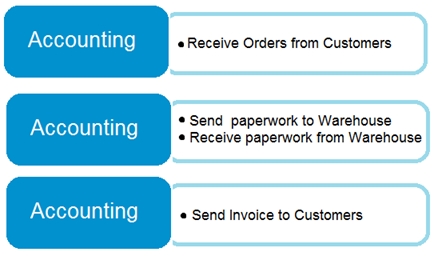
The accounting team enters orders for the sales team, sends pick tickers back to the warehouse, and organizes shipping documents. The accounting team invoices the orders when they receive instructions from the warehouse that an order shipped.

Employees have expressed frustration because they need to work longer hours to accommodate the increase in sales.

The company does not use the Advanced Warehousing function.

Requirements

Salespeople
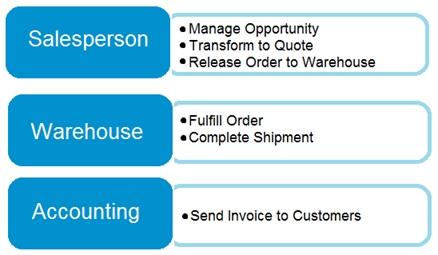
-Salespeople must be able to manage opportunities that are converted to quotes.
-Salespeople must be able to release orders to the warehouse to be fulfilled once a quote is final.
-Salespeople must be trained on how to determine if inventory is available when they are completing the quote to avoid promising inventory that is not on hand because all orders are processed one week in advance of delivery.

Team responsibilities
Deliveries must be shipped daily by employees in the warehouse. The office must be responsible for completing the invoicing process.

The current team responsibilities are shown in the following graphic:

The required team responsibilities are shown in the following graphic:

Vendor management
-The company contracts with each vendor for regular discounts at the invoice level.
-The company requires a pre-set discount percentage to calculate automatically when the purchaser completes a purchase order.
-The company must be able to see a copy of the completed purchase order in the system when they have new contract negotiations with their vendors.

Customer and inventory management
-Sales invoices must be automatically emailed by the system to customers.
-A template must be used for emails sent to customers. The template must not be altered.
-Customers who pre-pay their invoices must not receive a copy of their invoices.
-The company warehouses all products as Case quantities. The company has difficulty recording accurate costs for product returns. The company wants to expand their capabilities for managing returns by setting up all inventory in a quantity of Each.

Reporting
The company must be able to answer two key questions when they report financial results:

-Which customers are buying which items?
-Which salespeople are selling in which regions?

When discussing customers, the company must refer to each Customer Group as follows:

-Big Box
-Franchise
-Private

When discussing items, the company must refer to each Item Group as follows:

-Fair Trade
-Free Range
-Grass Fed
-Heirloom
-Organic

Salesperson names that must be used are:

-SalespersonA
-SalespersonB
-SalespersonC
-SalespersonD

Region names that must be used are:

-North
-South
-East
-West

Commission
-The company must be able to track salesperson performance within certain regions to calculate commission.
-Each salesperson must be assigned only to a single region.
-This commission data is currently recorded inconsistently, resulting in incorrect combinations that require manual correction. The company must have some level of automation to manage this.

Issues

Issue 1
The accounting team needs an improved process for reconciling inventory to the general ledger.

-Posted transactions are changing financial reporting in periods that have been closed.
-Unexpected changes in inventory cost for previous months are causing costing inaccuracies.
-The system must restrict the adjustment of costs for closed months.
-The new policy will be to restrict all users to posting in the current month only, with the exception of a few employees from the accounting team.
-The calendar fiscal year for company must begin on June 1.

Issue 2
The accounting team uses a complex manual accrual process to determine the accounting impact of items received but not invoiced. The system must streamline the item accrual process.

Issue 3
The company often receives a higher quantity of produce items than what they order because vendors allow for spoilage or damage of produce in transit. The company does not want to allow over receipt on non-produce items.

Issue 4

The company has received comments from their auditors that invoices are not being properly compared to received inventory documents before they are posted. The company does not use warehouse management and always handles processes directly from the purchase order. The company always has the following documents:

-purchase order from the procurement department
-receiving document from the warehouse
-electronic invoice from the vendor
-

You need to configure the system to meet the requirements for sending invoices.
Which three actions should you perform? Each correct answer presents part of the solution.
NOTE: Each correct selection is worth one point.

  1. Set Email to Yes (Use Default Settings).
  2. Allow Sender Substitution for SMTP Mail Setup.
  3. Set Email to Yes (Prompt for Settings).
  4. Assign a Document Sending Profile to the Customer where Email is set to No.
  5. Apply Office Server Settings to the SMTP Mail Setup.
  6. Assign a Document Sending Profile to the Customer where Email is set to Yes.

Answer(s): A,E,F


Reference:

https://docs.microsoft.com/en-gb/dynamics365/business-central/sales-how-setup-document-send-profiles


This is a case study. Case studies are not timed separately. You can use as much exam time as you would like to complete each case. However, there may be additional case studies and sections on this exam. You must manage your time to ensure that you are able to complete all questions included on this exam in the time provided.

To answer the questions included in a case study, you will need to reference information that is provided in the case study. Case studies might contain exhibits and other resources that provide more information about the scenario that is described in the case study. Each question is independent of the other questions in this case study.

At the end of this case study, a review screen will appear. This screen allows you to review your answers and to make changes before you move to the next section of the exam. After you begin a new section, you cannot return to this section.

To start the case study
To display the first question in the case study, click the Next button. Use the buttons in the left pane to explore the content of the case study before you answer the questions. Clicking these buttons displays information such as business requirements, existing environment, and problem statements. When you are ready to answer a question, click the Question button to return to the question.

Background
Best for You Organics Company is a mid-sized wholesale distributor of organic produce and other food items to national retail grocery store chains. Over half the company’s revenue is from produce with an average shelf life of less than a week. The remaining revenue comes from shelf-stable canned and packaged items.

Best for You Organics experienced substantial growth in the last two years. They expanded from one location to three locations, increased the number of employees from 25 to over 100, and more than doubled their revenue. The company’s business forecast predicts a steady rate of growth of at least 20 percent annually for the next five years.

As a result of their expansion, Best for You Organics is experiencing delays and bottlenecks in their processes. The company has decided to implement Dynamics 365 Business Central as a new Enterprise Resource Planning (ERP) solution to increase efficiency and automation to support their continued growth.

Current environment

Deliveries
-The company receives daily truckloads of products from their vendors, warehouses the products briefly, and then ships orders based on a weekly delivery cycle to each customer’s store.
-Customers have regular standing orders that are revised and finished one week prior to delivery.
-Best for You Organics has a fleet of trucks that make deliveries according to planned routes.
-The company also has a floating route for trucks to deliver rush orders. The route is being used more often by customers and has overwhelmed the warehouse with exception processing.

Duties
The company wants to provide greater separation of duties between activities in the office and activities in the warehouse.

The accounting team enters orders for the sales team, sends pick tickers back to the warehouse, and organizes shipping documents. The accounting team invoices the orders when they receive instructions from the warehouse that an order shipped.

Employees have expressed frustration because they need to work longer hours to accommodate the increase in sales.

The company does not use the Advanced Warehousing function.

Requirements

Salespeople
-Salespeople must be able to manage opportunities that are converted to quotes.
-Salespeople must be able to release orders to the warehouse to be fulfilled once a quote is final.
-Salespeople must be trained on how to determine if inventory is available when they are completing the quote to avoid promising inventory that is not on hand because all orders are processed one week in advance of delivery.

Team responsibilities
Deliveries must be shipped daily by employees in the warehouse. The office must be responsible for completing the invoicing process.

The current team responsibilities are shown in the following graphic:


The required team responsibilities are shown in the following graphic:


Vendor management
-The company contracts with each vendor for regular discounts at the invoice level.
-The company requires a pre-set discount percentage to calculate automatically when the purchaser completes a purchase order.
-The company must be able to see a copy of the completed purchase order in the system when they have new contract negotiations with their vendors.

Customer and inventory management
-Sales invoices must be automatically emailed by the system to customers.
-A template must be used for emails sent to customers. The template must not be altered.
-Customers who pre-pay their invoices must not receive a copy of their invoices.
-The company warehouses all products as Case quantities. The company has difficulty recording accurate costs for product returns. The company wants to expand their capabilities for managing returns by setting up all inventory in a quantity of Each.

Reporting
The company must be able to answer two key questions when they report financial results:

-Which customers are buying which items?
-Which salespeople are selling in which regions?

When discussing customers, the company must refer to each Customer Group as follows:

-Big Box
-Franchise
-Private

When discussing items, the company must refer to each Item Group as follows:

-Fair Trade
-Free Range
-Grass Fed
-Heirloom
-Organic

Salesperson names that must be used are:

-SalespersonA
-SalespersonB
-SalespersonC
-SalespersonD

Region names that must be used are:

-North
-South
-East
-West

Commission
-The company must be able to track salesperson performance within certain regions to calculate commission.
-Each salesperson must be assigned only to a single region.
-This commission data is currently recorded inconsistently, resulting in incorrect combinations that require manual correction. The company must have some level of automation to manage this.

Issues

Issue 1
The accounting team needs an improved process for reconciling inventory to the general ledger.

-Posted transactions are changing financial reporting in periods that have been closed.
-Unexpected changes in inventory cost for previous months are causing costing inaccuracies.
-The system must restrict the adjustment of costs for closed months.
-The new policy will be to restrict all users to posting in the current month only, with the exception of a few employees from the accounting team.
-The calendar fiscal year for company must begin on June 1.

Issue 2
The accounting team uses a complex manual accrual process to determine the accounting impact of items received but not invoiced. The system must streamline the item accrual process.

Issue 3
The company often receives a higher quantity of produce items than what they order because vendors allow for spoilage or damage of produce in transit. The company does not want to allow over receipt on non-produce items.

Issue 4

The company has received comments from their auditors that invoices are not being properly compared to received inventory documents before they are posted. The company does not use warehouse management and always handles processes directly from the purchase order. The company always has the following documents:

-purchase order from the procurement department
-receiving document from the warehouse
-electronic invoice from the vendor
-

DRAG DROP (Drag and Drop is not supported)
You need to configure discounting for sales.

Which three actions should you perform in sequence? To answer, move the appropriate actions from the list of actions to the answer area.
Select and Place:

  1. See Explanation section for answer.

Answer(s): A

Explanation:


This is a case study. Case studies are not timed separately. You can use as much exam time as you would like to complete each case. However, there may be additional case studies and sections on this exam. You must manage your time to ensure that you are able to complete all questions included on this exam in the time provided.

To answer the questions included in a case study, you will need to reference information that is provided in the case study. Case studies might contain exhibits and other resources that provide more information about the scenario that is described in the case study. Each question is independent of the other questions in this case study.

At the end of this case study, a review screen will appear. This screen allows you to review your answers and to make changes before you move to the next section of the exam. After you begin a new section, you cannot return to this section.

To start the case study
To display the first question in the case study, click the Next button. Use the buttons in the left pane to explore the content of the case study before you answer the questions. Clicking these buttons displays information such as business requirements, existing environment, and problem statements. When you are ready to answer a question, click the Question button to return to the question.

Background
Best for You Organics Company is a mid-sized wholesale distributor of organic produce and other food items to national retail grocery store chains. Over half the company’s revenue is from produce with an average shelf life of less than a week. The remaining revenue comes from shelf-stable canned and packaged items.

Best for You Organics experienced substantial growth in the last two years. They expanded from one location to three locations, increased the number of employees from 25 to over 100, and more than doubled their revenue. The company’s business forecast predicts a steady rate of growth of at least 20 percent annually for the next five years.

As a result of their expansion, Best for You Organics is experiencing delays and bottlenecks in their processes. The company has decided to implement Dynamics 365 Business Central as a new Enterprise Resource Planning (ERP) solution to increase efficiency and automation to support their continued growth.

Current environment

Deliveries
-The company receives daily truckloads of products from their vendors, warehouses the products briefly, and then ships orders based on a weekly delivery cycle to each customer’s store.
-Customers have regular standing orders that are revised and finished one week prior to delivery.
-Best for You Organics has a fleet of trucks that make deliveries according to planned routes.
-The company also has a floating route for trucks to deliver rush orders. The route is being used more often by customers and has overwhelmed the warehouse with exception processing.

Duties
The company wants to provide greater separation of duties between activities in the office and activities in the warehouse.

The accounting team enters orders for the sales team, sends pick tickers back to the warehouse, and organizes shipping documents. The accounting team invoices the orders when they receive instructions from the warehouse that an order shipped.

Employees have expressed frustration because they need to work longer hours to accommodate the increase in sales.

The company does not use the Advanced Warehousing function.

Requirements

Salespeople
-Salespeople must be able to manage opportunities that are converted to quotes.
-Salespeople must be able to release orders to the warehouse to be fulfilled once a quote is final.
-Salespeople must be trained on how to determine if inventory is available when they are completing the quote to avoid promising inventory that is not on hand because all orders are processed one week in advance of delivery.

Team responsibilities
Deliveries must be shipped daily by employees in the warehouse. The office must be responsible for completing the invoicing process.

The current team responsibilities are shown in the following graphic:


The required team responsibilities are shown in the following graphic:


Vendor management
-The company contracts with each vendor for regular discounts at the invoice level.
-The company requires a pre-set discount percentage to calculate automatically when the purchaser completes a purchase order.
-The company must be able to see a copy of the completed purchase order in the system when they have new contract negotiations with their vendors.

Customer and inventory management
-Sales invoices must be automatically emailed by the system to customers.
-A template must be used for emails sent to customers. The template must not be altered.
-Customers who pre-pay their invoices must not receive a copy of their invoices.
-The company warehouses all products as Case quantities. The company has difficulty recording accurate costs for product returns. The company wants to expand their capabilities for managing returns by setting up all inventory in a quantity of Each.

Reporting
The company must be able to answer two key questions when they report financial results:

-Which customers are buying which items?
-Which salespeople are selling in which regions?

When discussing customers, the company must refer to each Customer Group as follows:

-Big Box
-Franchise
-Private

When discussing items, the company must refer to each Item Group as follows:

-Fair Trade
-Free Range
-Grass Fed
-Heirloom
-Organic

Salesperson names that must be used are:

-SalespersonA
-SalespersonB
-SalespersonC
-SalespersonD

Region names that must be used are:

-North
-South
-East
-West

Commission
-The company must be able to track salesperson performance within certain regions to calculate commission.
-Each salesperson must be assigned only to a single region.
-This commission data is currently recorded inconsistently, resulting in incorrect combinations that require manual correction. The company must have some level of automation to manage this.

Issues

Issue 1
The accounting team needs an improved process for reconciling inventory to the general ledger.

-Posted transactions are changing financial reporting in periods that have been closed.
-Unexpected changes in inventory cost for previous months are causing costing inaccuracies.
-The system must restrict the adjustment of costs for closed months.
-The new policy will be to restrict all users to posting in the current month only, with the exception of a few employees from the accounting team.
-The calendar fiscal year for company must begin on June 1.

Issue 2
The accounting team uses a complex manual accrual process to determine the accounting impact of items received but not invoiced. The system must streamline the item accrual process.

Issue 3
The company often receives a higher quantity of produce items than what they order because vendors allow for spoilage or damage of produce in transit. The company does not want to allow over receipt on non-produce items.

Issue 4

The company has received comments from their auditors that invoices are not being properly compared to received inventory documents before they are posted. The company does not use warehouse management and always handles processes directly from the purchase order. The company always has the following documents:

-purchase order from the procurement department
-receiving document from the warehouse
-electronic invoice from the vendor
-

A customer in the restaurant buying group purchases olive oil on the date of the overstock special.
You need to verify the sales price of the product for the customer.
Which price will the system generate?

  1. $15.30
  2. $16.15
  3. $17.00
  4. $18.00

Answer(s): C

Explanation:

An overstocked olive oil has a regular price of $20 per unit.
However, on a specific day only, there is an overstock special at a 15 percent discount off the regular price.

The 15% is deducted from the ‘regular’ price ($20), not the special price that the restaurant buying group pay ($18).


This is a case study. Case studies are not timed separately. You can use as much exam time as you would like to complete each case. However, there may be additional case studies and sections on this exam. You must manage your time to ensure that you are able to complete all questions included on this exam in the time provided.

To answer the questions included in a case study, you will need to reference information that is provided in the case study. Case studies might contain exhibits and other resources that provide more information about the scenario that is described in the case study. Each question is independent of the other questions in this case study.

At the end of this case study, a review screen will appear. This screen allows you to review your answers and to make changes before you move to the next section of the exam. After you begin a new section, you cannot return to this section.

To start the case study
To display the first question in the case study, click the Next button. Use the buttons in the left pane to explore the content of the case study before you answer the questions. Clicking these buttons displays information such as business requirements, existing environment, and problem statements. When you are ready to answer a question, click the Question button to return to the question.

Background
Best for You Organics Company is a mid-sized wholesale distributor of organic produce and other food items to national retail grocery store chains. Over half the company’s revenue is from produce with an average shelf life of less than a week. The remaining revenue comes from shelf-stable canned and packaged items.

Best for You Organics experienced substantial growth in the last two years. They expanded from one location to three locations, increased the number of employees from 25 to over 100, and more than doubled their revenue. The company’s business forecast predicts a steady rate of growth of at least 20 percent annually for the next five years.

As a result of their expansion, Best for You Organics is experiencing delays and bottlenecks in their processes. The company has decided to implement Dynamics 365 Business Central as a new Enterprise Resource Planning (ERP) solution to increase efficiency and automation to support their continued growth.

Current environment

Deliveries
-The company receives daily truckloads of products from their vendors, warehouses the products briefly, and then ships orders based on a weekly delivery cycle to each customer’s store.
-Customers have regular standing orders that are revised and finished one week prior to delivery.
-Best for You Organics has a fleet of trucks that make deliveries according to planned routes.
-The company also has a floating route for trucks to deliver rush orders. The route is being used more often by customers and has overwhelmed the warehouse with exception processing.

Duties
The company wants to provide greater separation of duties between activities in the office and activities in the warehouse.

The accounting team enters orders for the sales team, sends pick tickers back to the warehouse, and organizes shipping documents. The accounting team invoices the orders when they receive instructions from the warehouse that an order shipped.

Employees have expressed frustration because they need to work longer hours to accommodate the increase in sales.

The company does not use the Advanced Warehousing function.

Requirements

Salespeople
-Salespeople must be able to manage opportunities that are converted to quotes.
-Salespeople must be able to release orders to the warehouse to be fulfilled once a quote is final.
-Salespeople must be trained on how to determine if inventory is available when they are completing the quote to avoid promising inventory that is not on hand because all orders are processed one week in advance of delivery.

Team responsibilities
Deliveries must be shipped daily by employees in the warehouse. The office must be responsible for completing the invoicing process.

The current team responsibilities are shown in the following graphic:


The required team responsibilities are shown in the following graphic:


Vendor management
-The company contracts with each vendor for regular discounts at the invoice level.
-The company requires a pre-set discount percentage to calculate automatically when the purchaser completes a purchase order.
-The company must be able to see a copy of the completed purchase order in the system when they have new contract negotiations with their vendors.

Customer and inventory management
-Sales invoices must be automatically emailed by the system to customers.
-A template must be used for emails sent to customers. The template must not be altered.
-Customers who pre-pay their invoices must not receive a copy of their invoices.
-The company warehouses all products as Case quantities. The company has difficulty recording accurate costs for product returns. The company wants to expand their capabilities for managing returns by setting up all inventory in a quantity of Each.

Reporting
The company must be able to answer two key questions when they report financial results:

-Which customers are buying which items?
-Which salespeople are selling in which regions?

When discussing customers, the company must refer to each Customer Group as follows:

-Big Box
-Franchise
-Private

When discussing items, the company must refer to each Item Group as follows:

-Fair Trade
-Free Range
-Grass Fed
-Heirloom
-Organic

Salesperson names that must be used are:

-SalespersonA
-SalespersonB
-SalespersonC
-SalespersonD

Region names that must be used are:

-North
-South
-East
-West

Commission
-The company must be able to track salesperson performance within certain regions to calculate commission.
-Each salesperson must be assigned only to a single region.
-This commission data is currently recorded inconsistently, resulting in incorrect combinations that require manual correction. The company must have some level of automation to manage this.

Issues

Issue 1
The accounting team needs an improved process for reconciling inventory to the general ledger.

-Posted transactions are changing financial reporting in periods that have been closed.
-Unexpected changes in inventory cost for previous months are causing costing inaccuracies.
-The system must restrict the adjustment of costs for closed months.
-The new policy will be to restrict all users to posting in the current month only, with the exception of a few employees from the accounting team.
-The calendar fiscal year for company must begin on June 1.

Issue 2
The accounting team uses a complex manual accrual process to determine the accounting impact of items received but not invoiced. The system must streamline the item accrual process.

Issue 3
The company often receives a higher quantity of produce items than what they order because vendors allow for spoilage or damage of produce in transit. The company does not want to allow over receipt on non-produce items.

Issue 4

The company has received comments from their auditors that invoices are not being properly compared to received inventory documents before they are posted. The company does not use warehouse management and always handles processes directly from the purchase order. The company always has the following documents:

-purchase order from the procurement department
-receiving document from the warehouse
-electronic invoice from the vendor
-

You need to set up units of measure for an item to meet the requirements.
What are two possible ways to achieve the goal? Each correct answer presents a complete solution.
NOTE: Each correct selection is worth one point.

  1. Set a Unit of Measure for case to a Qty. of 10.
  2. Set a Qty. per Unit of Measure to 1 in the Item Units of Measure table.
  3. Set a Unit of Measure for case to a Qty. of 1.
  4. Add a Code and Description to the Units of Measure table.

Answer(s): A,D


Reference:

https://docs.microsoft.com/en-gb/dynamics365/business-central/inventory-how-setup-units-of-measure


This is a case study. Case studies are not timed separately. You can use as much exam time as you would like to complete each case. However, there may be additional case studies and sections on this exam. You must manage your time to ensure that you are able to complete all questions included on this exam in the time provided.

To answer the questions included in a case study, you will need to reference information that is provided in the case study. Case studies might contain exhibits and other resources that provide more information about the scenario that is described in the case study. Each question is independent of the other questions in this case study.

At the end of this case study, a review screen will appear. This screen allows you to review your answers and to make changes before you move to the next section of the exam. After you begin a new section, you cannot return to this section.

To start the case study
To display the first question in the case study, click the Next button. Use the buttons in the left pane to explore the content of the case study before you answer the questions. Clicking these buttons displays information such as business requirements, existing environment, and problem statements. When you are ready to answer a question, click the Question button to return to the question.

Background
Best for You Organics Company is a mid-sized wholesale distributor of organic produce and other food items to national retail grocery store chains. Over half the company’s revenue is from produce with an average shelf life of less than a week. The remaining revenue comes from shelf-stable canned and packaged items.

Best for You Organics experienced substantial growth in the last two years. They expanded from one location to three locations, increased the number of employees from 25 to over 100, and more than doubled their revenue. The company’s business forecast predicts a steady rate of growth of at least 20 percent annually for the next five years.

As a result of their expansion, Best for You Organics is experiencing delays and bottlenecks in their processes. The company has decided to implement Dynamics 365 Business Central as a new Enterprise Resource Planning (ERP) solution to increase efficiency and automation to support their continued growth.

Current environment

Deliveries
-The company receives daily truckloads of products from their vendors, warehouses the products briefly, and then ships orders based on a weekly delivery cycle to each customer’s store.
-Customers have regular standing orders that are revised and finished one week prior to delivery.
-Best for You Organics has a fleet of trucks that make deliveries according to planned routes.
-The company also has a floating route for trucks to deliver rush orders. The route is being used more often by customers and has overwhelmed the warehouse with exception processing.

Duties
The company wants to provide greater separation of duties between activities in the office and activities in the warehouse.

The accounting team enters orders for the sales team, sends pick tickers back to the warehouse, and organizes shipping documents. The accounting team invoices the orders when they receive instructions from the warehouse that an order shipped.

Employees have expressed frustration because they need to work longer hours to accommodate the increase in sales.

The company does not use the Advanced Warehousing function.

Requirements

Salespeople
-Salespeople must be able to manage opportunities that are converted to quotes.
-Salespeople must be able to release orders to the warehouse to be fulfilled once a quote is final.
-Salespeople must be trained on how to determine if inventory is available when they are completing the quote to avoid promising inventory that is not on hand because all orders are processed one week in advance of delivery.

Team responsibilities
Deliveries must be shipped daily by employees in the warehouse. The office must be responsible for completing the invoicing process.

The current team responsibilities are shown in the following graphic:


The required team responsibilities are shown in the following graphic:


Vendor management
-The company contracts with each vendor for regular discounts at the invoice level.
-The company requires a pre-set discount percentage to calculate automatically when the purchaser completes a purchase order.
-The company must be able to see a copy of the completed purchase order in the system when they have new contract negotiations with their vendors.

Customer and inventory management
-Sales invoices must be automatically emailed by the system to customers.
-A template must be used for emails sent to customers. The template must not be altered.
-Customers who pre-pay their invoices must not receive a copy of their invoices.
-The company warehouses all products as Case quantities. The company has difficulty recording accurate costs for product returns. The company wants to expand their capabilities for managing returns by setting up all inventory in a quantity of Each.

Reporting
The company must be able to answer two key questions when they report financial results:

-Which customers are buying which items?
-Which salespeople are selling in which regions?

When discussing customers, the company must refer to each Customer Group as follows:

-Big Box
-Franchise
-Private

When discussing items, the company must refer to each Item Group as follows:

-Fair Trade
-Free Range
-Grass Fed
-Heirloom
-Organic

Salesperson names that must be used are:

-SalespersonA
-SalespersonB
-SalespersonC
-SalespersonD

Region names that must be used are:

-North
-South
-East
-West

Commission
-The company must be able to track salesperson performance within certain regions to calculate commission.
-Each salesperson must be assigned only to a single region.
-This commission data is currently recorded inconsistently, resulting in incorrect combinations that require manual correction. The company must have some level of automation to manage this.

Issues

Issue 1
The accounting team needs an improved process for reconciling inventory to the general ledger.

-Posted transactions are changing financial reporting in periods that have been closed.
-Unexpected changes in inventory cost for previous months are causing costing inaccuracies.
-The system must restrict the adjustment of costs for closed months.
-The new policy will be to restrict all users to posting in the current month only, with the exception of a few employees from the accounting team.
-The calendar fiscal year for company must begin on June 1.

Issue 2
The accounting team uses a complex manual accrual process to determine the accounting impact of items received but not invoiced. The system must streamline the item accrual process.

Issue 3
The company often receives a higher quantity of produce items than what they order because vendors allow for spoilage or damage of produce in transit. The company does not want to allow over receipt on non-produce items.

Issue 4

The company has received comments from their auditors that invoices are not being properly compared to received inventory documents before they are posted. The company does not use warehouse management and always handles processes directly from the purchase order. The company always has the following documents:

-purchase order from the procurement department
-receiving document from the warehouse
-electronic invoice from the vendor
-

You need to configure the system to meet the requirements for received items. What should you do?

  1. Set the default costing method to Standard
  2. Turn on Automatic Cost Posting
  3. Turn on Expected Cost Posting
  4. Set the value of the Automatic Cost Adjustment option to Always

Answer(s): C


Reference:

https://docs.microsoft.com/en-gb/dynamics365/business-central/design-details-expected-cost-posting


Share your comments for Microsoft MB-800 exam with other users:

A
AI Tutor Explanation
5/14/2026 11:59:47 AM

Question 12:
Here’s why Question 12’s correct choices are C and D.

  • C (Azure DevOps, build and upload to asset library)
- What it means: Create a deployable package from a branch in Azure DevOps, then use an LCS asset upload step to push that package into the Dynamics 365 F&O asset library. - Why it’s valid: This is a standard path to prepare and publish a deployable package to LCS for deployment.
  • D (Visual Studio, create deployment package and upload)
- What it means: Use Visual Studio to generate a Dynamics 365 deployment package, then upload that package to the LCS asset library. - Why it’s valid: Visual Studio can produce the deployable package, which is what LCS expects in the asset library.
Why A and B are not correct:
  • A: Visual Studio export the project and upload to asset library
- You don’t export a project to the asset library; you export a deployable package and upload that.
  • B: Azure DevOps, queue a build and upload the model to the asset library
- The asset library stores deployable packages, not models. You upload a package, not a model.

A
AI Tutor Explanation
5/14/2026 11:49:11 AM

Question 3:
Question 3 asks for two valid ways to meet the purchase order creation validation (warn if the vendor is on the exclusion list for the customer/product and block/alert accordingly).
Correct answers: C and D

  • C: In Application Explorer, create a form extension and implement validation.
- Extend the Purchase Order creation form and add validation logic (e.g., before save/submit) to check VendExclusions for the customer/item and show a warning or block the PO as needed.
  • D: Implement Chain of Command (CoC) and method wrapping by creating a form extension class.
- Use CoC to wrap the target PO creation method, perform the exclusion check after calling super(), and enforce the rule (warning or prevent creation).
Why not A or B?
  • A (class with a form data source event handler) is not the standard pattern for this UI-level validation scenario and is less direct for enforcing creation-time behavior.
  • B (table extension with validation) cannot sufficiently enforce the UI-level workflow or trigger user-facing warnings during PO creation.

So, the two valid techniques are C and D, reflecting the recommended form-extension patterns: direct form validation and CoC-based method wrapping.

A
AI Tutor Explanation
5/14/2026 11:42:28 AM

Question 12:
Here’s how to understand question 12.

  • What the question asks: Two valid ways to prepare and deploy a software deployable package to a test environment (via the asset library in LCS).

  • The correct options: C and D.

- C: In Azure DevOps, queue a build from the corresponding branch to produce a deployable package, then upload that package to the LCS asset library. This uses a release/build workflow and requires an LCS connection set up in Azure DevOps.
- D: In Visual Studio, create a Dynamics 365 deployment package using the dev tools, then upload that deployable package to the LCS asset library. This is the Visual Studio–based path to generate and publish a deployable package.
  • Why A and B are not correct:

- A: Exporting the project from Visual Studio and uploading the project itself to the asset library isn’t the correct artifact; the asset library expects a deployable package, not a raw project export.
- B: Queuing a build and “uploading the model” to the asset library isn’t the standard deployable package workflow; the target artifact should be a deployable package, not a model file.
Key concept: Deployable packages are published to the LCS Asset Library, and you can create them either from Visual Studio or from Azure DevOps as part of a build/release pipeline.

A
AI Tutor Explanation
5/13/2026 11:23:34 PM

Question 6:
Here’s how question 6 works.
Key constraint: All new and extended objects must be in an existing model named FinanceExt. Creating a brand-new model is not allowed.
Why the two correct options work:

  • B. Overlay the existing FinanceExt model and populate the solution definition.
- This keeps all changes inside FinanceExt by overlaying the base model with your solution details.
  • C. Extend the existing FinanceExt model and populate the project model definition.
- This uses the extension approach to add your changes while still residing in FinanceExt, organized via the project model definition.
Why the other options are not correct:
  • A. Create a new model that extends the existing FinanceExt model.
- Not allowed, since no new models may be created.
  • D. Modify DefaultModelForNewProject and name the model FinanceExt.
- The goal is to place changes in FinanceExt, not to name or create a new model via config; this doesn’t describe a valid way to satisfy the constraint.
In short: use B or C; both keep changes inside the existing FinanceExt model.

A
AI Tutor Explanation
5/13/2026 11:00:29 PM

Question 2:
I don’t have the text for Question 2 here. Please paste the exact Question 2 (including all answer choices) or describe the topic it covers.
Once I have it, I’ll:

  • Identify the exam objective it targets.
  • Break down the stem and each option.
  • Use elimination and key concepts to justify why options are correct or incorrect.
  • Give the final answer with a concise explanation of the reasoning.

If there’s an image in Question 2, describe it or transcribe any text shown.

A
AI Tutor Explanation
5/10/2026 12:51:57 AM

Which statement is true about using default environment variables? The environment variables can be read in workflows using the ENV: variable_name syntax. The environment variables created should be prefixed with GITHUB_ to ensure they can be accessed in workflows The environment variables can be set in the defaults: sections of the workflow The GITHUB_WORKSPACE environment variable should be used to access files from within the runner.
Correct answer: The statement "The GITHUB_WORKSPACE environment variable should be used to access files from within the runner." is true.
Why the others are false:

  • ENV: variable_name syntax is not how you read env vars in workflows. Use ${{ env.VARIABLE }} in expressions or $VARIABLE in a shell.
  • Environment variables don’t need a GITHUB_ prefix. Custom vars can have any name; GITHUB_ is only for built-in, predefined vars.
  • defaults: cannot set environment variables. It configures defaults for run steps (like shell or working-directory), not env vars.

Extra tip:
  • GITHUB_WORKSPACE (or ${{ github.workspace }}) is the root path on the runner where the repository is checked out. Use it to access files, e.g., $GITHUB_WORKSPACE/... or ${{ github.workspace }}/....

A
AI Tutor Explanation
5/7/2026 11:34:48 PM

As an administrator for this subscription, you have been tasked with recommending a solution that prohibits users from copying corporate information from managed applications installed on unmanaged devices. Which of the following should you recommend? Windows Virtual Desktop. Microsoft Intune. Windows AutoPilot. Azure AD Application Proxy.

  • Microsoft Intune

Reason: Intune can enforce app protection policies (MAM) on managed apps, even on unmanaged devices, to prevent data leakage (e.g., restricting copy/paste, saving to non-approved apps, etc.). The other options don’t address data protection within apps on unmanaged devices.

A
AI Tutor Explanation
5/4/2026 2:43:10 AM

Question 34:

  • Question 34 asks: Which role(s) has the capability to create Policies? Choose two.
  • Likely correct roles: Compliance Manager and Compliance admin (A and B). These roles typically have policy governance rights to create and manage policies.
  • Why not the others: Compliance User is usually a limited user, not allowed to create policies. Risk Manager focuses on risks, not policy creation in standard setups.
  • Note on the provided key: The answer shown is “C” (Compliance User), which conflicts with “Choose two.” This is probably a key error. In practice, verify against your instance’s ACLs or official docs.
  • Quick check tip: In ServiceNow, review the ACLs and role permissions for the Policy records to see which roles can create policies.

A
AI Tutor Explanation
4/29/2026 11:59:58 PM

function of appnav in sdwan

  • AppNav (Application Navigation) is the Cisco SD-WAN feature that provides application-level visibility and control.
  • It maintains a catalog of applications (AppIDs) with attributes (ports/protocols, categories) and classifies traffic accordingly.
  • It allows policy authors to reference apps by name in policies, enabling application-aware routing, QoS, and service chaining based on the app’s requirements.
  • The SD-WAN fabric uses AppNav data to steer traffic along the best path, improving user experience for critical apps while optimizing WAN usage.

A
AI Tutor Explanation
4/29/2026 5:25:25 AM

Question 1:

  • Correct answer: C. Extract the hardware ID information of each computer to a CSV file and upload the file from the Microsoft Intune admin center.

  • Why this is correct

A
AI Tutor Explanation
4/29/2026 5:23:14 AM

Question 5:

  • Correct answer: A. User4 and User1 only

  • Why this is correct:
- The Automatic Enrollment setting in Intune has MDM user scope: GroupA. Only users in GroupA can enroll devices via MDM auto-enrollment. - Device6 will be enrolled via Windows Autopilot and Intune, so enrollment is allowed only for users in GroupA. - Based on the group memberships in the scenario, User4 and User1 are in GroupA, while User2 and User3 are not. Therefore only User4 and User1 can enroll Device6.
  • Quick tip for the exam:
- Remember: MDM user scope determines who can auto-enroll devices; MAM scope controls app protection enrollment. When a new Autopilot device is enrolled, the signing-in user must be in the MDM scope.

A
AI Tutor Explanation
4/29/2026 5:17:10 AM

Why this is correct

  • Correct answer: C. Extract the hardware ID information of each computer to a CSV file and upload the file from the Microsoft Intune admin center.

  • Why this is correct:
- Windows Autopilot requires devices to be registered by their hardware IDs (hash) before Autopilot can deploy Windows 10 Enterprise. - Collect the hardware IDs from the new Phoenix machines, save them in a CSV, and upload that CSV in the Intune/Windows Autopilot area. This maps each device to an Autopilot deployment profile. - After registration, you can assign Autopilot profiles (Windows 10 Enterprise, etc.). Other options (serial number CSV, generalizing, or Mobility settings) are not the initial Autopilot registration steps.

A
AI Tutor Explanation
4/25/2026 1:53:46 PM

Question 7:

  • Correct answer: B — A risk score is computed based on the number of remediations needed compared to the industry peer average.

Explanation:
  • Risk360 uses a remediation-based score. It benchmarks how many actions are required to fix issues against peers, giving a relative risk posture.
  • Why not the others:
- A: Not just total risk events by location. - C: Time to mitigate isn’t the primary scoring method. - D: Not a four-stage breach scoring approach.
Note: The page text shows a mismatch (it lists D as the answer), but the study guide describes the remediation-based scoring (B) as the correct concept.

A
AI Tutor Explanation
4/25/2026 1:42:20 PM

Question 104:

  • Correct answer: D) Multi-Terabyte (TB) Range

  • Brief explanation:
- clustering keys organize data into micro-partitions to improve pruning when queries filter on those columns. - The performance benefit is most significant for very large tables; for small tables the overhead of maintaining clustering outweighs gains. - Therefore, as a best practice, define clustering keys on tables at the TB scale.

C
Community Helper
4/25/2026 2:03:10 AM

Q23: Fabric Admin is correct. Because Domain admin cannot create domains. Only Fabric Admin can among the given options. Q51: Wrapping @pipeline.parameter.param1 inside {} will return a string. But question requires the expression to return Int, so correct answer should be @pipeline.parameter.param1 (no {})

A
AI Tutor Explanation
4/23/2026 3:07:03 PM

Question 62:

  • Correct answer: D (per the page)

  • Note: The explanation text on the page describes option B (use ZDX score and Analyze Score to trigger the Y Engine analysis), indicating a mismatch between the stated answer and the rationale.

  • Key concept: For fast root-cause analysis, leverage telemetry and auto-correlated insights:
- Use the user’s ZDX score for AWS and run Analyze Score to activate the Y Engine, which correlates metrics across network, client, and application to pinpoint the issue quickly.
  • Why the other options are less effective:
- A: Only checks for outages; doesn’t provide actionable root-cause analysis. - C: Deep Trace helps visibility but is manual and time-consuming. - D: Packet capture is invasive and slow; not the quickest path to root cause.

A
AI Tutor Explanation
4/23/2026 12:26:21 PM

Question 32:

  • Answer: A (2.4GHz)

  • Why: Lower-frequency signals have longer wavelengths and experience less attenuation when passing through walls and obstacles. Higher frequencies (5GHz, 6GHz) are more easily blocked by walls. NFC operates over very short distances and is not meant to penetrate walls. So 2.4 GHz best penetrates physical objects like walls.

A
AI Tutor Explanation
4/21/2026 8:48:36 AM

Question 3:

  • False is the correct answer (Option B).

Why:
  • In Snowflake, a database is a metadata object that exists within a single Snowflake account. Accounts are isolated—there isn’t one database that lives in multiple accounts.
  • You can access data across accounts via data sharing or database replication, but these create separate database objects in the other accounts (e.g., a database in the consumer account created from a share), not a single shared database across accounts.

So a single database cannot exist in more than one Snowflake account.

A
Anonymous User
4/16/2026 10:54:18 AM

Question 1:

  • Correct answer: E — date = sys.argv[1]
  • Why this is correct:
- When a Databricks Job passes parameters to a notebook, those parameters are supplied to the notebook's Python process as command-line arguments. The first argument after the script name is sys.argv[1], so date = sys.argv[1] captures the passed date value directly.
  • How it compares to other options:
- date = spark.conf.get("date") reads from Spark config, not from job parameters. - input() waits for user input at runtime, which isn’t how job parameters are provided. - date = dbutils.notebooks.getParam("date") would work if the notebook were invoked via dbutils.notebook.run with parameters, not

A
Anonymous User
4/15/2026 4:42:07 AM

Question 528:

  • Correct answer: NSG flow logs for NSG1 (Option B)

  • Why:
- Traffic Analytics uses NSG flow logs to analyze traffic patterns. You must have NSG flow logs enabled for the NSGs you want to monitor. - An Azure Log Analytics workspace is also required to store and query the traffic data. - Network Watcher must be available in the subscription for traffic analytics to function.
  • What to configure (brief steps):
- Ensure Network Watcher is enabled in the East US region (for the subscription/region). - Enable NSG flow logs on NSG1. - Ensure a Log Analytics workspace exists and is accessible (read/write) so Traffic Analytics can store and query logs.
  • Why other options aren’t correct:
- “Diagnostic settings for VM1” or “Diagnostic settings for NSG1” alone don’t guarantee flow logs are captured and sent to Log Analytics, which Traffic Analytics relies on. - “Insights for VM1” is not how Traffic Analytics collects traffic data.

A
Anonymous User
4/15/2026 2:43:53 AM

Question 23:
The correct answer is Domain admin (option B), not Fabric admin.

  • Domain admin provides domain-level management: create domains/subdomains and assign workspaces within those domains, which matches the tasks while following least privilege.
  • Fabric admin is global-level access and is more privileges than needed for this scenario (it would grant broader control across the Fabric environment).

A
Anonymous User
4/14/2026 12:31:34 PM

Question 2:
For question 2, the key concept is the Longest Prefix Match. Routers pick the route whose subnet mask is the most specific (largest prefix length) that still matches the destination IP.
From the options:

  • A) 10.10.10.0/28 ? 10.10.10.0–10.10.10.15
  • B) 10.10.13.0/25 ? 10.10.13.0–10.10.13.127
  • C) 10.10.13.144/28 ? 10.10.13.144–10.10.13.159
  • D) 10.10.13.208/29 ? 10.10.13.208–10.10.13.215

The destination Host A’s IP must fall within 10.10.13.208–10.10.13.215 for the /29 to be the best match. Since /29 is the longest prefix among the matching options, Router1 will use 10.10.13.208/29.
Thus, the correct answer is D.

S
srameh
4/14/2026 10:09:29 AM

Question 3:

  • Correct answer: Phase 4, Post Accreditation

  • Explanation:
- In DITSCAP, the four phases are: - Phase 1: Definition (concept and requirements) - Phase 2: Verification (design and testing) - Phase 3: Validation (fielding and evaluation) - Phase 4: Post Accreditation (ongoing operations and lifecycle management) - The description—continuing operation of an accredited IT system and addressing changing threats throughout its life cycle—fits the Post Accreditation phase, which covers operations, maintenance, monitoring, and reauthorization as threats and environment evolve.

O
onibokun10
4/13/2026 7:50:14 PM

Question 129:
Correct answer: CNAME

  • A CNAME record creates an alias for a domain, so newapplication.comptia.org will resolve to whatever IP address www.comptia.org resolves to. This ensures both names point to the same resource without duplicating the IP.
  • Why not the others:
- SOA defines authoritative information for a zone. - MX specifies mail exchange servers. - NS designates name servers for a zone.
  • Notes: The alias name (newapplication.comptia.org) should not have other records if you use a CNAME for it, and CNAMEs aren’t used for the zone apex (root) domain. This scenario uses a subdomain, so a CNAME is appropriate.

A
Anonymous User
4/13/2026 6:29:58 PM

Question 1:

  • Correct answer: C

  • Why this is best:
- Uses OS Login with IAM, so SSH access is granted via Google accounts rather than distributing per-user SSH keys. - Granting the compute.osAdminLogin role to a Google group gives admin access to all team members in a centralized, auditable way. - Access is auditable: Cloud Audit Logs show who accessed which VM, satisfying the security requirement to determine who accessed a given instance.
  • How it works:
- Enable OS Login on the project/instances (enable-oslogin metadata). - Add the team’s

A
Anonymous User
4/13/2026 1:00:51 PM

Question 2:

  • Answer: D. Azure Advisor

  • Why: To view security-related recommendations for resources in the Compute and Apps area (including App Service Web Apps and Functions), you use Azure Advisor. Advisor surfaces personalized best-practice recommendations across resources, including security, and shows which resources are affected and the severity.

  • Why not the others:
- Azure Log Analytics is for ad-hoc querying of telemetry, not for viewing security recommendations. - Azure Event Hubs is for streaming telemetry data, not for security recommendations.
  • Quick tip: In the portal, navigate to Azure Advisor and check the Security recommendations for App Services to see actionable items and affe

D
Don
4/11/2026 5:36:42 AM

Recommend using AI for Solutions rather the Answer(s) submitted here

M
Mogae Malapela
4/8/2026 6:37:56 AM

This is very interesting

A
Anon
4/6/2026 5:22:54 PM

Are these the same questions you have to pay for in ExamTopics?

L
LRK
3/22/2026 2:38:08 PM

For Question 7 - while the answer description indicates the correct answer, the option no. mentioned is incorrect. Nice and Comprehensive. Thankyou

R
Rian
3/19/2026 9:12:10 AM

This is very good and accurate. Explanation is very helpful even thou some are not 100% right but good enough to pass.

G
Gerrard
3/18/2026 6:58:37 AM

The DP-900 exam can be tricky if you aren't familiar with Microsoft’s specific cloud terminology. I used the practice questions from free-braindumps.com and found them incredibly helpful. The site breaks down core data concepts and Azure services in a way that actually mirrors the real test. As a resutl I passed my exam.

V
Vineet Kumar
3/6/2026 5:26:16 AM

interesting

J
Joe
1/20/2026 8:25:24 AM

Passed this exam 2 days ago. These questions are in the exam. You are safe to use them.

AI Tutor 👋 I’m here to help!