Microsoft Administering Windows Server Hybrid Core Infrastructure AZ-800 Dumps in PDF

Free Microsoft AZ-800 Real Questions (page: 2)


Case Study:

This is a case study. Case studies are not timed separately. You can use as much exam time as you would like to complete each case. However, there may be additional case studies and sections on this exam. You must manage your time to ensure that you are able to complete all questions included on this exam in the time provided.
To answer the questions included in a case study, you will need to reference information that is provided in the case study. Case studies might contain exhibits and other resources that provide more information about the scenario that is described in the case study. Each question is independent of the other questions in this case study.
At the end of this case study, a review screen will appear. This screen allows you to review your answers and to make changes before you move to the next section of the exam. After you begin a new section, you cannot return to this section.
To start the case study To display the first question in this case study, click the Next button. Use the buttons in the left pane to explore the content of the case study before you answer the questions. Clicking these buttons displays information such as business requirements, existing environment, and problem statements. If the case study has an All Information tab, note that the information displayed is identical to the information displayed on the subsequent labs.
When you are ready to answer a question, click the Question button to return to the question.

Overview:
Contoso, Ltd. is a company that has a main office in Seattle and two branch offices in Los Angeles and Montreal.

Existing Environment
AD DS Environment
The network contains an on premises Active Directory Domain Services (AD DS) forest named contoso.com. The forest contains two domains named contoso.com and canada.contoso.com.
The forest contains the domain controllers shown in the following table.
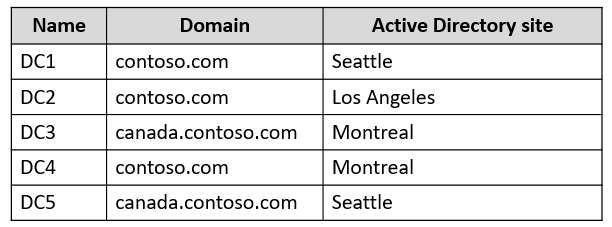
All the domain controllers are global catalog servers.
Server infrastructure
The network contains the servers shown in the following table.
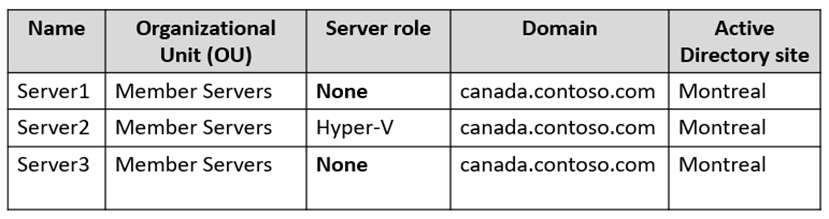
A server named Server4 runs Windows Server and is in a workgroup. Windows Firewall on Server4 uses the private profile.
Server2 hosts three virtual machines named VM1, VM2, and VM3.
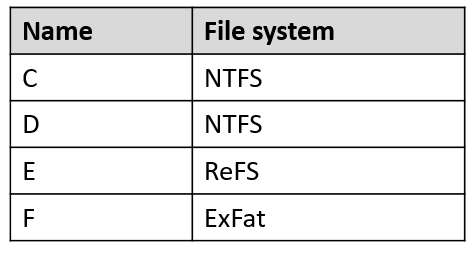
VM3 is a file server that stores data in the volumes shown in the following table.
Group Policies
The contoso.com domain has the Group Policies Objects (GPOs) shown in the following table.

Existing Identities
The forest contains the users shown in the following table.
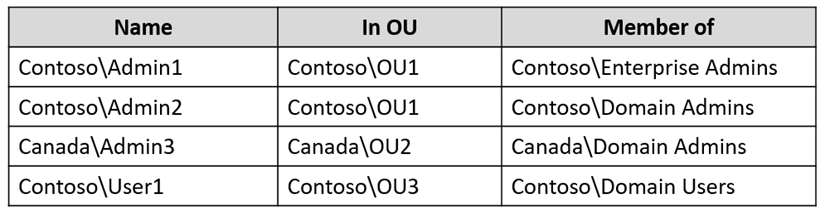
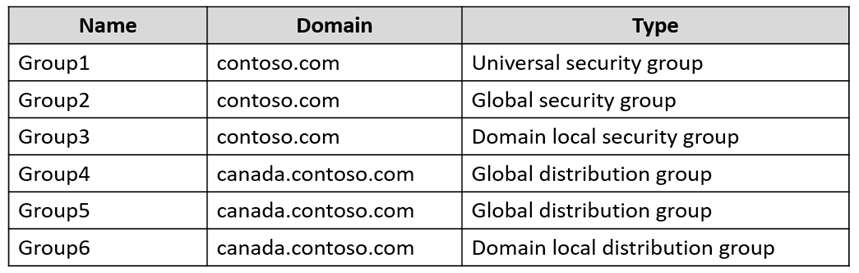
The forest contains the groups shown in the following table.
Current Problems
When an administrator signs in to the console of VM2 by using Virtual Machine Connection, and then disconnects from the session without signing out, another administrator can connect to the console session as the currently signed in user.

Requirements
Technical
Requirements
Contoso identifies the following technical requirements:
-Change the replication schedule for all site links to 30 minutes.
-Promote Server1 to a domain controller in canada.contoso.com.
-Install and authorize Server3 as a DHCP server.
-Ensure that User1 can manage the membership of all the groups in Contoso\OU3.
-Ensure that you can manage Server4 from Server1 by using PowerShell remoting.
-Ensure that you can run virtual machines on VM1.
-Force users to provide credentials when they connect to VM2.
-On VM3, enable Data Deduplication on all volumes that support the feature.

You need to meet the technical requirements for User1. The solution must use the principle of least privilege.
What should you do?

  1. Add User1 to the Server Operators group in contoso.com.
  2. Create a delegation on contoso.com.
  3. Add User1 to the Account Operators group in contoso.com.
  4. Create a delegation on OU3.

Answer(s): D


Reference:

https://docs.microsoft.com/en-us/windows-server/identity/ad-ds/plan/delegating-administration-of-account-ous-and-resource-ous


Case Study:

This is a case study. Case studies are not timed separately. You can use as much exam time as you would like to complete each case. However, there may be additional case studies and sections on this exam. You must manage your time to ensure that you are able to complete all questions included on this exam in the time provided.
To answer the questions included in a case study, you will need to reference information that is provided in the case study. Case studies might contain exhibits and other resources that provide more information about the scenario that is described in the case study. Each question is independent of the other questions in this case study.
At the end of this case study, a review screen will appear. This screen allows you to review your answers and to make changes before you move to the next section of the exam. After you begin a new section, you cannot return to this section.
To start the case study To display the first question in this case study, click the Next button. Use the buttons in the left pane to explore the content of the case study before you answer the questions. Clicking these buttons displays information such as business requirements, existing environment, and problem statements. If the case study has an All Information tab, note that the information displayed is identical to the information displayed on the subsequent labs.
When you are ready to answer a question, click the Question button to return to the question.

Overview:
Contoso, Ltd. is a company that has a main office in Seattle and two branch offices in Los Angeles and Montreal.

Existing Environment
AD DS Environment
The network contains an on premises Active Directory Domain Services (AD DS) forest named contoso.com. The forest contains two domains named contoso.com and canada.contoso.com.
The forest contains the domain controllers shown in the following table.

All the domain controllers are global catalog servers.
Server infrastructure
The network contains the servers shown in the following table.

A server named Server4 runs Windows Server and is in a workgroup. Windows Firewall on Server4 uses the private profile.
Server2 hosts three virtual machines named VM1, VM2, and VM3.
VM3 is a file server that stores data in the volumes shown in the following table.

Group Policies
The contoso.com domain has the Group Policies Objects (GPOs) shown in the following table.

Existing Identities
The forest contains the users shown in the following table.

The forest contains the groups shown in the following table.

Current Problems
When an administrator signs in to the console of VM2 by using Virtual Machine Connection, and then disconnects from the session without signing out, another administrator can connect to the console session as the currently signed in user.

Requirements
Technical
Requirements
Contoso identifies the following technical requirements:
-Change the replication schedule for all site links to 30 minutes.
-Promote Server1 to a domain controller in canada.contoso.com.
-Install and authorize Server3 as a DHCP server.
-Ensure that User1 can manage the membership of all the groups in Contoso\OU3.
-Ensure that you can manage Server4 from Server1 by using PowerShell remoting.
-Ensure that you can run virtual machines on VM1.
-Force users to provide credentials when they connect to VM2.
-On VM3, enable Data Deduplication on all volumes that support the feature.

HOTSPOT (Drag and Drop is not supported)
Which groups can you add to Group3 and Group5? To answer, select the appropriate options in the answer area.
Note: Each correct selection is worth one point.
Hot Area:

  1. See Explanation section for answer.

Answer(s): A

Explanation:


Reference:

https://docs.microsoft.com/en-us/windows/security/identity-protection/access-control/active-directory-security-groups


Case Study:

This is a case study. Case studies are not timed separately. You can use as much exam time as you would like to complete each case. However, there may be additional case studies and sections on this exam. You must manage your time to ensure that you are able to complete all questions included on this exam in the time provided.
To answer the questions included in a case study, you will need to reference information that is provided in the case study. Case studies might contain exhibits and other resources that provide more information about the scenario that is described in the case study. Each question is independent of the other questions in this case study.
At the end of this case study, a review screen will appear. This screen allows you to review your answers and to make changes before you move to the next section of the exam. After you begin a new section, you cannot return to this section.
To start the case study To display the first question in this case study, click the Next button. Use the buttons in the left pane to explore the content of the case study before you answer the questions. Clicking these buttons displays information such as business requirements, existing environment, and problem statements. If the case study has an All Information tab, note that the information displayed is identical to the information displayed on the subsequent labs.
When you are ready to answer a question, click the Question button to return to the question.

Overview:
Contoso, Ltd. is a company that has a main office in Seattle and two branch offices in Los Angeles and Montreal.

Existing Environment
AD DS Environment
The network contains an on premises Active Directory Domain Services (AD DS) forest named contoso.com. The forest contains two domains named contoso.com and canada.contoso.com.
The forest contains the domain controllers shown in the following table.

All the domain controllers are global catalog servers.
Server infrastructure
The network contains the servers shown in the following table.

A server named Server4 runs Windows Server and is in a workgroup. Windows Firewall on Server4 uses the private profile.
Server2 hosts three virtual machines named VM1, VM2, and VM3.
VM3 is a file server that stores data in the volumes shown in the following table.

Group Policies
The contoso.com domain has the Group Policies Objects (GPOs) shown in the following table.

Existing Identities
The forest contains the users shown in the following table.

The forest contains the groups shown in the following table.

Current Problems
When an administrator signs in to the console of VM2 by using Virtual Machine Connection, and then disconnects from the session without signing out, another administrator can connect to the console session as the currently signed in user.

Requirements
Technical
Requirements
Contoso identifies the following technical requirements:
-Change the replication schedule for all site links to 30 minutes.
-Promote Server1 to a domain controller in canada.contoso.com.
-Install and authorize Server3 as a DHCP server.
-Ensure that User1 can manage the membership of all the groups in Contoso\OU3.
-Ensure that you can manage Server4 from Server1 by using PowerShell remoting.
-Ensure that you can run virtual machines on VM1.
-Force users to provide credentials when they connect to VM2.
-On VM3, enable Data Deduplication on all volumes that support the feature.

You need to meet the technical requirements for Server3.
Which users can perform the required tasks?

  1. Admin3 only
  2. Admin1 and Admin3 only
  3. Admin1 only
  4. Admin1, Admin2, and Admin3
  5. Admin1 and Admin2 only

Answer(s): C


Note: This question is part of a series of questions that present the same scenario. Each question in the series contains a unique solution that might meet the stated goals. Some question sets might have more than one correct solution, while others might not have a correct solution.
After you answer a question in this section, you will NOT be able to return to it. As a result, these questions will not appear in the review screen.
Your network contains an Active Directory Domain Services (AD DS) domain named contoso.com.
You need to identify which server is the PDC emulator for the domain.
Solution: From Active Directory Domains and Trusts, you right-click Active Directory Domains and Trusts in the console tree, and then select Operations Master.
Does this meet the goal?

  1. Yes
  2. No

Answer(s): B


Note: This question is part of a series of questions that present the same scenario. Each question in the series contains a unique solution that might meet the stated goals. Some question sets might have more than one correct solution, while others might not have a correct solution.
After you answer a question in this section, you will NOT be able to return to it. As a result, these questions will not appear in the review screen.
Your network contains an Active Directory Domain Services (AD DS) domain named contoso.com.
You need to identify which server is the PDC emulator for the domain.
Solution: From a command prompt, you run netdom.exe query fsmo.
Does this meet the goal?

  1. Yes
  2. No

Answer(s): A


Reference:

https://activedirectorypro.com/how-to-check-fsmo-roles/


You have an on premises Active Directory Domain Services (AD DS) domain that syncs with a Microsoft Entra tenant.
You plan to implement Microsoft Entra self-service password reset (SSPR).
You need to ensure that users that reset their passwords by using SSPR can use the new password resources in the AD DS domain.
What should you do?

  1. Deploy the Microsoft Entra Password Protection proxy service to the on premises network.
  2. Run the Microsoft Entra Connect wizard and select Password writeback.
  3. Grant the Change password permission for the domain to the Microsoft Entra Connect service account.
  4. Grant the impersonate a client after authentication user right to the Microsoft Entra Connect service account.

Answer(s): B


Reference:

https://docs.microsoft.com/en-us/azure/active-directory/authentication/tutorial-enable-sspr-writeback


You have a Microsoft Entra Domain Services domain named contoso.com.
You need to provide an administrator with the ability to manage Group Policy Objects (GPOs). The solution must use the principle of least privilege.
To which group should you add the administrator?

  1. AAD DC Administrators
  2. Domain Admins
  3. Schema Admins
  4. Enterprise Admins
  5. Group Policy Creator Owners

Answer(s): A

Explanation:

Microsoft Entra ID, Domain Services, Administer Group Policy in a Microsoft Entra Domain Services managed domain.
Settings for user and computer objects in Microsoft Entra Domain Services are often managed using Group Policy Objects (GPOs). Domain Services includes built-in GPOs for the AADDC Users and AADDC Computers containers. You can customize these built-in GPOs to configure Group Policy as needed for your environment. Members of the AAD DC Administrators group have Group Policy administration privileges in the Domain Services domain, and can also create custom GPOs and organizational units (OUs).


Reference:

https://learn.microsoft.com/en-us/entra/identity/domain-services/manage-group-policy


DRAG DROP (Drag and Drop is not supported)
You create a new Azure subscription.
You plan to deploy Microsoft Entra Domain Services (Azure AD DS) and Azure virtual machines.
You need to ensure that the virtual machines can join to Microsoft Entra Domain Services.
Which three actions should you perform in sequence? To answer, move the appropriate actions from the list of actions to the answer area and arrange them in the correct order.
Select and Place:

  1. See Explanation section for answer.

Answer(s): A

Explanation:


Reference:

https://docs.microsoft.com/en-us/azure/active-directory-domain-services/tutorial-create-instance


Share your comments for Microsoft AZ-800 exam with other users:

S
Saint Pierre
10/24/2023 6:21:00 AM

i would give 5 stars to this website as i studied for az-800 exam from here. it has all the relevant material available for preparation. i got 890/1000 on the test.

AI Tutor 👋 I’m here to help!