Financial CFA Level 2 Chartered Analyst® Level II CFA Level 2 Dumps in PDF

Free Financial CFA Level 2 Real Questions (page: 1)

Ota L'Abbe, a supervisor at an investment research firm, has asked one of the junior analysts, Andreas Hally, to draft a research report dealing with various accounting issues. Excerpts from the request are as follows:

•“There's an exciting company that we're starting to follow these days. It's called Snowboards and Skateboards, Inc. They are a multinational company with operations and a head office based in the resort town of Whistler in western Canada. However, they also have a significant subsidiary located in the United States."
•"Look at the subsidiary and deal with some foreign currency issues including the specific differences between the temporal and all-current methods of translation, as well as the effect on financial ratios."
•"The attached file contains the September 30, 2008, financial statements of the U.S. subsidiary. Translate the financial statements into Canadian dollars in a manner consistent with U.S. GAAP."

The following are statements from the research report subsequently written by Hally:
Statement 1: Subsidiaries whose operations are well integrated with the parent will use the all- current method of translation.

Statement 2: Self-contained, independent subsidiaries whose operating, investing, and financing activities are primarily located in the local market will use the temporal method of translation.
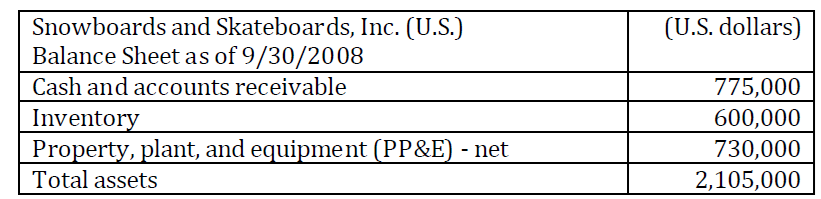
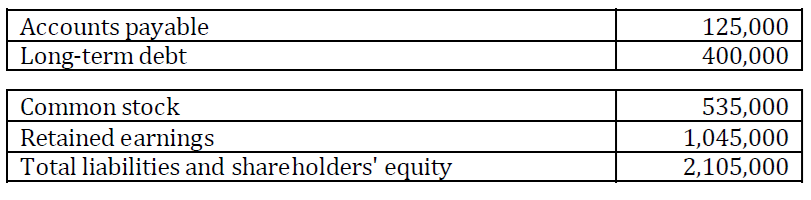
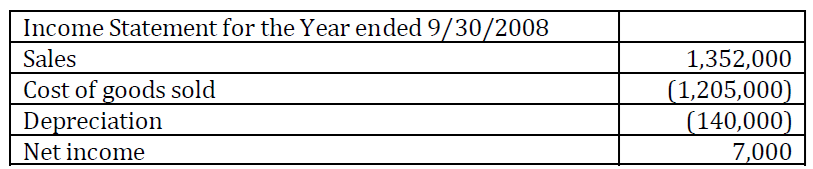


Other information to be considered
•Exchange rates (CAD/USD)
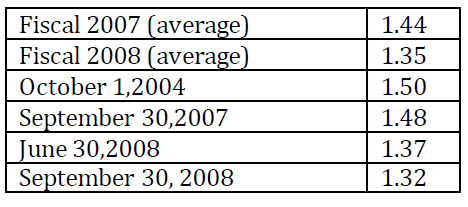

•Beginning inventory for fiscal 2008 had been purchased evenly throughout fiscal 2007. The company uses the FIFO inventory value method.
•Dividends of USD 25,000 were paid to the shareholders on June 30, 2008.
•All of the remaining inventory at the end of fiscal 2008 was purchased evenly throughout fiscal 2008.
•All of the PP&E was purchased, and all of the common equity was issued at the inception of the company on October 1, 2004. No new PP&E has been acquired, and no additional common stock has been issued since then. However, they plan to purchase new PP&E starting in fiscal 2009.
•The beginning retained earnings balance for fiscal 2008 was CAD 1,550,000.
•The accounts payable on the fiscal 2008 balance sheet were all incurred on June 30, 2008.
•The U.S. subsidiary's operations are highly integrated with the main operations in Canada.
•The remeasured inventory for 2008 using the temporal method is CAD 810,000.

•All monetary asset and liability balances are the same as they were at the end of the 2007 fiscal year, except that long-term debt was USD 467,700.
•Costs of goods sold under the temporal method in 2008 is CAD 1,667,250.

Are Hally's statements regarding foreign currency translation correct?

Statement 1 Statement 2

  1. Yes Yes
  2. Yes No
  3. No No

Answer(s): C

Explanation:

Subsidiaries whose operations are well integrated with the parent will use the parent's currency as the functional currency. When the functional currency is the same as the parent's presentation currency (reporting currency), as it is in this case, the temporal merhod is used. Therefore, Statement 1 is incorrect.

Self-contained, independent subsidiaries whose operating, investing, and financing activities are primarily located in the local market will use the local currency as the functional currency. When the functional currency is not the same as the parent's presentation currency (reporting currency), as in this case, the all-current method is used. Therefore, Statement 2 is incorrect. (Study Session 6, LOS 23.c)


Ota L'Abbe, a supervisor at an investment research firm, has asked one of the junior analysts, Andreas Hally, to draft a research report dealing with various accounting issues. Excerpts from the request are as follows:

•“There's an exciting company that we're starting to follow these days. It's called Snowboards and Skateboards, Inc. They are a multinational company with operations and a head office based in the resort town of Whistler in western Canada. However, they also have a significant subsidiary located in the United States."
•"Look at the subsidiary and deal with some foreign currency issues including the specific differences between the temporal and all-current methods of translation, as well as the effect on financial ratios."
•"The attached file contains the September 30, 2008, financial statements of the U.S. subsidiary. Translate the financial statements into Canadian dollars in a manner consistent with U.S. GAAP."

The following are statements from the research report subsequently written by Hally:
Statement 1: Subsidiaries whose operations are well integrated with the parent will use the all- current method of translation.

Statement 2: Self-contained, independent subsidiaries whose operating, investing, and financing activities are primarily located in the local market will use the temporal method of translation.


Other information to be considered
•Exchange rates (CAD/USD)


•Beginning inventory for fiscal 2008 had been purchased evenly throughout fiscal 2007. The company uses the FIFO inventory value method.
•Dividends of USD 25,000 were paid to the shareholders on June 30, 2008.
•All of the remaining inventory at the end of fiscal 2008 was purchased evenly throughout fiscal 2008.
•All of the PP&E was purchased, and all of the common equity was issued at the inception of the company on October 1, 2004. No new PP&E has been acquired, and no additional common stock has been issued since then. However, they plan to purchase new PP&E starting in fiscal 2009.
•The beginning retained earnings balance for fiscal 2008 was CAD 1,550,000.
•The accounts payable on the fiscal 2008 balance sheet were all incurred on June 30, 2008.
•The U.S. subsidiary's operations are highly integrated with the main operations in Canada.
•The remeasured inventory for 2008 using the temporal method is CAD 810,000.

•All monetary asset and liability balances are the same as they were at the end of the 2007 fiscal year, except that long-term debt was USD 467,700.
•Costs of goods sold under the temporal method in 2008 is CAD 1,667,250.

Which of the following best describes the effect on the parent's fiscal 2008 sales when translated to Canadian dollars? Sales, relative to what it would have been if the CAD/USD exchange rate had not changed, will be:

  1. lower because the U.S. dollar depreciated during fiscal 2008.
  2. higher because the average value of the Canadian dollar depreciated during fiscal 2008.
  3. lower because the U.S. dollar appreciated during fiscal 2008.

Answer(s): A

Explanation:

Sales will be lower after translation because of the depreciating U.S. dollar. (Study Session 6, LOS 23.d)


Ota L'Abbe, a supervisor at an investment research firm, has asked one of the junior analysts, Andreas Hally, to draft a research report dealing with various accounting issues. Excerpts from the request are as follows:

•“There's an exciting company that we're starting to follow these days. It's called Snowboards and Skateboards, Inc. They are a multinational company with operations and a head office based in the resort town of Whistler in western Canada. However, they also have a significant subsidiary located in the United States."
•"Look at the subsidiary and deal with some foreign currency issues including the specific differences between the temporal and all-current methods of translation, as well as the effect on financial ratios."
•"The attached file contains the September 30, 2008, financial statements of the U.S. subsidiary. Translate the financial statements into Canadian dollars in a manner consistent with U.S. GAAP."

The following are statements from the research report subsequently written by Hally:
Statement 1: Subsidiaries whose operations are well integrated with the parent will use the all- current method of translation.

Statement 2: Self-contained, independent subsidiaries whose operating, investing, and financing activities are primarily located in the local market will use the temporal method of translation.


Other information to be considered
•Exchange rates (CAD/USD)


•Beginning inventory for fiscal 2008 had been purchased evenly throughout fiscal 2007. The company uses the FIFO inventory value method.
•Dividends of USD 25,000 were paid to the shareholders on June 30, 2008.
•All of the remaining inventory at the end of fiscal 2008 was purchased evenly throughout fiscal 2008.
•All of the PP&E was purchased, and all of the common equity was issued at the inception of the company on October 1, 2004. No new PP&E has been acquired, and no additional common stock has been issued since then. However, they plan to purchase new PP&E starting in fiscal 2009.
•The beginning retained earnings balance for fiscal 2008 was CAD 1,550,000.
•The accounts payable on the fiscal 2008 balance sheet were all incurred on June 30, 2008.
•The U.S. subsidiary's operations are highly integrated with the main operations in Canada.
•The remeasured inventory for 2008 using the temporal method is CAD 810,000.
•All monetary asset and liability balances are the same as they were at the end of the 2007 fiscal year, except that long-term debt was USD 467,700.
•Costs of goods sold under the temporal method in 2008 is CAD 1,667,250.

As compared to the temporal method, which of the following financial statement elements of the parent are lower under the all-current method?

  1. Cash and accounts receivable.
  2. Depreciation expense and cost of goods sold.
  3. Common stock and dividends paid.

Answer(s): B

Explanation:

Depreciation expense and COGS are remeasured at the historical rate under the temporal method. Under the all-current method, depreciation and COGS are translation the average rate. Since the U.S. dollar is depreciating, depreciation expense and COGS are lower under the all-current method. (Study Session 6, LOS 23.d)


Ota L'Abbe, a supervisor at an investment research firm, has asked one of the junior analysts, Andreas Hally, to draft a research report dealing with various accounting issues. Excerpts from the request are as follows:

•“There's an exciting company that we're starting to follow these days. It's called Snowboards and Skateboards, Inc. They are a multinational company with operations and a head office based in the resort town of Whistler in western Canada. However, they also have a significant subsidiary located in the United States."
•"Look at the subsidiary and deal with some foreign currency issues including the specific differences between the temporal and all-current methods of translation, as well as the effect on financial ratios."
•"The attached file contains the September 30, 2008, financial statements of the U.S. subsidiary. Translate the financial statements into Canadian dollars in a manner consistent with U.S. GAAP."

The following are statements from the research report subsequently written by Hally:
Statement 1: Subsidiaries whose operations are well integrated with the parent will use the all-current method of translation.

Statement 2: Self-contained, independent subsidiaries whose operating, investing, and financing activities are primarily located in the local market will use the temporal method of translation.


Other information to be considered
•Exchange rates (CAD/USD)


•Beginning inventory for fiscal 2008 had been purchased evenly throughout fiscal 2007. The company uses the FIFO inventory value method.
•Dividends of USD 25,000 were paid to the shareholders on June 30, 2008.
•All of the remaining inventory at the end of fiscal 2008 was purchased evenly throughout fiscal 2008.
•All of the PP&E was purchased, and all of the common equity was issued at the inception of the company on October 1, 2004. No new PP&E has been acquired, and no additional common stock has been issued since then. However, they plan to purchase new PP&E starting in fiscal 2009.
•The beginning retained earnings balance for fiscal 2008 was CAD 1,550,000.
•The accounts payable on the fiscal 2008 balance sheet were all incurred on June 30, 2008.
•The U.S. subsidiary's operations are highly integrated with the main operations in Canada.
•The remeasured inventory for 2008 using the temporal method is CAD 810,000.
•All monetary asset and liability balances are the same as they were at the end of the 2007 fiscal year, except that long-term debt was USD 467,700.
•Costs of goods sold under the temporal method in 2008 is CAD 1,667,250.

Using the appropriate translation method, which of the following best describes the effect of changing exchange rates on the parent's fiscal 2008 financial statements?

  1. An accumulated loss of CAD 242,100 is reported in the shareholders' equity.
  2. A loss of CAD 31,200 is recognized in the income statement.
  3. A gain of CAD 27,400 is recognized in the income statement.

Answer(s): B

Explanation:

Use the following to answer this question.
The Canadian dollar is the functional currency because the subsidiary is highly integrated with the parent. Therefore, the temporal method applies.


Since the subsidiary's operations are highly integrated with the parent, the temporal method is used. Accordingly, a loss of CAD 31,200 is recognized in the parent's income statement (see balance sheet and income statement worksheet). However, no calculations are actually necessary to answer this question. The parent has a net monetary asset position in the subsidiary (monetary assets > monetary liabilities). Holding net monetary assets when the foreign currency is depreciating will result in a loss. Under the temporal method, the loss is reported in the income statement. Only choice B satisfies this logic. (Study Session 6, LOS 23.d)


Ota L'Abbe, a supervisor at an investment research firm, has asked one of the junior analysts, Andreas Hally, to draft a research report dealing with various accounting issues. Excerpts from the request are as follows:

•“There's an exciting company that we're starting to follow these days. It's called Snowboards and Skateboards, Inc. They are a multinational company with operations and a head office based in the resort town of Whistler in western Canada. However, they also have a significant subsidiary located in the United States."
•"Look at the subsidiary and deal with some foreign currency issues including the specific differences between the temporal and all-current methods of translation, as well as the effect on financial ratios."
•"The attached file contains the September 30, 2008, financial statements of the U.S. subsidiary. Translate the financial statements into Canadian dollars in a manner consistent with U.S. GAAP."

The following are statements from the research report subsequently written by Hally:
Statement 1: Subsidiaries whose operations are well integrated with the parent will use the all-current method of translation.
Statement 2: Self-contained, independent subsidiaries whose operating, investing, and financing activities are primarily located in the local market will use the temporal method of translation.


Other information to be considered
•Exchange rates (CAD/USD)


•Beginning inventory for fiscal 2008 had been purchased evenly throughout fiscal 2007. The company uses the FIFO inventory value method.
•Dividends of USD 25,000 were paid to the shareholders on June 30, 2008.
•All of the remaining inventory at the end of fiscal 2008 was purchased evenly throughout fiscal 2008.
•All of the PP&E was purchased, and all of the common equity was issued at the inception of the company on October 1, 2004. No new PP&E has been acquired, and no additional common stock has been issued since then. However, they plan to purchase new PP&E starting in fiscal 2009.
•The beginning retained earnings balance for fiscal 2008 was CAD 1,550,000.
•The accounts payable on the fiscal 2008 balance sheet were all incurred on June 30, 2008.
•The U.S. subsidiary's operations are highly integrated with the main operations in Canada.
•The remeasured inventory for 2008 using the temporal method is CAD 810,000.
•All monetary asset and liability balances are the same as they were at the end of the 2007 fiscal year, except that long-term debt was USD 467,700.
•Costs of goods sold under the temporal method in 2008 is CAD 1,667,250.

As compared to the temporal method, the parent's fixed asset turnover for fiscal 2008 using the all-current method is:

  1. higher.
  2. lower.
  3. the same.

Answer(s): A

Explanation:

The local currency (the USD) is depreciating, so the historical rate will be higher than the current rate. Fixed asset turnover (sales divided by net PP&E) will be higher under the all-current method. Net PP&E will be translated at the lower current rate, and because sales are the same under both methods, the ratio will be higher.
If you want to do the calculations, net PP&E under the all-current method is USD730.00O x 1.32CAD/USD = CAD 963,600. and fixed asset turnover is CAD 1,825,200/CAD 963,600 = 1.9 times. Fixed asset turnover under the temporal method is CAD 1,825,200/CAD 1,095,000 = 1.7 times. (Study Session 6, LOS 23.d)


Share your comments for Financial CFA Level 2 exam with other users:

K
Kvana
9/28/2023 12:08:00 PM

good info about oml

C
Checo Lee
7/3/2023 5:45:00 PM

very useful to practice

D
dixitdnoh@gmail.com
8/27/2023 2:58:00 PM

this website is very helpful.

S
Sanjay
8/14/2023 8:07:00 AM

good content

B
Blessious Phiri
8/12/2023 2:19:00 PM

so challenging

P
PAYAL
10/17/2023 7:14:00 AM

17 should be d ,for morequery its scale out

K
Karthik
10/12/2023 10:51:00 AM

nice question

G
Godmode
5/7/2023 10:52:00 AM

yes.

B
Bhuddhiman
7/30/2023 1:18:00 AM

good mateial

K
KJ
11/17/2023 3:50:00 PM

good practice exam

S
sowm
10/29/2023 2:44:00 PM

impressivre qustion

C
CW
7/6/2023 7:06:00 PM

questions seem helpful

L
luke
9/26/2023 10:52:00 AM

good content

Z
zazza
6/16/2023 9:08:00 AM

question 21 answer is alerts

A
Abwoch Peter
7/4/2023 3:08:00 AM

am preparing for exam

M
mohamed
9/12/2023 5:26:00 AM

good one thanks

M
Mfc
10/23/2023 3:35:00 PM

only got thru 5 questions, need more to evaluate

W
Whizzle
7/24/2023 6:19:00 AM

q26 should be b

S
sarra
1/17/2024 3:44:00 AM

the aaa triad in information security is authentication, accounting and authorisation so the answer should be d 1, 3 and 5.

D
DBS
5/14/2023 12:56:00 PM

need to attend this

D
Da_costa
8/1/2023 5:28:00 PM

these are free brain dumps i understand, how can one get free pdf

V
vikas
10/28/2023 6:57:00 AM

provide access

A
Abdullah
9/29/2023 2:06:00 AM

good morning

R
Raj
6/26/2023 3:12:00 PM

please upload the ncp-mci 6.5 dumps, really need to practice this one. thanks guys

M
Miguel
10/5/2023 12:21:00 PM

question 16: https://help.salesforce.com/s/articleview?id=sf.care_console_overview.htm&type=5

H
Hiren Ladva
7/8/2023 10:34:00 PM

yes i m prepared exam

O
oliverjames
10/24/2023 5:37:00 AM

my experience was great with this site as i studied for the ms-900 from here and got 900/1000 on the test. my main focus was on the tutorials which were provided and practice questions. thanks!

B
Bhuddhiman
7/20/2023 11:52:00 AM

great course

A
Anuj
1/14/2024 4:07:00 PM

very good question

S
Saravana Kumar TS
12/8/2023 9:49:00 AM

question: 93 which statement is true regarding the result? sales contain 6 columns and values contain 7 columns so c is not right answer.

L
Lue
3/30/2023 11:43:00 PM

highly recommend just passed my exam.

D
DC
1/7/2024 10:17:00 AM

great practice! thanks

A
Anonymus
11/9/2023 5:41:00 AM

anyone who wrote this exam recently?

K
Khalid Javid
11/17/2023 3:46:00 PM

kindly share the dump

AI Tutor 👋 I’m here to help!