APMG-International AgilePM-Practitioner Exam (page: 2)
APMG-International Agile Project Management (AgilePM) Practitioner
Updated on: 25-Dec-2025


Overview
Scenario:

Hoy Hall Hotel Refurbishment Project

Note:
Hoy Hall, a historic, timber-framed building dating from the 17th century, was originally the residence of the Lords of the Manor of Hoytown. The building is registered as a Heritage Building of Special Interest and is subject to restrictions in terms of development. Used as a hotel for over a century, it has recently fallen into disrepair, and for two years it has been completely unused, accelerating its deterioration. The local community has formed the Action Group "Hoy for Hoy Hall" to save the building, and wants to be closely involved in its future success.

After much discussion Hoy Hall has been purchased by Architecture Angels (AA), a small company whose directors are experienced hoteliers. Five years ago they decided to move into the property renovation business and have recently restored two other similarly-endangered buildings for use as hotels.

Architecture Angels are keen to both support local businesses and to have local people run their hotels, giving them a significant amount of autonomy to do this. To maintain core consistency, the hotels use Architecture Angels' Head Office services, such as IT operations, accounting, payroll, stocktaking, compliance, human resources and property management. The Head Office is based 80 miles from Hoy Hall.

Recently Architecture Angels commenced an Agile project to renovate Hoy Hall, which has a large downstairs hall and reception area, and 20 potential bedrooms upstairs. The roof requires extensive repairs and the electrical and plumbing installations require complete replacement. The 40 acres of land around the site are overgrown and need to be restored, and the driveway needs re-laying.

In the hotel industry, the trend for direct customer bookings via the internet has had a major impact on the growth of those hotels with this facility. Online booking now accounts for around 80% of room bookings, with only 20% being made via walk-in and telephone enquiries. Before Hoy Hall can open for business, a reservation system must be fully operational.

Architecture Angels use contractors to manage such work and have good relationships with two local companies: Timber Tigers (TT) who will handle the internal works, and Earth Excavations (EE) who will handle the gardens.

A Project Manager, who has since left the company, started the Feasibility phase. This phase has been continued by the Senior Management Team, which consists of the Sales, Marketing, and Finance Directors and the Chief Executive. This was scheduled to take a month and has almost been completed. A Feasibility Assessment has been produced. An Outline Business Case has been completed which assessed the project as being viable.

The Architecture Angels Senior Management Team will be responsible for Steering the project.

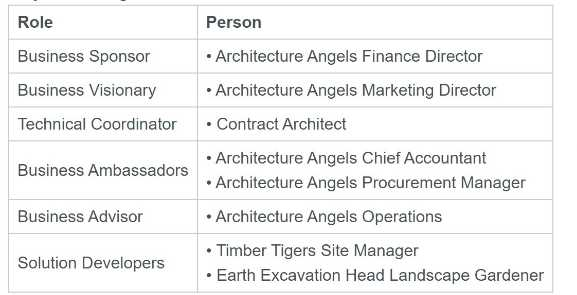
The table below shows the appointments planned for the project team and is subject to change.


Additional Information:
The project is approaching the end of Feasibility. The original Project Manager was involved in drafting a Delivery Plan for the project but not in the outline refurbishment options.

The Senior Management Team generated several options for the refurbishment. All the options included a landscaping solution for the gardens and re-laying of the driveway, as the solution will not be acceptable without these. However, the best solution for the refurbishment is still under debate. The new Project Manager has suggested that a Feasibility Prototype could consist of paper-based drawings for each option. The "Hoy for Hoy Hall" Action Group thinks that a physically-built representation is mandatory for a prototype and wants a small-scale model of the recommendation for the building. The time available to produce this, however, is limited.

Contracts for resources have not yet been signed and will be postponed until the chosen outline solution has been agreed.


HOTSPOT (Drag and Drop is not supported)

Using the Project Scenario answer the following question about the technical quality of the solution to be delivered. An assessment of the maintenance requirement for the new reservation system was made during Feasibility.

Column 1 describes a list of different types of hotel reservation systems considered. Column 2 lists the three DSDM maintainability objectives. For each description in Column 1, select from Column 2 the maintainability objective it would support.

Each selection from Column 2 can be used once, more than once or not at all.

Column 1:

1. Off-the-shelf software with ready-to-use templates that will need to be customised to fully meet Hoy Hall requirements, after deployment.

2. Developing a fully functioning in-house system, developed and hosted by Architecture Angels IT Operations team.

3. All-in-one web-based reservation and accommodation management system built to Hoy Hall's specification.

4. All bookings for Hoy Hall to be scheduled by one of the other two hotels within the group, until a suitable system can be implemented at the site.

5. A spreadsheet is used to capture customer details manually. Data will then be exported into a fully functional system at a later date.

Column 2

Maintainability is a required attribute of the initial delivered solution

Deliver first, re-engineer later

Short-term, tactical solution

  1. See Explanation section for answer.

Answer(s): A

Explanation:

For each of the descriptions in Column 1, the maintainability objective from Column 2 that each would support is as follows:
Off-the-shelf software with ready-to-use templates that will need to be customised to fully meet Hoy

Hall requirements, after deployment.
A: Maintainability is a required attribute of the initial delivered solution Rationale: Customizing off-the-shelf software indicates a need for the solution to be maintainable from the onset to allow for these adjustments.
Developing a fully functioning in-house system, developed and hosted by Architecture Angels IT Operations team.
A: Maintainability is a required attribute of the initial delivered solution Rationale: In-house developed systems need to be maintainable to facilitate future changes and enhancements by the team that created them.
All-in-one web-based reservation and accommodation management system built to Hoy Hall's specification.
A: Maintainability is a required attribute of the initial delivered solution Rationale: A system built to specific requirements will require the ability to maintain and adjust the system as needs evolve, making maintainability a key initial attribute. All bookings for Hoy Hall to be scheduled by one of the other two hotels within the group, until a suitable system can be implemented at the site.
C: Short-term, tactical solution
Rationale: This is clearly a temporary measure until a proper system is in place, indicative of a tactical solution to address immediate needs.
A spreadsheet is used to capture customer details manually. Data will then be exported into a fully functional system at a later date.
C: Short-term, tactical solution
Rationale: Using a spreadsheet is a stop-gap solution to manage information in the short term, emphasizing the tactical nature rather than long-term maintainability. Option B is not selected for any of the descriptions as none of them imply an approach of delivering first with the intention to re-engineer later. They all suggest a need for immediate maintainability or a short-term fix, not a re-engineering approach.


Overview
Scenario:

Hoy Hall Hotel Refurbishment Project

Note:
Hoy Hall, a historic, timber-framed building dating from the 17th century, was originally the residence of the Lords of the Manor of Hoytown. The building is registered as a Heritage Building of Special Interest and is subject to restrictions in terms of development. Used as a hotel for over a century, it has recently fallen into disrepair, and for two years it has been completely unused, accelerating its deterioration. The local community has formed the Action Group "Hoy for Hoy Hall" to save the building, and wants to be closely involved in its future success.

After much discussion Hoy Hall has been purchased by Architecture Angels (AA), a small company whose directors are experienced hoteliers. Five years ago they decided to move into the property renovation business and have recently restored two other similarly-endangered buildings for use as hotels.

Architecture Angels are keen to both support local businesses and to have local people run their hotels, giving them a significant amount of autonomy to do this. To maintain core consistency, the hotels use Architecture Angels' Head Office services, such as IT operations, accounting, payroll, stocktaking, compliance, human resources and property management. The Head Office is based 80 miles from Hoy Hall.

Recently Architecture Angels commenced an Agile project to renovate Hoy Hall, which has a large downstairs hall and reception area, and 20 potential bedrooms upstairs. The roof requires extensive repairs and the electrical and plumbing installations require complete replacement. The 40 acres of land around the site are overgrown and need to be restored, and the driveway needs re-laying.

In the hotel industry, the trend for direct customer bookings via the internet has had a major impact on the growth of those hotels with this facility. Online booking now accounts for around 80% of room bookings, with only 20% being made via walk-in and telephone enquiries. Before Hoy Hall can open for business, a reservation system must be fully operational.

Architecture Angels use contractors to manage such work and have good relationships with two local companies: Timber Tigers (TT) who will handle the internal works, and Earth Excavations (EE) who will handle the gardens.

A Project Manager, who has since left the company, started the Feasibility phase. This phase has been continued by the Senior Management Team, which consists of the Sales, Marketing, and Finance Directors and the Chief Executive. This was scheduled to take a month and has almost been completed. A Feasibility Assessment has been produced. An Outline Business Case has been completed which assessed the project as being viable.

The Architecture Angels Senior Management Team will be responsible for Steering the project.

The table below shows the appointments planned for the project team and is subject to change.


Additional Information:
The project is approaching the end of Feasibility. The original Project Manager was involved in drafting a Delivery Plan for the project but not in the outline refurbishment options.

The Senior Management Team generated several options for the refurbishment. All the options included a landscaping solution for the gardens and re-laying of the driveway, as the solution will not be acceptable without these. However, the best solution for the refurbishment is still under debate. The new Project Manager has suggested that a Feasibility Prototype could consist of paper-based drawings for each option. The "Hoy for Hoy Hall" Action Group thinks that a physically-built representation is mandatory for a prototype and wants a small-scale model of the recommendation for the building. The time available to produce this, however, is limited.

Contracts for resources have not yet been signed and will be postponed until the chosen outline solution has been agreed.


Answer the following questions about the acceptance criteria within the project.

Decide whether the approach to setting and using acceptance criteria has been applied appropriately and select the response that supports your decision.

When specifying high-level prioritised requirements during Foundations, the Business Visionary has suggested that acceptance criteria for the requirement to "temporarily weatherproof the roof" should NOT be set until Solution Development Timebox A.

Is this an appropriate approach to setting high-level acceptance criteria?

  1. Yes, because the Local Planning Authority Officer will set the acceptance criteria.
  2. Yes, because acceptance criteria are NOT set before the Timeboxed work is started.
  3. No, because by the end of Foundations the quality expectations and overall acceptance criteria for at least the first increment should have been set, and high-level acceptance criteria set for later increments.
  4. No, because a Review Session should have been scheduled during Feasibility to enable the Solution Development Team to validate their understanding of the Local Planning Authority Officer's expectations.

Answer(s): C

Explanation:

C: No, because by the end of Foundations the quality expectations and overall acceptance criteria for at least the first increment should have been set, and high-level acceptance criteria set for later increments.
Rationale:
In Agile Project Management, it's important to establish high-level acceptance criteria early in the project to guide development and ensure that the solution meets the business needs and quality expectations. The Foundations phase is when the project's scope, objectives, and methods are defined, including the acceptance criteria for the first increment and at a high level for subsequent increments. This ensures that everyone has a clear understanding of what "done" looks like before development begins, reducing the risk of misalignment and rework.


Overview
Scenario:

Hoy Hall Hotel Refurbishment Project

Note:
Hoy Hall, a historic, timber-framed building dating from the 17th century, was originally the residence of the Lords of the Manor of Hoytown. The building is registered as a Heritage Building of Special Interest and is subject to restrictions in terms of development. Used as a hotel for over a century, it has recently fallen into disrepair, and for two years it has been completely unused, accelerating its deterioration. The local community has formed the Action Group "Hoy for Hoy Hall" to save the building, and wants to be closely involved in its future success.

After much discussion Hoy Hall has been purchased by Architecture Angels (AA), a small company whose directors are experienced hoteliers. Five years ago they decided to move into the property renovation business and have recently restored two other similarly-endangered buildings for use as hotels.

Architecture Angels are keen to both support local businesses and to have local people run their hotels, giving them a significant amount of autonomy to do this. To maintain core consistency, the hotels use Architecture Angels' Head Office services, such as IT operations, accounting, payroll, stocktaking, compliance, human resources and property management. The Head Office is based 80 miles from Hoy Hall.

Recently Architecture Angels commenced an Agile project to renovate Hoy Hall, which has a large downstairs hall and reception area, and 20 potential bedrooms upstairs. The roof requires extensive repairs and the electrical and plumbing installations require complete replacement. The 40 acres of land around the site are overgrown and need to be restored, and the driveway needs re-laying.

In the hotel industry, the trend for direct customer bookings via the internet has had a major impact on the growth of those hotels with this facility. Online booking now accounts for around 80% of room bookings, with only 20% being made via walk-in and telephone enquiries. Before Hoy Hall can open for business, a reservation system must be fully operational.

Architecture Angels use contractors to manage such work and have good relationships with two local companies: Timber Tigers (TT) who will handle the internal works, and Earth Excavations (EE) who will handle the gardens.

A Project Manager, who has since left the company, started the Feasibility phase. This phase has been continued by the Senior Management Team, which consists of the Sales, Marketing, and Finance Directors and the Chief Executive. This was scheduled to take a month and has almost been completed. A Feasibility Assessment has been produced. An Outline Business Case has been completed which assessed the project as being viable.

The Architecture Angels Senior Management Team will be responsible for Steering the project.

The table below shows the appointments planned for the project team and is subject to change.


Additional Information:
The project is approaching the end of Feasibility. The original Project Manager was involved in drafting a Delivery Plan for the project but not in the outline refurbishment options.

The Senior Management Team generated several options for the refurbishment. All the options included a landscaping solution for the gardens and re-laying of the driveway, as the solution will not be acceptable without these. However, the best solution for the refurbishment is still under debate. The new Project Manager has suggested that a Feasibility Prototype could consist of paper-based drawings for each option. The "Hoy for Hoy Hall" Action Group thinks that a physically-built representation is mandatory for a prototype and wants a small-scale model of the recommendation for the building. The time available to produce this, however, is limited.

Contracts for resources have not yet been signed and will be postponed until the chosen outline solution has been agreed.


Answer the following questions about the acceptance criteria within the project.

Decide whether the approach to setting and using acceptance criteria has been applied appropriately and select the response that supports your decision.

At the beginning of Solution Development Timebox A, the Timebox is being planned in detail. Although Foundations was conducted at a high level, the Prioritised Requirements List was baselined. Now the Solution Development Team is setting detailed acceptance criteria against each requirement.

Is this an appropriate approach to setting detailed acceptance criteria?

  1. Yes, because acceptance criteria can only be understood at a high level during Foundations and will always need further investigation.
  2. Yes, because the Solution Development Team members will be setting acceptance criteria for the first time during Solution Development Timebox A.
  3. No, because the Solution Development Team should NOT be involved in setting acceptance criteria.
  4. No, because acceptance criteria should be set in detail against each requirement during Foundations.

Answer(s): A

Explanation:

A: Yes, because acceptance criteria can only be understood at a high level during Foundations and will always need further investigation.
Rationale:
In Agile Project Management, while the Foundations phase does involve setting high-level expectations and a prioritized requirements list, the detailed acceptance criteria are often refined during the actual Solution Development iterations or timeboxes. This is because, as the work progresses, the team's understanding of the product grows, and they are better equipped to define detailed acceptance criteria that align closely with the customer's needs and the project's evolving context. It's a collaborative and iterative process, allowing for greater precision in defining what will make a particular feature or requirement acceptable.


Overview
Scenario:

Hoy Hall Hotel Refurbishment Project

Note:
Hoy Hall, a historic, timber-framed building dating from the 17th century, was originally the residence of the Lords of the Manor of Hoytown. The building is registered as a Heritage Building of Special Interest and is subject to restrictions in terms of development. Used as a hotel for over a century, it has recently fallen into disrepair, and for two years it has been completely unused, accelerating its deterioration. The local community has formed the Action Group "Hoy for Hoy Hall" to save the building, and wants to be closely involved in its future success.

After much discussion Hoy Hall has been purchased by Architecture Angels (AA), a small company whose directors are experienced hoteliers. Five years ago they decided to move into the property renovation business and have recently restored two other similarly-endangered buildings for use as hotels.

Architecture Angels are keen to both support local businesses and to have local people run their hotels, giving them a significant amount of autonomy to do this. To maintain core consistency, the hotels use Architecture Angels' Head Office services, such as IT operations, accounting, payroll, stocktaking, compliance, human resources and property management. The Head Office is based 80 miles from Hoy Hall.

Recently Architecture Angels commenced an Agile project to renovate Hoy Hall, which has a large downstairs hall and reception area, and 20 potential bedrooms upstairs. The roof requires extensive repairs and the electrical and plumbing installations require complete replacement. The 40 acres of land around the site are overgrown and need to be restored, and the driveway needs re-laying.

In the hotel industry, the trend for direct customer bookings via the internet has had a major impact on the growth of those hotels with this facility. Online booking now accounts for around 80% of room bookings, with only 20% being made via walk-in and telephone enquiries. Before Hoy Hall can open for business, a reservation system must be fully operational.

Architecture Angels use contractors to manage such work and have good relationships with two local companies: Timber Tigers (TT) who will handle the internal works, and Earth Excavations (EE) who will handle the gardens.

A Project Manager, who has since left the company, started the Feasibility phase. This phase has been continued by the Senior Management Team, which consists of the Sales, Marketing, and Finance Directors and the Chief Executive. This was scheduled to take a month and has almost been completed. A Feasibility Assessment has been produced. An Outline Business Case has been completed which assessed the project as being viable.

The Architecture Angels Senior Management Team will be responsible for Steering the project.

The table below shows the appointments planned for the project team and is subject to change.


Additional Information:
The project is approaching the end of Feasibility. The original Project Manager was involved in drafting a Delivery Plan for the project but not in the outline refurbishment options.

The Senior Management Team generated several options for the refurbishment. All the options included a landscaping solution for the gardens and re-laying of the driveway, as the solution will not be acceptable without these. However, the best solution for the refurbishment is still under debate. The new Project Manager has suggested that a Feasibility Prototype could consist of paper-based drawings for each option. The "Hoy for Hoy Hall" Action Group thinks that a physically-built representation is mandatory for a prototype and wants a small-scale model of the recommendation for the building. The time available to produce this, however, is limited.

Contracts for resources have not yet been signed and will be postponed until the chosen outline solution has been agreed.


Answer the following questions about the acceptance criteria within the project.

Decide whether the approach to setting and using acceptance criteria has been applied appropriately and select the response that supports your decision.

During Solution Development Timebox A, a new Health and Safety requirement arises: the front door is required to have wheelchair access. This is a legal requirement and is a Must Have before any staff or general public access can be allowed. The Solution Development Team will work with the Local Planning Authority Officer, the specialist who identified the requirement, to identify further acceptance criteria for Solution Development Timebox A.

Is this an appropriate action related to acceptance criteria?

  1. Yes, because the new requirement needs to be understood, built and delivered in this Timebox.
  2. Yes, because the Local Planning Authority Officer owns the justification for the new requirement.
  3. No, because this new requirement would NOT be included in the original Prioritised Requirements List and therefore does NOT need acceptance criteria to be defined.
  4. No, because the Business Visionary is responsible for defining acceptance criteria.

Answer(s): A

Explanation:

A: Yes, because the new requirement needs to be understood, built and delivered in this Timebox.
Rationale:
Agile Project Management is adaptable to changes, even late in the development process. The introduction of a new Health and Safety requirement, such as wheelchair access, which is a legal and must-have requirement, needs to be incorporated into the project as soon as it is identified. Working with the Local Planning Authority Officer to define acceptance criteria ensures that the requirement is clearly understood and that the solution developed meets the necessary legal standards. This approach ensures that the team can immediately address the new requirement and integrate it into the current work cycle, aligning with Agile's principle of welcoming changing requirements, even late in development, for the customer's competitive advantage.


Overview
Scenario:

Hoy Hall Hotel Refurbishment Project

Note:
Hoy Hall, a historic, timber-framed building dating from the 17th century, was originally the residence of the Lords of the Manor of Hoytown. The building is registered as a Heritage Building of Special Interest and is subject to restrictions in terms of development. Used as a hotel for over a century, it has recently fallen into disrepair, and for two years it has been completely unused, accelerating its deterioration. The local community has formed the Action Group "Hoy for Hoy Hall" to save the building, and wants to be closely involved in its future success.

After much discussion Hoy Hall has been purchased by Architecture Angels (AA), a small company whose directors are experienced hoteliers. Five years ago they decided to move into the property renovation business and have recently restored two other similarly-endangered buildings for use as hotels.

Architecture Angels are keen to both support local businesses and to have local people run their hotels, giving them a significant amount of autonomy to do this. To maintain core consistency, the hotels use Architecture Angels' Head Office services, such as IT operations, accounting, payroll, stocktaking, compliance, human resources and property management. The Head Office is based 80 miles from Hoy Hall.

Recently Architecture Angels commenced an Agile project to renovate Hoy Hall, which has a large downstairs hall and reception area, and 20 potential bedrooms upstairs. The roof requires extensive repairs and the electrical and plumbing installations require complete replacement. The 40 acres of land around the site are overgrown and need to be restored, and the driveway needs re-laying.

In the hotel industry, the trend for direct customer bookings via the internet has had a major impact on the growth of those hotels with this facility. Online booking now accounts for around 80% of room bookings, with only 20% being made via walk-in and telephone enquiries. Before Hoy Hall can open for business, a reservation system must be fully operational.

Architecture Angels use contractors to manage such work and have good relationships with two local companies: Timber Tigers (TT) who will handle the internal works, and Earth Excavations (EE) who will handle the gardens.

A Project Manager, who has since left the company, started the Feasibility phase. This phase has been continued by the Senior Management Team, which consists of the Sales, Marketing, and Finance Directors and the Chief Executive. This was scheduled to take a month and has almost been completed. A Feasibility Assessment has been produced. An Outline Business Case has been completed which assessed the project as being viable.

The Architecture Angels Senior Management Team will be responsible for Steering the project.

The table below shows the appointments planned for the project team and is subject to change.


Additional Information:
The project is approaching the end of Feasibility. The original Project Manager was involved in drafting a Delivery Plan for the project but not in the outline refurbishment options.

The Senior Management Team generated several options for the refurbishment. All the options included a landscaping solution for the gardens and re-laying of the driveway, as the solution will not be acceptable without these. However, the best solution for the refurbishment is still under debate. The new Project Manager has suggested that a Feasibility Prototype could consist of paper-based drawings for each option. The "Hoy for Hoy Hall" Action Group thinks that a physically-built representation is mandatory for a prototype and wants a small-scale model of the recommendation for the building. The time available to produce this, however, is limited.

Contracts for resources have not yet been signed and will be postponed until the chosen outline solution has been agreed.


Answer the following questions about the acceptance criteria within the project.

Decide whether the approach to setting and using acceptance criteria has been applied appropriately and select the response that supports your decision.

The requirement to 'install a heat reclamation system' shows as a Should Have in the Prioritised Requirements List. During Investigation in Solution Development Timebox B, the Project Manager advised the team NOT to set detailed acceptance criteria for this requirement until later in the Timebox, since the requirement may have to be dropped and the work would be wasted.

Is this an appropriate action related to acceptance criteria?

  1. Yes, because only Must Have requirements should be fully understood.
  2. Yes, because the acceptance criteria might need to be changed during the Solution Development Timebox.
  3. No, because it is necessary to understand the full detail of all the work for completion in the Solution Development Timebox during Investigation.
  4. No, because it indicates that the Solution Development Team has NO intention of delivering the Should Have requirements.

Answer(s): B

Explanation:

B: Yes, because the acceptance criteria might need to be changed during the Solution Development

Timebox.
Rationale:
In Agile Project Management, flexibility is key. It is important to prioritize work based on the value it provides and the necessity of the requirement. "Should Have" requirements are important but not critical, and they can be subject to change as the project progresses and as more information becomes available. Deferring the detailed setting of acceptance criteria for a "Should Have" requirement that might be dropped is a practical approach to managing workload and focusing efforts on the most critical aspects of the project first. This approach is in line with Agile's principle of responding to change over following a fixed plan.


Viewing Page 2 of 28


Share your comments for APMG-International AgilePM-Practitioner exam with other users:

sheik 10/14/2023 11:37:00 AM

@aarun , thanks for the information. it would be great help if you share your email
Anonymous


Random user 12/11/2023 1:34:00 AM

1z0-1078-23 need this dumps
Anonymous


labuschanka 11/16/2023 6:06:00 PM

i gave the microsoft azure az-500 tests and prepared from this site as it has latest mock tests available which helped me evaluate my performance and score 919/1000
Anonymous


Marianne 10/22/2023 11:57:00 PM

i cannot see the button to go to the questions
Anonymous


sushant 6/28/2023 4:52:00 AM

good questions
EUROPEAN UNION


A\MAM 6/27/2023 5:17:00 PM

q-6 ans-b correct. https://docs.paloaltonetworks.com/pan-os/9-1/pan-os-cli-quick-start/use-the-cli/commit-configuration-changes
UNITED STATES


unanimous 12/15/2023 6:38:00 AM

very nice very nice
Anonymous


akminocha 9/28/2023 10:36:00 AM

please help us with 1z0-1107-2 dumps
INDIA


Jefi 9/4/2023 8:15:00 AM

please upload the practice questions
Anonymous


Thembelani 5/30/2023 2:45:00 AM

need this dumps
Anonymous


Abduraimov 4/19/2023 12:43:00 AM

preparing for this exam is overwhelming. you cannot pass without the help of these exam dumps.
UNITED KINGDOM


Puneeth 10/5/2023 2:06:00 AM

new to this site but i feel it is good
EUROPEAN UNION


Ashok Kumar 1/2/2024 6:53:00 AM

the correct answer to q8 is b. explanation since the mule app has a dependency, it is necessary to include project modules and dependencies to make sure the app will run successfully on the runtime on any other machine. source code of the component that the mule app is dependent of does not need to be included in the exported jar file, because the source code is not being used while executing an app. compiled code is being used instead.
Anonymous


Merry 7/30/2023 6:57:00 AM

good questions
Anonymous


VoiceofMidnight 12/17/2023 4:07:00 PM

Delayed the exam until December 29th.
UNITED STATES


Umar Ali 8/29/2023 2:59:00 PM

A and D are True
Anonymous


vel 8/28/2023 9:17:09 AM

good one with explanation
Anonymous


Gurdeep 1/18/2024 4:00:15 PM

This is one of the most useful study guides I have ever used.
CANADA